 Semiahmoo
 Siding Built for Bellingham's Climate
Bellingham sits in one of the wetter corners of Washington, wedged between Bellingham Bay and the foothills of the Cascades, with Whatcom County's marine air keeping things damp for most of the year. Homes here don't just get rained on — they sit under a long, low gray season where surfaces rarely get a chance to fully dry out before the next system rolls through. Add in proximity to saltwater and the tree cover that shades so many Bellingham lots, and you've got a climate that is genuinely tough on exterior building materials.
As a local crew serving the Semiahmoo and greater Whatcom County area, we see the same failure patterns on Bellingham homes again and again: siding that trapped moisture instead of shedding it, paint that failed years ahead of schedule, and moss and algae staining that never fully goes away no matter how often it's pressure washed. This page walks through what Bellingham's climate actually does to a home's exterior and how we approach siding, roofing, windows, and decks to hold up against it.
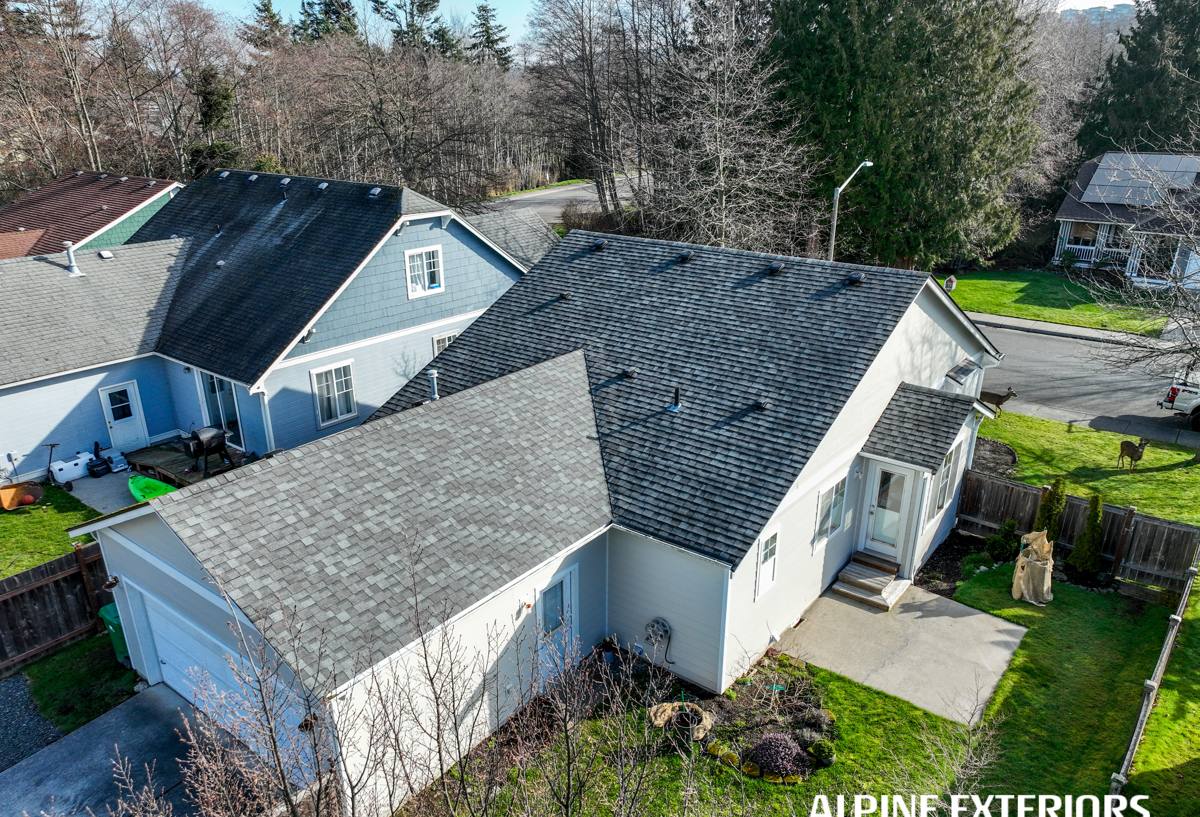
What Salt Air, Rain, and Moss Do to a Home
Salt Air and Coastal Moisture
Bellingham isn't right on the open coast, but Bellingham Bay and the broader Salish Sea put homes within reach of salt-laden air, especially on west- and north-facing elevations that catch wind off the water. Salt air accelerates corrosion on fasteners, flashing, and any metal trim that isn't rated for coastal exposure, and it speeds up the breakdown of lower-quality paint films. Over years, that combination shows up as rust streaking, chalking paint, and soft spots where moisture has been working behind the surface.
Driving, Wind-Driven Rain
Whatcom County's weather pattern brings extended stretches of rain, often pushed sideways by wind off the water or funneled through valley terrain. Driving rain doesn't just wet a wall — it forces water sideways and upward into laps, seams, and butt joints that were designed for water running straight down. This is exactly where poor installation shows its weaknesses: gaps at trim, unsealed joints, and siding hung too close to grade all become entry points once the rain starts coming in at an angle instead of straight down.
The Long Moss Season
Bellingham's combination of shade, humidity, and mild temperatures gives moss and algae a long growing window — often close to year-round on north-facing walls and anywhere tree canopy blocks the sun. Moss holds moisture directly against a wall surface far longer than open exposure would, and its root structure can work into small surface imperfections. On wood-based sidings, that constant damp contact is one of the more common paths to rot. On any siding, moss buildup is also just an ongoing maintenance headache that never fully resolves itself.
Why We Install Only James Hardie Fiber Cement
We made a deliberate choice as a company to install James Hardie fiber cement siding exclusively. We don't install vinyl, LP SmartSide, cedar, primed spruce, Cemplank, or Allura. That's not a marketing angle — it's a standard we hold because of what we've seen play out on homes in this climate over time.
What We Weighed
- Vinyl is affordable and low-maintenance, but it can warp or crack in temperature swings, and it doesn't hold paint the way fiber cement does if a homeowner ever wants to change the color down the road.
- Wood-based products (cedar, primed spruce, engineered wood like LP SmartSide) offer a natural look and reasonable performance when maintained diligently, but they depend on an unbroken paint/coating film and consistent upkeep to keep moisture out — a tall order in a climate with Bellingham's rain totals and moss pressure.
- Other fiber cement brands (Cemplank, Allura) are legitimate fiber cement products, but we standardized on one manufacturer's system — profiles, trim, fasteners, and factory finish — so every install follows a single set of specifications we know inside and out, rather than mixing components across brands.
James Hardie's fiber cement is non-combustible, dimensionally stable across wet and dry cycles, and available in HZ product lines engineered for different climate zones — which matters in a place where a wall can stay damp for days at a stretch. The factory-applied ColorPlus finish is baked on under controlled conditions rather than field-painted, which gives it more consistent coverage and a stronger track record holding color and resisting the fading and chalking that field-applied paint is prone to. It's backed by a transferable warranty, which also matters to homeowners who may sell within the life of the siding.
How We Approach a Bellingham Siding Job
Assessment First
Before we talk product, we look at the house: which walls take the worst weather, where moss and algae are already established, how the existing siding has failed (if it has), and what the flashing and water management around windows, doors, and roof lines currently look like. A siding job that ignores the water management underneath it is a job that will show the same problems again in a few years, regardless of what material goes on top.
Installation Details That Matter Here
- Correct clearance between siding and grade, decks, and roof lines so water has somewhere to go instead of wicking upward.
- Properly lapped and sealed flashing at windows, doors, and any wall penetrations — the most common failure point we find on older Bellingham homes.
- Fastener patterns and spacing that match manufacturer specification, since under- or over-driven fasteners are a common cause of premature siding failure.
- Factory-finished panels and trim installed to keep field-cut edges sealed, minimizing raw material exposure to moisture.
Roofing, Windows, and Decks in the Same Climate
Siding is rarely the only part of a Bellingham exterior under stress. The same rain and moss pressure that wears on siding works on roofing, and the same driving rain that finds gaps in poor siding installation finds gaps around poorly flashed windows. We handle all four — siding, roofing, windows, and decks — because they're one connected water-management system on a house, not four separate products. A new roof with a poorly integrated wall flashing detail, or new siding installed without attention to window and door transitions, both create the same kind of hidden moisture problems we get called out to fix years later.
Decks in this climate face their own version of the same issue: standing moisture, moss on horizontal surfaces, and ledger board connections that need the same careful flashing attention as a wall. When we're on a property for siding work, we're looking at the whole exterior envelope, not just the walls.
Cost Factors for Bellingham Homeowners
Every home is different, but a few factors consistently move the price on siding projects in this area:
| Factor | Why It Matters Here |
|---|---|
| Existing siding removal and disposal | Older wood or vinyl siding with hidden moisture damage often means added sheathing repair before new siding goes on |
| House size and wall complexity | More corners, gables, and trim details mean more labor and material, especially with Hardie's precise fastening requirements |
| Moisture damage discovered mid-project | Common on homes with a history of moss growth or unmaintained wood siding — sheathing and framing repair is priced separately from siding install |
| Trim and accessory choices | Corner boards, window trim, and fascia details affect both material and labor cost |
| Site access | Tree cover, tight lots, and sloped Bellingham terrain can affect staging and scaffolding needs |
We don't quote broad, generic price ranges on this page because every Bellingham property is different — but we'll walk your specific home with you and explain exactly what's driving your number before any work starts.
Why a Local Crew Matters
A crew that works Whatcom County regularly knows which walls on a given lot orientation take the worst weather, how far moss pressure typically reaches up a shaded wall, and what a Bellingham winter actually does to an improperly flashed joint over a few seasons. That local pattern recognition shows up in small decisions — where extra flashing attention goes, which details get reinforced — that a crew unfamiliar with this specific climate might not prioritize the same way.
It also means we're accountable locally. If a question comes up after the work is done, we're not a crew that passed through — we're based here and plan to be answering questions on Bellingham homes for years to come.
A Simple Maintenance Checklist for Bellingham Homes
- Walk the exterior once or twice a year and look for moss or algae buildup, especially on north-facing and shaded walls.
- Check that gutters and downspouts are clear so water isn't overflowing onto siding or pooling near the foundation.
- Look at caulking and sealant around windows and doors for cracking or gaps — small failures here are cheap to fix early and expensive to ignore.
- Keep vegetation and mulch beds pulled back from direct contact with siding to reduce trapped moisture and soil splashback.
- After any major windstorm, do a visual check for loose trim, lifted panels, or roof damage before the next rain system arrives.
Get a Straightforward Look at Your Home
If you're dealing with moss staining, failing paint, soft spots, or you're just planning ahead for a Bellingham home that needs siding built for this climate, we're happy to take a look. We'll walk the exterior with you, point out what we see, and give you an honest read on what your home actually needs — no pressure, no upsell. Use the form below to request a free estimate.