 Semiahmoo
 What Ferndale's Climate Does to a House
Ferndale sits close enough to Bellingham Bay and the Strait of Georgia that homes here deal with a version of coastal exposure most inland Washington towns never see. Salt-tinged marine air moves in off the water, driving rain comes at exteriors sideways during fall and winter storms, and the long stretch of gray, wet months between October and May gives moss, algae, and mildew plenty of time to take hold on anything that stays damp. Add in Whatcom County's freeze-thaw swings in the coldest weeks of winter, and you have a climate that is genuinely harder on siding, roofing, windows, and decks than the marketing materials for most exterior products want to admit.
None of this is dramatic on its own. A house doesn't fail overnight in Ferndale. It fails slowly, one wet season at a time, through swelling seams, soft trim boards, moss-choked shingles, and paint that won't hold. The homes that hold up best over twenty and thirty years are the ones where the exterior materials and the installation were both matched to what this specific area actually throws at a building.
Salt Air and Metal Fasteners
Proximity to salt water accelerates corrosion on exposed fasteners, flashing, and hardware. It's a slow process, but over a couple of decades it shows up as rust streaking down siding, corroded nail heads, and flashing that's thinned out at the edges. Material choice and fastener selection both matter more here than they would forty miles inland.
Driving Rain and Wind Exposure
Open exposure toward the water means wind-driven rain doesn't just fall on a house, it gets pushed into seams, laps, and butt joints. Siding systems and installation details that rely on gravity alone to shed water — rather than proper lapping, flashing, and gapping — tend to let moisture in around windows, doors, and horizontal trim first.
Moss, Algae, and the Long Wet Season
Whatcom County's wet season runs long, and north-facing walls, shaded elevations, and anything under tree cover stay damp for weeks at a stretch. That's ideal growing conditions for moss and algae, which hold moisture against a surface and accelerate whatever decay process is already underway underneath.
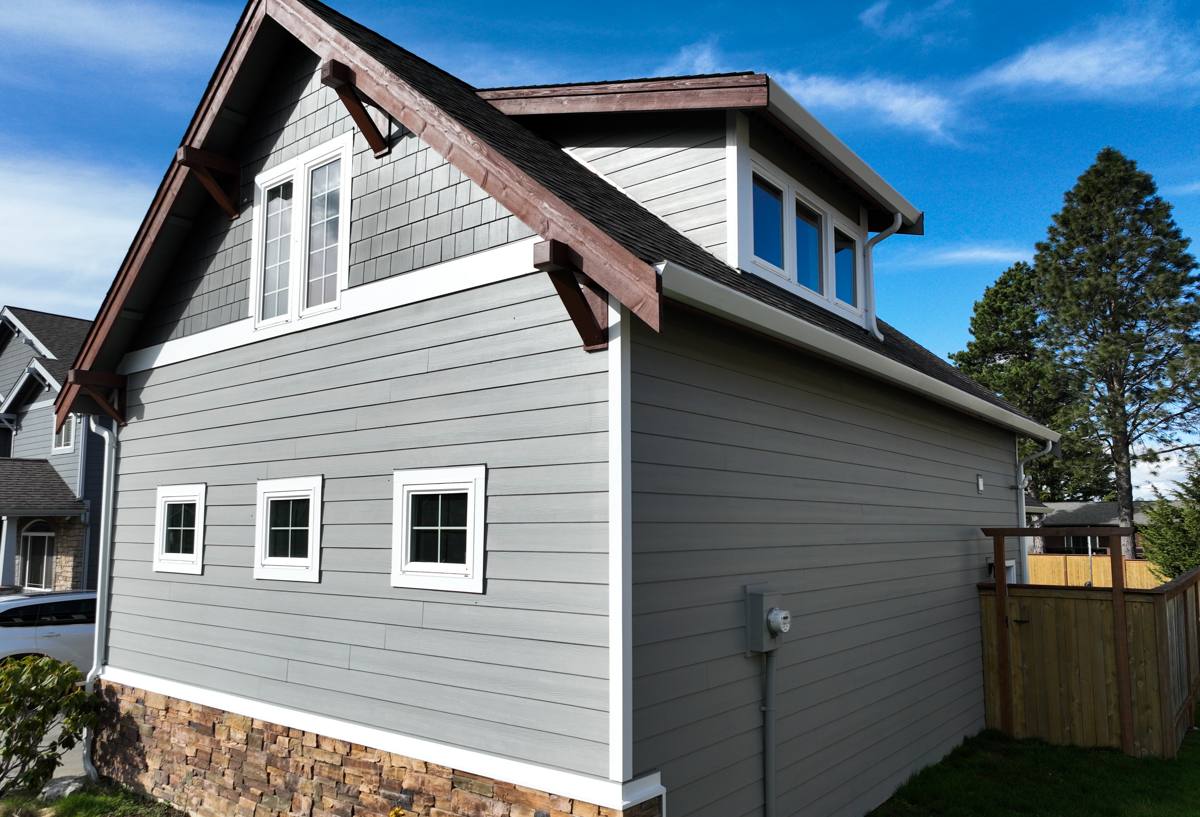
Why We Only Install James Hardie Fiber Cement Siding
We made a deliberate decision years ago to install one siding system and stand behind it fully, rather than offer a menu of products and let price alone decide the outcome on a homeowner's largest asset. That system is James Hardie fiber cement.
Fiber cement is a mix of cement, sand, and cellulose fibers, engineered to be dimensionally stable in a way that wood-based and polymer-based sidings generally aren't. It doesn't absorb water the way wood does, it doesn't soften or delaminate in a wet climate the way some engineered wood products can if a seam or cut edge is left exposed, and it's non-combustible, which matters given how much wildfire smoke and ember exposure Western Washington has seen in recent fire seasons even without a fire burning locally.
James Hardie also builds region-specific product lines — their HZ5 formulation is engineered for climates with more moisture and freeze-thaw cycling, which fits the Pacific Northwest better than a one-size-fits-all product. The factory-applied ColorPlus finish is baked on under controlled conditions, which gives more consistent color and adhesion than field-applied paint over raw material, and it comes with a real transferable warranty backing both the substrate and the finish.
We're not going to tell you every other siding product on the market is junk — that's not honest and it's not our call to make about materials we don't install. What we will say is that after years of doing exterior work in this climate, we stopped installing vinyl, LP SmartSide, primed spruce, cedar, and other fiber cement brands like Cemplank and Allura, because the trade-offs — maintenance burden, moisture sensitivity at cut edges and seams, inconsistent factory finishes, or warranty structures that don't hold up the way homeowners expect — didn't hold up as well over the long run in a marine climate as Hardie has. Standardizing on one product also means our crews install it constantly, know its details cold, and aren't guessing on flashing and clearances.
How a Siding Project Works on a Ferndale Home
Every house is different, but the process generally follows the same sequence:
- Exterior assessment. We look at the existing siding, trim, flashing, and any signs of moisture intrusion — soft spots, staining, bubbling paint, or moss buildup that points to a wet wall assembly underneath.
- Removal and inspection of sheathing. Once old siding comes off, we can see the actual condition of the wall — whether the sheathing is sound, whether there's rot around windows or at the base of walls, and whether the weather-resistive barrier needs to be replaced.
- Water management details. This is where a lot of siding jobs succeed or fail. Proper flashing at windows, doors, and horizontal trim; correct house wrap integration; and rain screen or drainage gap detailing where called for, all matter more here than in a drier climate.
- Hardie installation to manufacturer spec. Correct fastener spacing, clearances from grade and roofing, proper caulking at butt joints, and factory-recommended nailing patterns — deviations from spec are one of the most common reasons a siding job underperforms.
- Trim, caulking, and final detailing. The small stuff — corner boards, J-channel, caulk lines — is what keeps water from finding its way behind the siding field over the following decades.
Roofing in a Wet, Marine-Influenced Climate
Siding and roofing work together as one system for keeping water out of a house, so we treat them that way. Whatcom County's rainfall totals and long wet stretches put real demands on roofing materials, flashing, and ventilation.
Moss is the most visible issue on Ferndale roofs — it doesn't just look bad, it holds moisture against shingles and can work its way under the shingle edge over time, shortening the life of the roof. Proper attic and roof ventilation also matters more here than in drier climates, since trapped moisture from indoor humidity condensing in a cold attic adds to what the roof deck already has to deal with from outside.
Flashing at valleys, chimneys, skylights, and where a roof meets a wall is where most roof leaks actually originate, not in the open field of shingles. We pay particular attention to these transition points, since they're also where roofing and siding details need to line up correctly.
Windows: Where Water Intrusion Usually Starts
Old or improperly flashed windows are one of the most common sources of hidden moisture damage in older Ferndale homes. Wind-driven rain finds gaps around window frames that wouldn't be a problem in a calmer climate, and once water gets behind a window flange, it can travel and rot framing well before it shows up as a visible stain inside.
When we replace windows as part of an exterior project, we integrate the window flashing with the house wrap and siding water management plan rather than treating it as a separate trade — because a new window installed with poor flashing details can undo the benefit of new siding around it.
Signs Older Windows Are Contributing to Bigger Problems
- Fogging or condensation between glass panes, indicating a failed seal
- Soft or discolored trim and siding immediately around a window
- Drafts or noticeable temperature difference near the window in winter
- Difficulty opening, closing, or latching due to frame swelling
- Visible gaps or deteriorated caulking at the frame perimeter
Decks: Built for a Wet, Shaded Climate
Decks in this area take a beating from the same moisture and moss pressures as siding and roofing, plus the added stress of standing water on horizontal surfaces and, often, tree cover that keeps a deck shaded and damp longer than a south-facing deck in a sunnier climate would stay. Proper decking material choice, ledger board flashing, joist protection, and drainage detailing underneath the deck all matter for longevity here.
Composite decking has become common because it resists rot better than untreated wood, but it still needs correct ventilation underneath and proper fastening to perform well over time. Wood decks can work well too, but they need a real maintenance commitment — cleaning, sealing, and prompt attention to any soft boards — to hold up through repeated wet seasons.
Comparing Exterior Material Behavior in This Climate
| Material | Moisture Behavior | Maintenance Burden | Typical Longevity Here |
|---|---|---|---|
| James Hardie fiber cement | Dimensionally stable; resists swelling and rot | Low — factory finish, occasional wash | Long-term with correct install |
| Vinyl siding | Doesn't absorb water but can warp/crack in temperature swings | Low, but limited repair options if damaged | Moderate |
| Engineered wood (LP SmartSide) | Vulnerable at cut edges and seams if not fully sealed | Moderate — edge sealing critical | Depends heavily on installation care |
| Cedar / primed spruce | Absorbs moisture; prone to swelling, checking, rot | High — regular refinishing needed | Shorter without diligent upkeep |
| Other fiber cement brands | Similar base material to Hardie; finish quality varies by manufacturer | Varies by factory finish quality | Varies |
What to Look For in a Local Exterior Contractor
Ferndale and the surrounding Whatcom County communities have enough microclimates — closer to the water versus further inland, shaded lots versus open exposure — that local installation experience is worth more than it might seem. A crew that works in this area regularly already knows where moss builds up fastest, which elevations take the worst wind-driven rain, and how local building department expectations run for flashing and ventilation.
- Manufacturer training or certification on the specific siding product being installed
- A written scope that spells out flashing, house wrap, and water management details — not just "install siding"
- Local references or a track record of jobs in this specific climate, not just a regional service area on paper
- Clear warranty terms, both on materials and on the labor/installation itself
- A willingness to explain why they use the products they use, including trade-offs
- Proper licensing and insurance, verifiable rather than just claimed
Simple Maintenance That Extends the Life of Your Exterior
Even the best-installed exterior benefits from basic upkeep in this climate. A yearly walk-around in early fall, before the wet season sets in, catches most small problems before they become expensive ones — check for moss starting on north-facing siding or roof sections, look at caulk lines around windows and trim for cracking, clear gutters and downspouts so water isn't pooling against the foundation or siding base, and keep an eye on any spot where two materials meet, since that's almost always where water finds a way in first if it's going to.
If you're weighing a siding, roofing, window, or deck project for a Ferndale home, we're happy to take a look and walk you through what we're seeing and why we'd recommend one approach over another — no pressure, no obligation. Reach out below for a free estimate.