 Semiahmoo
 Custer sits in the part of Whatcom County where the Pacific Northwest shows its full range in a single week — bright and dry one afternoon, socked in with drizzle the next, and damp underfoot most mornings in between. Homes here are close enough to Semiahmoo Bay and the Strait of Georgia that salt-laden air is part of daily life, and the tree cover that makes this area beautiful also means a lot of shaded, slow-drying wall and roof surfaces. That combination is hard on exterior building materials, and it's exactly the kind of environment we build our siding, roofing, window, and deck work around.
What Custer's Climate Actually Does to a House
It's easy to think of "bad weather" as the occasional windstorm or heavy rain event. In reality, the bigger threat to a home's exterior in this part of Whatcom County is the steady, low-grade exposure that never lets up: months of damp air, driving rain that comes in sideways off the water during winter storms, and long stretches where surfaces simply don't get enough sun and airflow to dry out between rain events.
Salt Air
Proximity to Semiahmoo Bay and the broader Puget Sound/Strait of Georgia airshed means airborne salt settles on siding, trim, fasteners, and roofing year-round, not just on stormy days. Salt is corrosive to unprotected metal fasteners and flashing, and it accelerates the breakdown of paint films and lesser siding materials that aren't engineered to handle it.
Driving Rain
Winter storms in this area frequently bring rain at an angle rather than straight down, which pushes water into seams, laps, and butt joints that would stay dry in a calmer climate. Any siding system with weak joints, poor caulking, or gaps at penetrations is going to take on moisture here — and once moisture gets behind siding, it doesn't leave quickly given the humidity and limited sun exposure.
Moss and Organic Growth
Custer's tree cover and marine humidity add up to a long moss season — moss, algae, and mildew get a real foothold on north-facing walls, shaded rooflines, and anywhere airflow is limited. Beyond the cosmetic issue, sustained organic growth holds moisture against the surface underneath it, which is a problem for wood-based products in particular.
Why Some Siding Materials Struggle Here
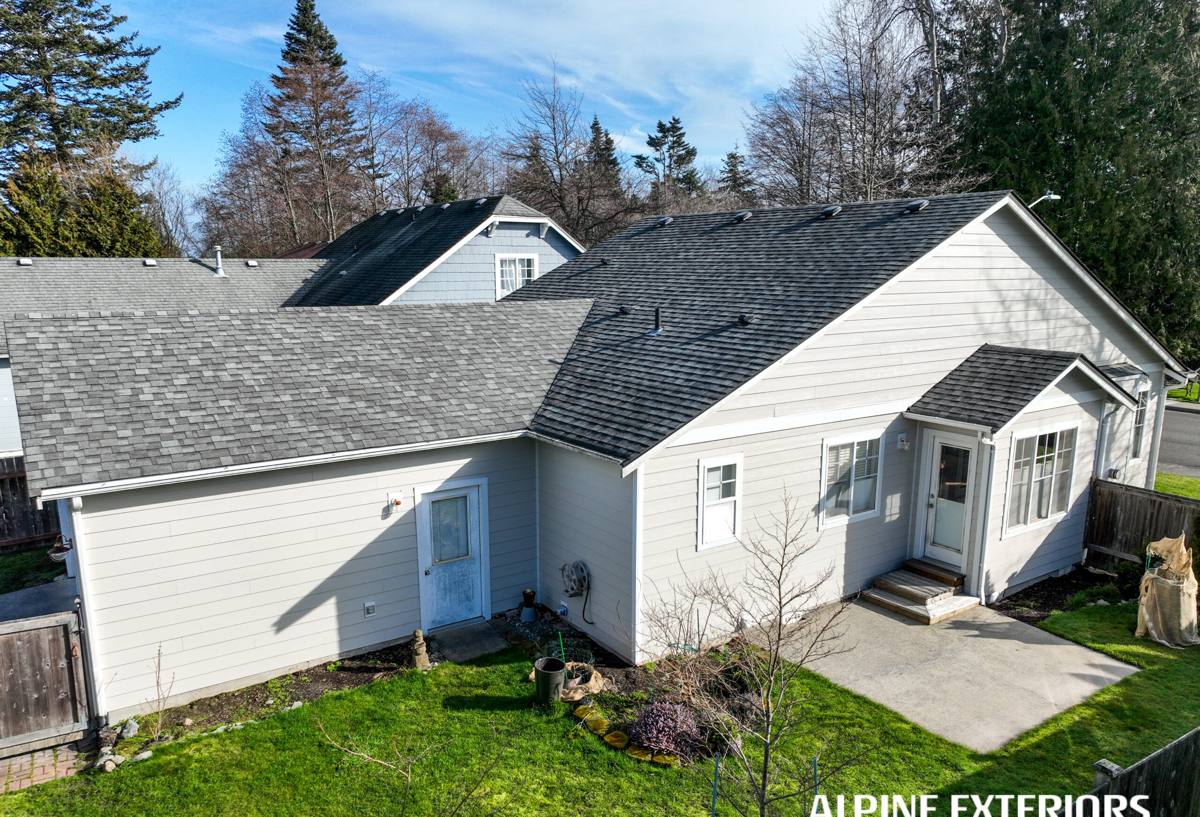
Not every siding product is built for this kind of exposure, and we've made deliberate choices about what we will and won't install because of it. Wood-based composite sidings and traditional wood siding are especially vulnerable to swelling, edge deterioration, and paint failure when they stay damp for long periods, which is common in shaded, moss-prone areas like Custer. Vinyl siding holds up reasonably well against moisture itself, but it can warp or become brittle with temperature swings and UV exposure over time, and its seams and panel joints are a common entry point for wind-driven rain if installation isn't precise.
These aren't defects so much as trade-offs — every siding material has a set of conditions it performs best in, and a set it performs worst in. Our job is to be honest about which materials are a good match for a marine, moss-heavy, salt-air environment like this one, and which ones are going to demand more upkeep than most homeowners want to sign up for.
Why We Install James Hardie Fiber Cement — and Only James Hardie
We install James Hardie fiber cement siding exclusively. It's not a brand preference so much as a materials decision: fiber cement is dimensionally stable, non-combustible, and doesn't absorb moisture the way wood-based products do, which matters enormously in a climate where surfaces stay damp for extended stretches. James Hardie's HardiePlank, HardiePanel, and HardieShingle lines are engineered in climate-specific formulations (HZ5 for the Pacific Northwest's wetter, cooler conditions), which means the product itself is built with regions like Whatcom County in mind rather than a one-size-fits-all approach.
The factory-applied ColorPlus finish is also a real advantage here. Because the finish is baked on in a controlled environment rather than field-painted, it resists the fading, chalking, and peeling that field-applied paint tends to suffer under repeated damp-dry cycling and salt exposure. That translates into fewer repaint cycles and a more consistent look over the life of the siding.
What Correct Installation Looks Like
- Proper rainscreen or drainage gap behind the siding so any incidental moisture can drain and the wall can dry
- Correct nail placement and fastener spacing per Hardie's published specs — not "close enough"
- Stainless or coated corrosion-resistant fasteners and flashing appropriate for a salt-air environment
- Tight, properly sealed joints at butt seams, corners, and penetrations (pipes, vents, hose bibs, light fixtures)
- Correct clearance from grade, decks, and roof lines so siding isn't sitting in standing water or constant splash-back
- Factory-cut edges used wherever possible, with any field cuts properly sealed to protect the substrate
Fiber cement's real-world performance depends heavily on getting these details right. A well-made product installed poorly will still develop problems; a properly installed system is what actually delivers the low-maintenance, long-service-life outcome homeowners are paying for.
Roofing, Windows, and Decks in the Same Climate
Siding rarely fails in isolation — it's usually one piece of an exterior envelope that's fighting the same rain, salt, and moss pressure everywhere else. We handle roofing, windows, and decks for the same reason we're particular about siding: these systems have to work together, and a weak point in one (a roof valley that backs up, a window that isn't flashed correctly, a deck ledger that traps moisture against the house) can undo good work everywhere else.
Roofing
A roof in this area needs to shed driving rain cleanly and resist the same moss growth that affects walls. Proper ventilation, underlayment, and flashing details at valleys, chimneys, and wall intersections matter as much as the shingle or roofing material itself.
Windows
Wind-driven rain finds poorly flashed window openings quickly. Correct window flashing and sealing — tied properly into the siding's drainage plane — is one of the most common places we see older homes in this area develop hidden moisture damage.
Decks
Decks take direct weather exposure and also sit close to the house, which means ledger connections and flashing where the deck meets the siding need to be done right to keep water from tracking back into the wall assembly.
Comparing Siding Options for a Custer Home
| Material | Moisture Behavior | Salt-Air Durability | Maintenance Over Time |
|---|---|---|---|
| James Hardie Fiber Cement | Dimensionally stable; doesn't swell or rot | Engineered HZ5 formulation, factory finish resists coastal wear | Low — periodic cleaning, no repainting for many years |
| Vinyl Siding | Doesn't absorb water, but seams are moisture-prone if installed loosely | Can become brittle over time; color can fade | Low upfront, but replacement (not repair) is common when damaged |
| Wood / Wood-Composite Siding | Absorbs moisture readily; slow to dry in shaded, humid conditions | Vulnerable to swelling and edge breakdown | High — regular painting, caulking, and moss treatment |
| Primed Spruce / Cedar | Natural material, moisture-sensitive at cuts and joints | Requires diligent sealing to resist salt and damp exposure | High — ongoing sealing and inspection needed |
Choosing a Contractor for Exterior Work in Custer
A siding, roofing, window, or deck job is only as good as the crew doing the installation, and in a climate this unforgiving of shortcuts, workmanship matters more than the brand name on the material. A local crew that works this area regularly understands where the rain comes from, which sides of a house need the most attention for moss and drainage, and what kind of flashing details actually hold up here — not generic advice from a manufacturer spec sheet written for a drier climate.
What to Check Before You Hire
- Washington contractor license and current insurance, verifiable through the state
- Manufacturer certification if you're getting James Hardie or another specified product installed
- A written estimate that spells out materials, fastener type, and drainage/flashing approach — not just a total price
- Willingness to explain why they recommend one material over another for your specific exposure (sun, shade, wind direction)
- References or completed local work you can ask about directly
- A clear warranty explanation — both the manufacturer's product warranty and the contractor's workmanship warranty
What a Typical Siding Project Involves
Every home is different, but most siding replacement projects in this area follow a similar sequence: an on-site inspection to assess the existing siding, sheathing, and any hidden moisture damage; removal of the old siding and repair of any compromised sheathing underneath (a step that's easy to skip but critical in a climate where hidden rot is common); installation of a proper weather-resistive barrier and drainage plane; and then the Hardie siding installation itself, followed by trim, caulking, and final detailing at penetrations.
Timelines vary with home size, weather windows, and whether sheathing repair is needed, but homeowners should expect a straightforward walkthrough of the plan before work starts, not a surprise mid-project.
Cost Factors Worth Understanding
Siding cost isn't just about square footage. The condition of the existing sheathing, the complexity of the roofline and trim details, the number of window and door openings, and accessibility all factor into labor time. Fiber cement typically costs more upfront than vinyl but requires less frequent maintenance and repainting, which narrows or eliminates the gap over the life of the siding. Getting a detailed, written estimate that breaks down materials and labor is the best way to compare options honestly rather than comparing bottom-line numbers alone.
Ready to Talk About Your Home
If your Custer home is showing moss buildup, paint failure, soft spots, or siding that's due for replacement, we're happy to take a look and talk through what's actually going on and what your options are — no pressure, no sales script. Reach out for a free estimate using the form below, and we'll walk your exterior with you and give you a straight answer about what it needs.