 Semiahmoo
 Birch Bay's Exterior Problem Isn't Really About the Rain
Everyone who's lived along Birch Bay for a few winters knows the rain isn't the hard part — it's everything that comes with it. The bay sits open to the Strait of Georgia, which means wind-driven rain hits siding sideways instead of falling straight down, working its way into laps, seams, and trim joints that would stay dry on a more sheltered lot a few miles inland. Add the salt carried in off the water, the shade from mature evergreens on many lots, and a marine layer that keeps things damp well after the rain has stopped, and you get an exterior environment that's genuinely harder on building materials than most of Whatcom County.
We're a local crew based near Semiahmoo, and Birch Bay is inside our normal service area — not a stretch drive we tack a trip charge onto. We see the same handful of failure patterns on Birch Bay homes over and over, and that repetition is useful: it tells us exactly what to check for and exactly what to build back with.
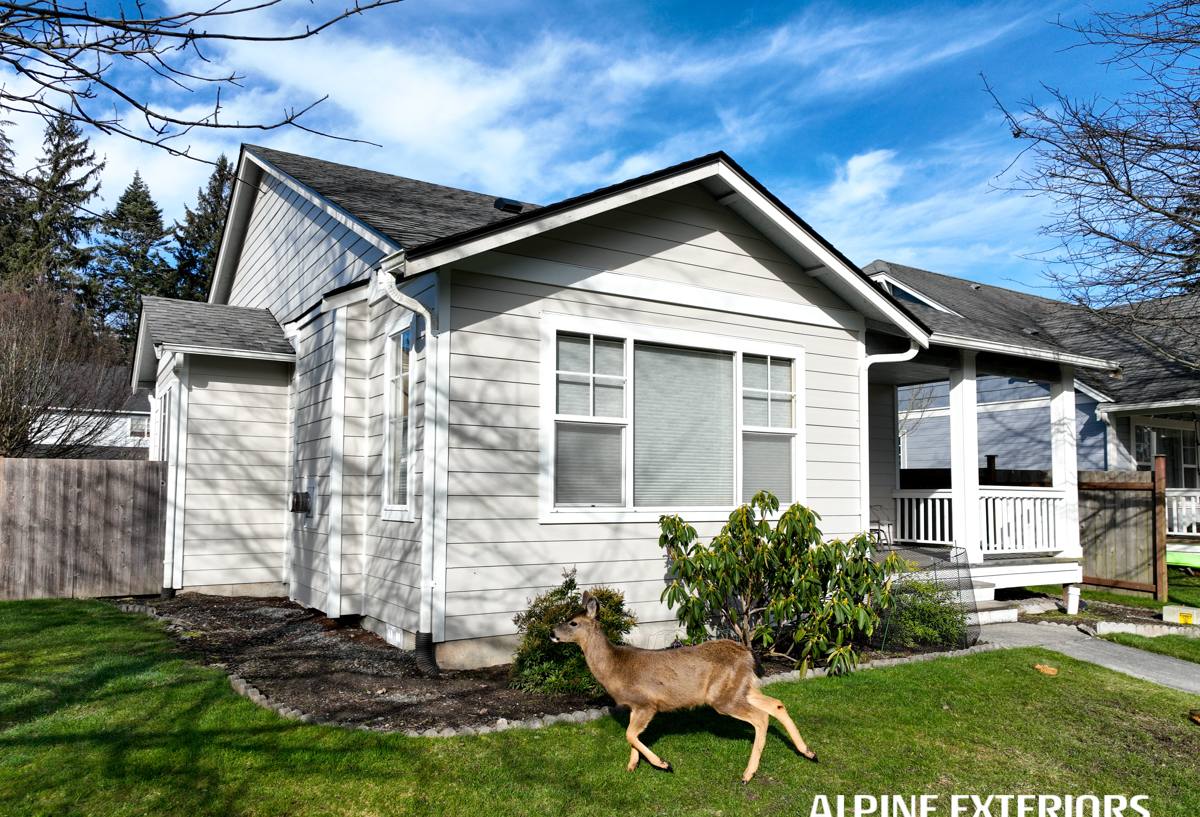
What Birch Bay's Climate Actually Does to Siding
Salt Air and Corrosion
Homes within the first few blocks of the water take the brunt of this. Airborne salt accelerates corrosion on fasteners, flashing, and any exposed metal trim, and it can degrade certain paint and coating systems faster than the manufacturer's stated service life would suggest. It's not dramatic — it's slow, cumulative wear that shows up as chalking, pitting, or premature fading years before a homeowner expects to be thinking about their siding again.
Driving Rain and Wind Exposure
Because Birch Bay sits on open water with limited windbreak on the bay-facing side, rain doesn't just fall on the house — it's pushed into it. That matters most at the details: butt joints, window and door trim, corner boards, and anywhere two pieces of siding meet. A product or installation that's marginal on moisture resistance will find its weak point exactly there.
Shade, Moss, and the Long Wet Season
Plenty of Birch Bay lots are wooded or sit close to neighboring tree lines, which keeps north- and west-facing walls shaded and slow to dry out after a storm. Combine that with our long fall-through-spring wet stretch and you get ideal conditions for moss and algae to take hold on siding, trim, and roofing — not just cosmetically, but as a moisture trap that keeps the wall assembly damp longer than it should be.
Why We Only Install James Hardie Fiber Cement
We made a decision a while back to stop installing several common siding products, even though they're perfectly normal choices elsewhere in the industry. It wasn't about any one product being "bad" — it was about what holds up, with minimal maintenance, in exactly the conditions Birch Bay throws at a house.
Vinyl
Vinyl siding is affordable and low-maintenance in mild climates, and we're not going to pretend otherwise. But it's a petroleum-based product that expands and contracts with temperature swings, and in sustained wind-driven rain, its overlapping panel system relies heavily on correct installation to keep water from tracking behind it. It also has a lower melting and warping threshold than fiber cement, which matters near grills, fire pits, and in wildfire-adjacent zoning discussions that are becoming more common region-wide.
LP SmartSide (Engineered Wood)
LP SmartSide is a strand-based engineered wood product with a factory-applied resin coating, and it performs reasonably well when detailing and caulking are kept up. The catch is that it's still wood at its core — any breach in that coating, whether from a fastener, a cut edge, or years of salt-laden moisture working at a seam, opens the door to swelling and rot in a way that non-combustible fiber cement simply doesn't experience.
Cemplank and Allura (Other Fiber Cement Brands)
These are legitimate fiber cement products and share Hardie's core material advantages over wood and vinyl. Where we see the gap is in the factory finish system and the specific engineering behind regional product lines. We standardized on one manufacturer so our crews master one installation system to spec, rather than splitting attention across several — and James Hardie's ColorPlus factory finish and warranty structure won our confidence for coastal, high-moisture applications like Birch Bay.
Primed Spruce and Cedar
Real wood siding, whether primed spruce or cedar, has a genuine aesthetic appeal that some homeowners specifically want, and we respect that. But it is the highest-maintenance option on this list in a marine environment — repainting or restaining on a tight cycle, constant vigilance against moisture intrusion at end grain and joints, and real vulnerability to the moss and algae growth this climate encourages. On a bay-facing wall, that maintenance burden compounds fast.
Why James Hardie Fits This Coastline
James Hardie fiber cement is roughly 90% sand, cement, and cellulose fiber — it doesn't rot, it doesn't feed insects, and it's non-combustible, which matters more each year as regional fire-risk conversations expand beyond the dry side of the state. The HardieZone system engineers specific product formulations for different climate zones, and our region falls into the HZ10 zone, built around moisture and freeze-thaw performance rather than the drier conditions HZ5 products are designed for.
The factory-applied ColorPlus finish is baked on under controlled conditions before the boards ever reach the jobsite, which gives far more consistent, UV- and moisture-resistant color than field-applied paint — a real advantage against the fading and chalking we see accelerated by salt air here. And because it's dimensionally stable, it doesn't expand and contract the way vinyl or wood does, which keeps joints and caulk lines intact longer under Birch Bay's wind and moisture cycle.
Quick Comparison
| Material | Moisture/Rot Risk | Maintenance | Fire Resistance | Typical Lifespan |
|---|---|---|---|---|
| James Hardie Fiber Cement | Low | Low | Non-combustible | 30-50+ years |
| Vinyl | Moderate (install-dependent) | Low | Combustible, low melt point | 20-30 years |
| LP SmartSide | Moderate-High if coating breached | Moderate | Combustible | 20-30 years |
| Primed Spruce / Cedar | High | High (repaint/restain cycle) | Combustible | 15-25 years (with upkeep) |
How We Approach a Siding Job in Birch Bay
Every project starts with a walk-around, not a sales pitch. On a bay-area home, we're specifically looking at:
- Wall orientation relative to the water — which sides take the most wind-driven rain
- Condition of existing flashing around windows, doors, and roof-to-wall transitions
- Signs of moss, algae, or trapped moisture on shaded or north-facing walls
- Corrosion on existing fasteners, gutters, and metal trim
- Whether the underlying sheathing and weather-resistive barrier need attention before new siding goes on
Correct installation matters more than the product spec sheet in a climate like this. That means proper fastener spacing and type (we account for the added corrosion exposure near the water), correctly lapped and sealed house wrap, drip caps and flashing detailed to shed water outward at every horizontal transition, and rain-screen gapping where the wall assembly calls for it so any moisture that does get behind the siding can actually dry out instead of sitting there.
Roofing, Windows, and Decks — The Same Climate Logic Applies
Siding is rarely the only thing wearing out on a Birch Bay exterior at the same time. We also handle roofing, window replacement, and decks, and we look at them together rather than in isolation, because they share the same weak points: flashing details, moisture management, and materials that can stand up to salt air and constant damp shade.
Roofing
A roof in poor condition undermines even the best siding job, since water that gets past bad flashing or worn shingles doesn't stop at the roofline — it works down into the wall assembly. We check roof condition as part of any siding estimate for exactly this reason.
Windows
Old or poorly flashed windows are one of the most common points of water intrusion we find during a siding tear-off. If your windows are original to an older Birch Bay home, replacement often makes more sense done alongside new siding than after it.
Decks
Decks facing the bay take the same wind and salt exposure as the siding above them, and materials and fastener choices matter just as much there — corrosion-resistant hardware and moisture-tolerant decking hold up far better than budget alternatives in this setting.
Why a Local Crew Matters Here
Birch Bay isn't a generic climate zone on a spec sheet — it's a specific set of conditions shaped by the water, the shade, and the wind exposure of individual lots. A crew that works this stretch of Whatcom County regularly knows which walls on a typical Birch Bay lot take the worst of the weather, what the moss growth pattern on a given roof or wall is actually telling you, and how local permitting and inspection tend to run. That local familiarity shows up in the details — the flashing choices, the fastener spec, the attention paid to the bay-facing wall — not in anything you'd notice on a brochure.
Get a Straightforward Look at Your Home
If your Birch Bay home is showing moss buildup, fading, soft spots, or aging trim, it's worth having someone take an honest look before those small issues turn into a bigger repair. We'll walk the exterior with you, tell you plainly what we see, and give you a free, no-pressure estimate using the form below.