 Semiahmoo
 Siding Work Around Blaine Harbor
Blaine Harbor sits at the working edge of town, tucked into Drayton Harbor near Semiahmoo Bay, where the marina, the shoreline, and the residential streets that climb back from the water all share the same weather. Homes in this part of Blaine don't just get an occasional gust off the water — they sit inside a marine microclimate that's on duty year-round, and it shows up in how fast exterior materials age compared to houses even a short distance further inland. We work this stretch of Whatcom County regularly, and Blaine Harbor is a part of it we know well enough to make informed calls about what a house here actually needs, not just what a general siding estimate would assume.
We install siding, roofing, windows, and decks, and we treat those four systems as one connected building envelope rather than four separate jobs, which matters more on a harbor-adjacent property than almost anywhere else in the county. On the siding side, we install James Hardie fiber cement exclusively — no LP SmartSide, no vinyl, no Cemplank, no Allura, no primed spruce or cedar. That's a standard we hold to because of what we've seen hold up, and what hasn't, on homes facing this kind of sustained marine exposure.
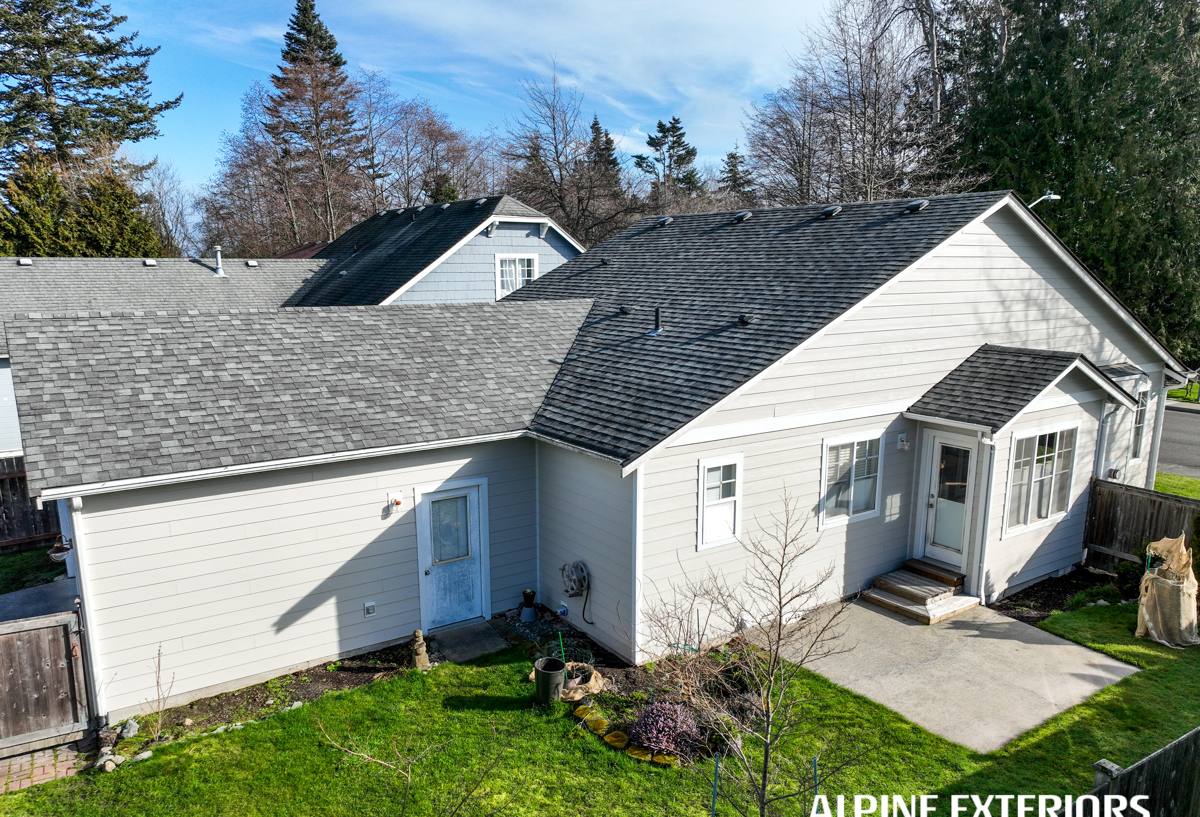
What Life Near the Harbor Does to a House
Salt Air That Never Really Lets Up
Proximity to Drayton Harbor and Semiahmoo Bay means salt-laden air is a constant here, not an occasional weather event. It settles into fastener heads, flashing seams, and any exposed metal trim, and it accelerates corrosion at a pace that homes set back a mile or two inland simply don't experience. Paint and lower-grade coatings break down faster under that kind of steady salt exposure too, which is part of why a factory-applied finish matters more here than it does in a drier, more sheltered part of Whatcom County.
Wind-Driven Rain Off the Water
Storms coming across Semiahmoo Bay or up Drayton Harbor arrive with wind behind them, and that wind pushes rain sideways into siding joints, window flashing, and the transitions where a roof meets a wall. A harbor-adjacent home doesn't get the luxury of rain that mostly falls straight down and sheds off a wall the way a well-drained roof would handle it. That sideways moisture load is the detail that separates a siding job that holds up for decades from one that starts letting water in behind the cladding within a few wet seasons, and it's a bigger factor here than the region's average rainfall numbers alone would suggest.
A Moss and Mildew Season That Runs Long
Mild coastal temperatures and near-constant humidity add up to a moss and mildew season that stretches across most of the year on shaded or north-facing walls, and homes tucked closer to the water or shaded by mature trees near the harbor tend to see it hit hardest. Any siding material that holds moisture against the substrate, or that's even slightly porous at cut edges and joints, becomes a growth surface over time. It's common for one side of a harbor-area home to dry out quickly in open sun while the opposite side stays damp for days, which means moss and moisture pressure can vary sharply across a single property rather than affecting the whole house evenly.
Why James Hardie Is the Only Siding We Install
We didn't arrive at a single-product standard from a supplier relationship or a marketing angle. It came from years of tear-offs and service calls on homes in exposed, salt-heavy settings like this one, where the difference between a siding product that performs on paper and one that performs on an actual wall becomes obvious fast.
- Non-combustible core: Fiber cement doesn't feed a fire the way wood-based siding products can, which matters for homeowner safety and often for insurance underwriting as well.
- Factory-applied ColorPlus finish: Baked on under controlled factory conditions rather than brushed on at the job site, holding color and adhesion far longer against sustained salt air and UV exposure than field-applied paint.
- Climate-engineered HZ product lines: Hardie's HZ5 formulation is built for regions with heavy moisture exposure and freeze-thaw cycling, a solid match for the harbor and the rest of coastal Whatcom County.
- Dimensional stability: Fiber cement doesn't swell, cup, or warp the way engineered wood siding can after repeated wetting and drying cycles over a long marine wet season.
- A strong transferable warranty: Hardie backs its product with one of the more substantial warranty structures in the industry, provided installation follows their published spec.
We won't install LP SmartSide, vinyl siding, Cemplank, Allura, primed spruce, or cedar. Each has legitimate uses and satisfied customers elsewhere, and we're not making a blanket claim that they're poorly made products. Our position is a professional judgment specific to this environment: on a property facing this much sustained salt and wind-driven moisture, we'd rather commit fully to one system we understand thoroughly than offer a cheaper alternative that quietly shifts maintenance risk onto the homeowner a few years down the line.
How Common Siding Materials Compare in a Harbor Setting
| Material | Trade-off in this environment |
|---|---|
| Vinyl siding | Can warp or grow brittle under sustained UV and salt-air exposure; panel seams give wind-driven rain a path inward |
| LP SmartSide / engineered wood | Wood-strand core is more moisture-sensitive at cut edges and fastener points than fiber cement, a real liability in a marine climate |
| Primed spruce or cedar | Needs ongoing paint and moisture maintenance to prevent rot; salt air shortens the repaint cycle noticeably |
| Other fiber cement brands | May not offer a climate-specific HZ-style formulation or the same depth of factory-finish warranty as James Hardie |
| James Hardie fiber cement | Dimensionally stable, factory-finished, and engineered specifically for high-moisture regions like this one |
What Correct Installation Actually Requires Here
A Hardie product only performs the way it's engineered to when it's installed to spec, and that matters more on a harbor-facing wall than almost anywhere else in the county. Correct installation means the right fastener type and spacing, proper clearance above grade and roofline, drainage detailing behind the panels where the assembly calls for it, and joints that are either factory-mitered or properly sealed rather than just butted together. Skipping any of those steps doesn't show up immediately — it shows up two or three wet seasons later as staining, softness, or a warranty claim that's harder to make because the installation didn't follow the manufacturer's published specification in the first place.
How a Siding Project Runs on a Blaine Harbor Home
Inspection and Estimate
We start with an honest look at the house: current siding condition, any sign of trapped moisture or sheathing damage, and how exposure varies across the different walls given the home's orientation to the harbor and prevailing wind. That assessment shapes the estimate rather than a flat per-square-foot number pulled without seeing the property.
Tear-Off and Substrate Check
Once the old siding is off, we check the sheathing underneath for rot or soft spots before anything new goes up. Covering damaged sheathing with new siding just buries a problem that keeps getting worse behind the wall, so we'd rather find it and deal with it at this stage than have it resurface later as a bigger repair.
Weather Barrier and Flashing Detail
Most coastal siding failures trace back to water getting behind the cladding rather than through the material itself, so the house wrap, window flashing, and every wall penetration get careful attention on a harbor-area job. This is the step that's easiest to rush and hardest to inspect once the siding is up, so we treat it as non-negotiable, particularly on walls that face open water or take the brunt of prevailing wind.
Installation to Manufacturer Spec
James Hardie's warranty depends on installation following their published specifications, and we install to that standard as the baseline rather than as an upsell. That includes fastener spacing, clearance requirements, and correct field-cutting and sealing practices at every joint.
Final Walkthrough
We walk the finished job with the homeowner, cover maintenance expectations specific to a harbor-adjacent property, and confirm the completed work matches what was estimated before calling the job done.
Roofing, Windows, and Decks Near the Harbor
Siding problems on homes near Blaine Harbor frequently start somewhere else on the house. A roof with failing flashing at a wall transition, or a window with a compromised seal, can undo a brand-new siding job within a couple of wet seasons by feeding moisture in from a different angle entirely. Decks near the water carry a related but distinct set of pressures — ground contact, standing water, and the same salt air and moss pressure that affects walls and roofs, just working on horizontal surfaces instead of vertical ones. We handle siding, roofing, windows, and decks together so a homeowner isn't left coordinating between separate contractors who each only see their own piece of the building envelope.
Signs a Harbor-Area Home's Siding Needs Attention
- Moss or dark staining that returns quickly after cleaning, especially on shaded or water-facing walls
- Soft or spongy siding, particularly low on the wall or around window and door trim
- Peeling paint or visible warping, most common on older wood-based or engineered wood siding
- Cracked, buckled, or missing panels after a windstorm off the harbor
- Rust staining trailing down from fasteners or trim hardware
- Musty odors or discoloration on interior walls that back up to exterior siding
- Siding older than 20-25 years with no documented replacement history
None of these automatically means a full replacement is necessary, but each one is worth a professional look before another wet season adds to whatever damage has already started.
What Affects Siding Cost on a Property Like This
Every estimate is specific to the individual house, but a handful of factors consistently move the number: total square footage and number of stories, how much trim and detail work surrounds windows and rooflines, the condition of the sheathing once old siding comes off, how directly the home is exposed to open water and prevailing wind, and which James Hardie product line and color fits the property. We go through those factors specifically during the estimate rather than handing over a number with no explanation behind it.
Why a Local Crew Matters This Close to the Water
Working this part of Whatcom County through every season, not just the dry stretches, shapes real decisions on a job near Blaine Harbor — which walls stay wet longest given the local wind pattern, where extra flashing attention earns its keep, and which install-day details are worth the time so a homeowner isn't dealing with a callback two winters later. It also means that when a warranty question or maintenance issue comes up years down the road, it's a call to a crew still working in this same area, not a company that's since moved on to a different region entirely.
If your Blaine Harbor home needs new siding, or you'd like a roof, window, or deck looked at alongside it, we're glad to come take a look and give you a straightforward, no-pressure estimate. Reach out using the form below to get started.