 Semiahmoo
 Composite Decking Built for Bellingham's Weather, Not Against It
Bellingham sits in a stretch of Whatcom County where marine air off the Salish Sea, long stretches of driving rain, and a moss season that can run eight months out of the year all work against outdoor wood surfaces. A deck here doesn't fail because the homeowner neglected it — it fails because it was built for a drier climate than the one it's actually sitting in. Composite decking, installed correctly for this specific environment, solves most of that problem. Installed the wrong way, it just fails differently than wood does.
This page is about composite decking specifically for homes in the Bellingham area — what the local climate demands, what a correct installation actually involves, and what we do differently because we work in this region every week, not occasionally.
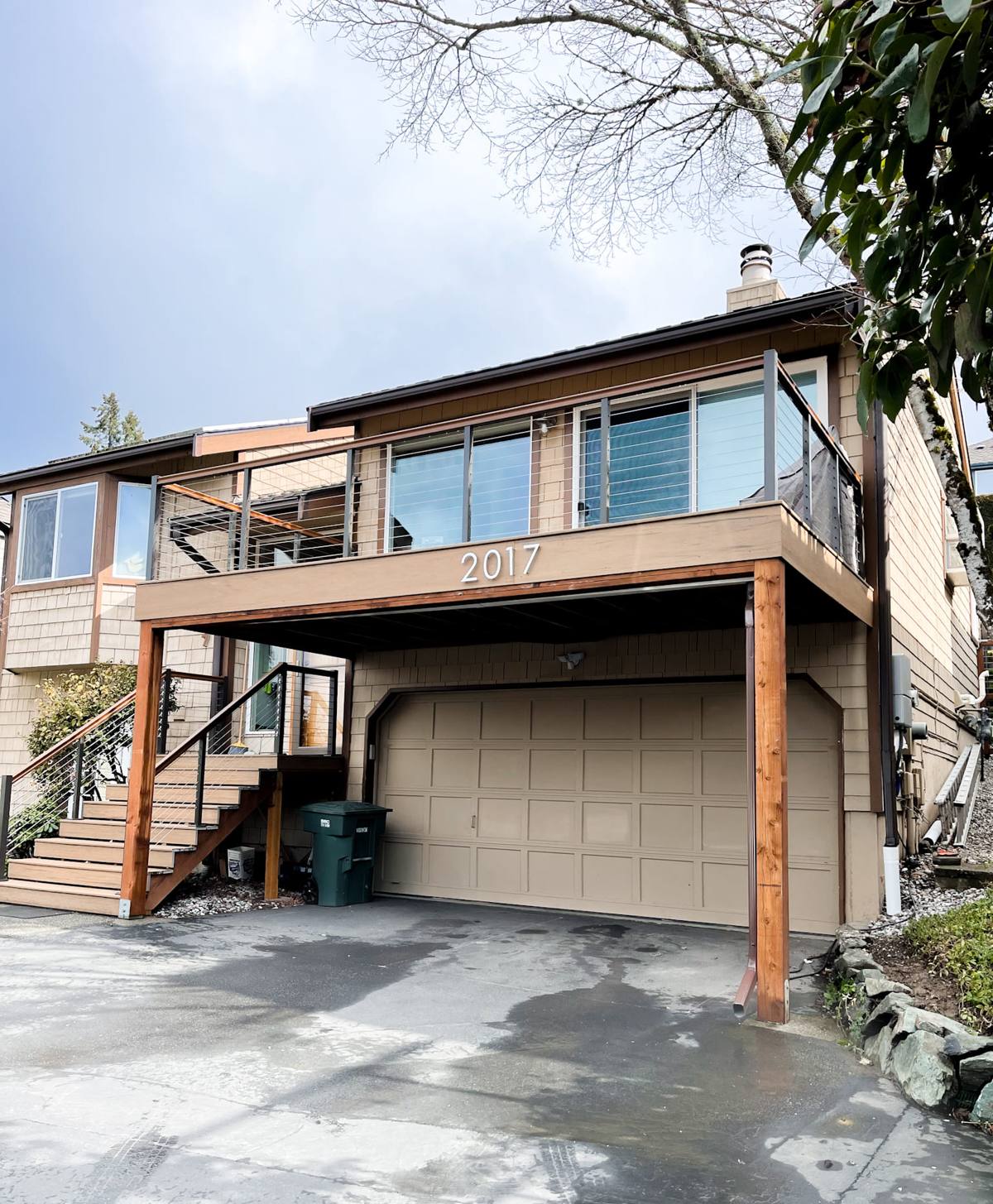
What Bellingham's Climate Actually Does to a Deck
Three things define outdoor conditions here, and each one has a specific effect on decking materials:
- Salt-tinged marine air — corrodes unprotected fasteners, hardware, and metal railing components faster than an inland climate would, and can accelerate fading on lower-grade composite surfaces over time.
- Driving, wind-blown rain — doesn't just wet the top of a deck board, it pushes moisture sideways into board ends, fastener holes, and any gap where water can sit rather than run off.
- A long moss and algae season — shaded, damp decks under trees or on the north side of a house grow moss and algae film for much of the year, which makes surfaces slick and, on the wrong material, can trap moisture against the board.
None of this is unusual for Whatcom County — it's just the baseline. A deck built without accounting for it will show problems within a few seasons: soft spots at board ends, rust streaks from hardware, black-green film in shaded corners, and boards that cup or gap unevenly.
Why This Matters More for Composite Than People Expect
A common assumption is that composite decking is "install and forget" regardless of climate. That's not accurate. Composite boards themselves resist rot, but the substructure underneath, the fasteners holding them down, and the drainage path underneath the whole system are still exposed to the same rain and salt air as everything else on the house. Composite decking done well in this climate is really a system — board, substructure, fastening, and drainage all matched to the conditions — not just a material swap.
Composite vs. Wood vs. PVC: What Actually Matters Here
| Factor | Pressure-Treated Wood | Composite | PVC / Cellular |
|---|---|---|---|
| Moisture resistance | Requires ongoing sealing; absorbs water at cut ends | Resists rot; capped boards resist moisture absorption well | Fully moisture-resistant; no organic material to rot |
| Moss/algae resistance | Prone to growth in shaded, damp spots | Capped composite resists staining better than wood; uncapped less so | Smooth surface sheds moss growth best of the three |
| Salt air / hardware | Standard fasteners can corrode without upgraded hardware | Needs corrosion-resistant fastening system regardless of board | Same fastening considerations as composite |
| Maintenance | Annual sealing/staining recommended | Periodic washing; no sealing or staining needed | Lowest maintenance of the three |
| Upfront cost | Lowest | Mid-range | Highest |
| Typical feel underfoot | Traditional wood grain | Wood-grain texture, wide color range | Smoother, more uniform look |
We install composite for the majority of Bellingham-area homeowners because it strikes the right balance for this climate: it holds up to the moisture without the sealing schedule wood requires, and it costs less than full PVC systems while performing close to them when the substructure underneath is done right.
What a Correct Composite Installation Involves
The Substructure — Where Most Failures Actually Start
Almost every deck problem we get called out to look at in this region traces back to what's under the boards, not the boards themselves. In a climate that gets this much sustained rain, the framing and ledger connections need real attention:
- Ledger board flashing that actually directs water away from the house band joist, not just a bead of caulk.
- Joist tape or a comparable protective barrier on top of framing lumber, since composite boards themselves don't rot but the wood joists underneath absolutely can.
- Proper joist spacing for the specific composite product being used — composite boards vary in span rating, and using wood-deck spacing on composite can lead to bounce or long-term sagging.
- A drainage path underneath the deck that lets water keep moving instead of pooling against posts or footings.
Fastening and Hardware
Given the salt air common along this part of the Whatcom County coastline, we don't treat fastener choice as an afterthought. Standard fasteners can corrode and streak a deck's surface within a couple of seasons in this environment. We use corrosion-resistant, manufacturer-approved hidden fastening systems matched to the board profile, which also gives a cleaner surface with no visible screw heads to catch water or wear.
Board Layout and Ventilation
Board spacing needs to account for both composite's thermal expansion and this region's rain volume. Too tight, and boards can buckle in warm stretches or trap water between them; too loose, and debris and moisture collect in the gaps. We also make sure there's enough airflow underneath low-clearance decks, since stagnant, damp air under a deck is exactly what encourages moss and mildew to creep up onto the surface from below.
Our Process for a Bellingham-Area Composite Deck
- On-site assessment — we look at sun/shade exposure, drainage slope, existing framing condition, and how exposed the deck is to wind-driven rain and salt air before recommending a board and structural approach.
- Structural plan — framing, ledger flashing, joist protection, and footing layout specified for the actual span and load, not a generic template.
- Material selection — capped composite in most cases for this climate, with color and texture options walked through based on how the space is used and how much sun/shade it gets.
- Installation — substructure first, then hidden fastening system, with attention to expansion gaps and drainage as the deck goes down.
- Railing and finish details — hardware and railing components chosen for corrosion resistance to match the decking system.
- Final walkthrough — we go over basic care specific to the board and site conditions before we consider the job done.
Living With a Composite Deck in a Moss-Prone Climate
Composite decking is genuinely lower-maintenance than wood, but "low-maintenance" doesn't mean "zero-maintenance" in a climate that produces this much moss and algae. What actually keeps a composite deck looking right here:
- Periodic washing with a soft-bristle brush and mild soap — a pressure washer on too high a setting or too close a distance can damage the board's cap layer over time.
- Keeping gutters and downspouts clear so runoff isn't dumping directly onto or under the deck.
- Sweeping fallen leaves and debris out of board gaps and corners before they hold moisture and feed moss growth.
- Trimming back overhanging branches where practical, since deep shade is the biggest driver of algae growth on any deck surface, composite included.
None of this is a heavy burden compared to sealing and staining a wood deck every year or two, but skipping it entirely in a climate this damp will still shorten how good the deck looks over time.
What Drives Cost on a Composite Deck Here
| Factor | Why It Moves the Price |
|---|---|
| Board tier (uncapped vs. fully capped) | Capped boards cost more upfront but resist moisture and staining better in this climate, which matters for long-term appearance |
| Substructure condition | Existing framing that needs repair, additional flashing, or joist protection adds labor and material |
| Site drainage and grading | Poor drainage under or around the deck footprint may need correction before decking goes down |
| Deck height and railing requirements | Taller decks and code-required railing systems add both material and labor |
| Footprint and layout complexity | Multi-level decks, curves, or built-in features take more time than a simple rectangle |
As a broad range, most composite deck projects in this region run somewhere between mid four figures for a smaller, straightforward deck up to well into five figures for larger decks with railing, multiple levels, or substructure repair involved. Every site is different enough that we'd rather walk your specific space and give you real numbers than quote a figure that doesn't apply to your project.
Why Local Installation Experience Matters
Composite decking manufacturers publish installation specs, but those specs assume a range of climates. A crew that installs decks across drier inland regions and a crew that installs them along the Whatcom County coastline are going to make different calls on flashing, fastener grade, ventilation, and drainage — even using the identical board product. We work in Bellingham and the surrounding Semiahmoo area regularly, which means we've seen how decks in this specific climate actually age, not just how a manufacturer's brochure says they should perform. That shows up in the decisions we make before the first board ever goes down — the flashing detail at the ledger, the fastener spec, the joist spacing — the parts of the job that determine whether a deck looks the same in year eight as it did in year one.
A Simple Checklist Before You Hire Anyone for a Composite Deck
- Do they inspect and address the existing substructure, or just build over it?
- Do they specify corrosion-resistant fasteners and hardware, or default to standard-grade materials?
- Do they explain ledger flashing and drainage, or skip past that part of the conversation?
- Do they know the span rating and spacing requirements for the specific composite product they're recommending?
- Can they explain maintenance expectations honestly, rather than claiming the deck needs zero upkeep?
If you're weighing a composite deck for a home in the Bellingham area, we're happy to walk the site, look at your drainage and sun exposure, and put together a straightforward plan and estimate — no pressure, no obligation. The form below is the easiest way to get that started.