 Semiahmoo
 Cedar Siding Has Real Appeal — We Won't Pretend Otherwise
Cedar is a beautiful material. It has a warm, natural grain that no engineered product fully replicates, it smells the way a lot of people picture the Pacific Northwest smelling, and on a dry, well-ventilated home with an owner committed to upkeep, it can look great for years. Western red cedar is also genuinely rot-resistant compared to most other softwoods, thanks to natural oils in the wood. If you've seen cedar siding on an older Whatcom County farmhouse still holding up, that's not an accident — it's a real property of the material.
We're not writing this page to talk cedar down. We're writing it because we install exterior siding for a living in Semiahmoo, right on the water near Drayton Harbor and Semiahmoo Bay, and we've made a business decision not to install cedar siding on new jobs. That decision is about what this specific climate does to wood siding over a 15-, 20-, 30-year window — not about cedar being a "bad" product in the abstract.
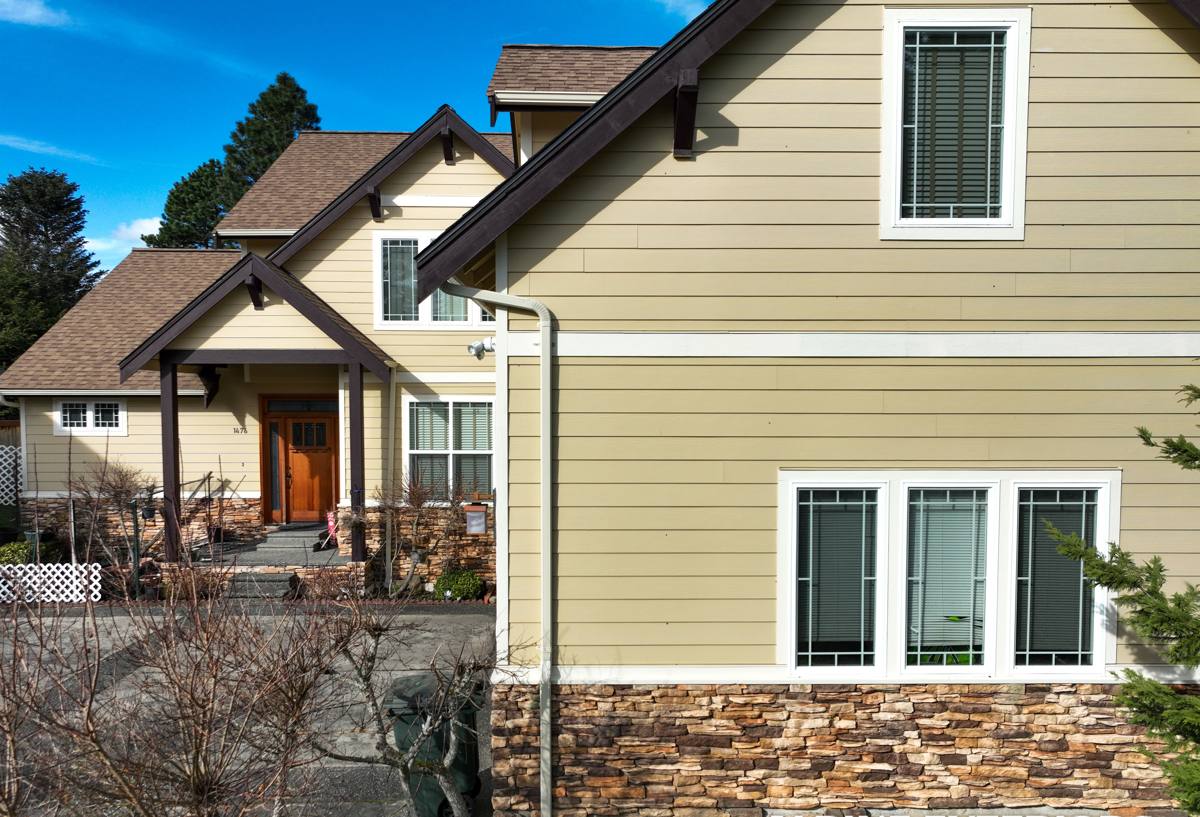
What Semiahmoo's Climate Actually Does to Wood Siding
Semiahmoo sits directly on Semiahmoo Bay, with salt air coming off the water more or less constantly, and it's inside a stretch of Whatcom County that gets a long, wet fall-through-spring season with a lot of driving rain off the Strait of Georgia. That combination — salt-laden moisture plus sustained wet weather plus a shoulder season where things just don't fully dry out — is close to the worst-case scenario for a natural wood cladding.
Three things happen to cedar siding here that don't happen the same way in a drier inland climate:
- Salt air accelerates finish breakdown. Airborne salt is abrasive and hygroscopic — it pulls moisture toward the wood surface and works against stains and paints faster than plain rainfall does.
- Extended dampness invites moss, algae, and mildew. Whatcom County's moss season isn't a two-week thing; on shaded north- and west-facing walls, siding can stay damp for weeks at a stretch, which is exactly the environment moss and algae need to take hold.
- Cycling between wet and dry stresses the wood. Cedar boards swell when wet and shrink as they dry. Repeated cycling opens hairline checks in the surface, and each check is a new entry point for moisture — even before the finish has visibly failed.
None of this means cedar "fails" on a Semiahmoo home. It means cedar asks for a level of ongoing attention that most homeowners don't sign up for when they picture a siding job as a one-time investment.
The Maintenance Cedar Actually Requires
Manufacturers and lumber associations that sell cedar siding are upfront that it needs a maintained finish — that's not a secret, it's in their own care guidance. In a marine, high-moisture climate like Semiahmoo's, that guidance translates to something like this in practice:
| Maintenance task | Typical interval in this climate | Why it matters here |
|---|---|---|
| Re-stain or repaint | Every 3-5 years (often closer to 3 on sun/rain-exposed walls) | Salt air and UV break the finish down faster than inland exposure |
| Wash to remove moss/algae | Annually, more on shaded walls | Whatcom County's damp season gives growth months to establish |
| Caulk and joint inspection | Annually | Wet/dry cycling opens gaps faster in a marine climate |
| Board replacement (splits, rot, insect damage) | As needed, ongoing | Localized failures are normal wear on wood siding over decades |
Add that up over 20 years and cedar isn't a "low-maintenance, natural" choice for a home near Semiahmoo Bay — it's a recurring line item that most homeowners underestimate at the time of installation, and that cost tends to show up as deferred maintenance rather than a clean, budgeted schedule.
Moisture Behavior and Rot Risk
The real risk with cedar isn't cosmetic weathering — a silvered, unfinished cedar look is a legitimate aesthetic choice some homeowners want. The risk is what happens underneath when a finish is neglected or when installation details (flashing, ventilation gaps, end-grain sealing) aren't done exactly right. Once moisture gets past the surface and into end grain or behind poorly lapped boards, cedar can hold that moisture against the wall assembly for a long time in our climate, because the drying window between rain events is short for much of the year. That's when rot starts, and it usually starts somewhere you can't see it — behind a board, at a butt joint, around a penetration — until it's advanced.
We've refactored our own process around not taking on that risk. We'd rather install a product engineered to shrug off Whatcom County's rain and salt air by design than install a beautiful product that depends on a homeowner's future maintenance discipline to avoid the same outcome.
Fire Exposure Is Part of Our Standard Too
Cedar, like any wood siding, is combustible. That's a straightforward material fact, not a knock on the product — wood siding has been used safely on homes for generations. But as a company, we've standardized on a non-combustible fiber cement product for every job we take, and that standard doesn't bend project to project. It's simpler for us, it's consistent for our clients, and it removes one variable from the conversation entirely.
Insects and Pests
Western red cedar's natural oils give it decent resistance to some insects, but it isn't immune, and that resistance is concentrated in the heartwood — sapwood, cut ends, and any board that's stayed damp are more vulnerable. Carpenter ants and other wood-seeking pests are a normal part of Pacific Northwest pest pressure, and damp wood siding is more attractive to them than dry fiber cement, which simply isn't a food source or a moisture reservoir for insects at all.
Why James Hardie Is What We Install Instead
We install James Hardie fiber cement siding exclusively — not LP SmartSide, not vinyl, not Cemplank or Allura, not primed spruce or cedar. Here's the reasoning that led us there, specific to this climate:
- Non-combustible — fiber cement doesn't burn, full stop.
- Engineered for moisture, not just tolerant of it — Hardie's HZ5 product line is specifically formulated for harsher, wetter climate zones, which fits a saltwater-adjacent, high-rainfall location like Semiahmoo.
- Factory-applied ColorPlus finish — the finish is baked on under controlled conditions before the boards ever reach the jobsite, rather than a stain or paint applied on-site to raw wood. That finish is backed by its own warranty and holds color longer than field-applied finishes typically do in salt air.
- No moss-friendly wood surface — algae and moss can still land on any siding, but they aren't feeding on or degrading the substrate the way they can with wood over time.
- Dimensionally stable — fiber cement doesn't swell and shrink with every wet-dry cycle the way wood does, so it doesn't check or crack from that stress.
- A strong, transferable warranty — one that's meaningful because it's backed by a product designed to actually perform for the stated period in a climate like this one, not just a generic materials warranty.
What Correct Siding Installation Looks Like
Whatever siding a home ends up with, the material is only half the equation — installation detail is what actually keeps water out in a climate like Semiahmoo's. When we quote a job, we're looking at:
- Proper weather-resistive barrier and correctly lapped house wrap
- Flashing at every window, door, and roof-to-wall intersection
- A drainage gap or rainscreen where the wall assembly calls for one
- Correct fastener type, spacing, and embedment for the specific product
- Manufacturer-specified clearances at grade, decks, and roof lines
- Caulking only where the manufacturer specifies it — not as a substitute for proper flashing
A premium product installed to a sloppy standard will fail early. A well-chosen product installed correctly is what actually protects a home through a Whatcom County winter.
Making the Right Call for Your Home
If you love the look of cedar and are willing to commit to the maintenance schedule, that's a legitimate choice — it's just not one we take on as a contractor, because we don't want to sell a homeowner a product whose long-term performance depends on upkeep we can't control after we leave the jobsite. What we can control is installing a product designed for this exact climate, to a consistent standard, backed by a warranty that means something.
If you're weighing cedar against fiber cement for a home in Semiahmoo or elsewhere in Whatcom County, we're happy to walk through the trade-offs in person, look at your specific exposure (sun, shade, wind-driven rain direction), and give you a straight answer about what we'd recommend. Reach out for a free, no-pressure estimate — there's a form right below this page.