 Semiahmoo
 Lynden's Exterior Climate: Different from the Coast, Still Demanding
Lynden sits inland from the water, out among the farmland of northern Whatcom County near the Nooksack River valley. That gives it a slightly different exterior climate than our coastal service areas like Semiahmoo and Blaine — homes here aren't taking the same direct salt spray off Semiahmoo Bay or Drayton Harbor. But "inland" in this part of Washington still means marine-influenced. Lynden gets long stretches of low-intensity rain, heavy morning dew off the surrounding fields, and the kind of persistent damp that keeps north-facing walls and shaded trim wet for days at a time. Add a moss season that can run from fall through spring, and you've got an exterior environment that punishes anything porous, poorly sealed, or installed without attention to detail.
We bring up the salt-air comparison because it matters for material choice. Homeowners closer to the water deal with corrosion and salt-driven paint failure; Lynden's bigger enemies are sustained moisture, algae and moss growth, and the freeze-thaw cycles that show up on the valley's colder winter mornings. Different threats, same conclusion: siding, roofing, and trim need to shed water fast and hold up to biological growth without constant babysitting.
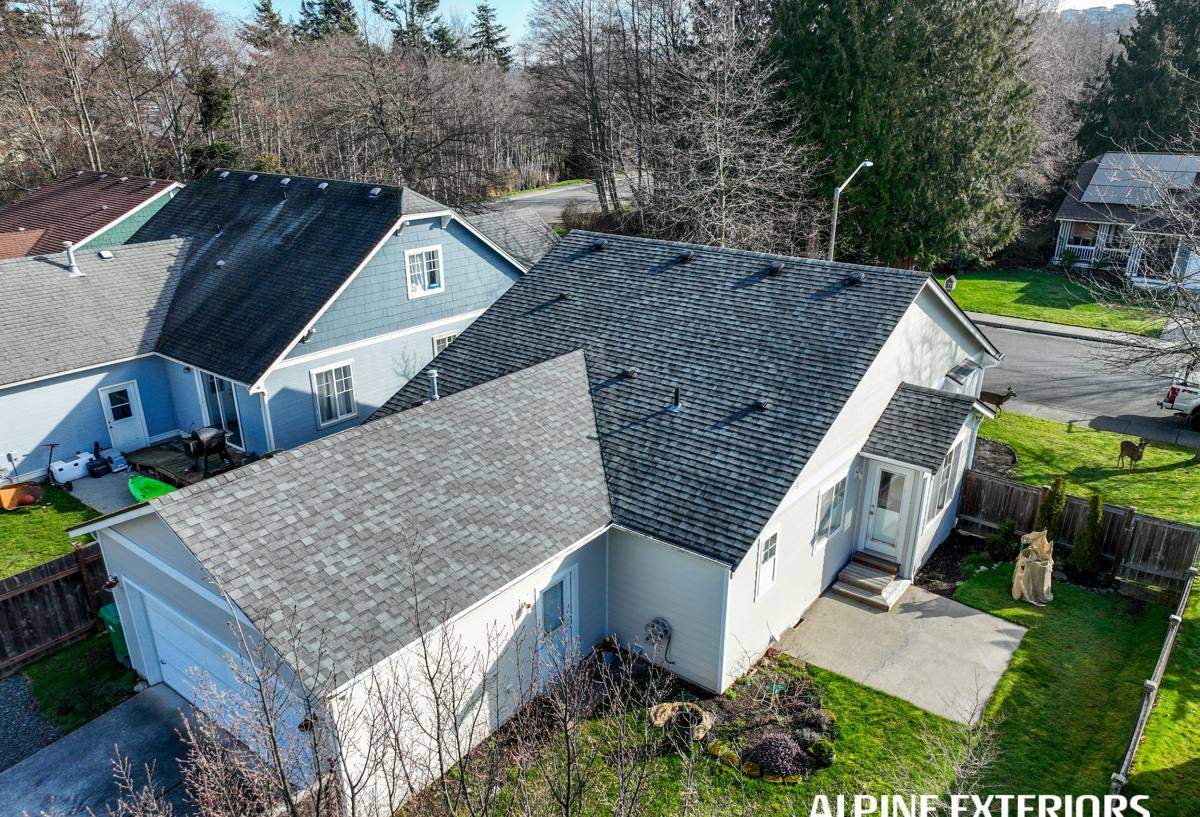
Why We Install Only James Hardie Fiber Cement Siding
We don't carry vinyl, LP SmartSide, Cemplank, Allura, or unfinished cedar or spruce siding, and that's a deliberate standard, not an oversight. In a climate like Whatcom County's, the differences between these products and James Hardie fiber cement show up over years, not on install day — which is exactly when a homeowner doesn't want to discover a problem.
What We're Avoiding, and Why
- Vinyl siding expands and contracts with temperature swings, and over time that movement works at the seams and fastener points. It doesn't rot, but it also doesn't stop moisture from getting behind it — and in a wet climate, what's behind the siding matters as much as what's in front of it.
- LP SmartSide and other engineered wood products are wood-based, which means the cut edges and any breach in the factory coating are an open invitation for moisture intake. In a region with Lynden's rain totals, that's a maintenance commitment we don't think most homeowners want to sign up for.
- Cedar and primed spruce look great fresh off the truck, but bare or minimally primed wood needs regular refinishing to keep water out, and moss and mildew take hold on wood surfaces faster than on cement composite.
- Cemplank and Allura are fiber cement too, and fiber cement as a category is the right call for this climate. Our reason for standardizing on Hardie specifically comes down to their factory-cured ColorPlus finish, their HZ5 product engineering for Pacific Northwest moisture exposure, and a warranty structure we've found to be more straightforward when a claim actually needs to be made.
None of this means the products we don't install are junk — they all have a place, and plenty of contractors install them well. It means that for the specific conditions Lynden and the rest of Whatcom County throw at a house, we've settled on one system we trust enough to stand behind, and we'd rather be straight with a homeowner about that than carry five product lines and let price alone decide.
What James Hardie Gets Right for This Area
Fiber cement is non-combustible, dimensionally stable, and doesn't feed moss and mildew the way wood-based products can. Hardie's ColorPlus finish is baked on at the factory under controlled conditions, which gives it better fade and moisture resistance than field-applied paint, and it comes backed by a real warranty on both the substrate and the finish. For a house that's going to sit through another thirty Lynden winters, that combination is hard to beat.
Roofing, Windows, and Decks: The Rest of the Exterior Envelope
Siding doesn't work in isolation. A roof that's shedding granules, a window that's letting moisture into the wall cavity, or a deck ledger board that's rotting where it meets the house all undermine the siding job around them. We handle all four trades — siding, roofing, windows, and decks — because on a house this age-range and this climate, they're connected problems.
Roofing
Moss on a roof isn't just cosmetic. In Lynden's damp, shaded conditions, moss holds water against shingles and speeds up granule loss, and it can work under flashing at valleys and penetrations over time. We look at roof condition as part of any exterior estimate, because a roof that's failing at the edges will eventually send water down behind new siding.
Windows
Older windows — especially original aluminum or early vinyl units — are a common source of hidden water intrusion around the frame. When we're doing siding work, we check flashing and window integration as a matter of course, since it's far cheaper to address during a siding project than to open the wall back up later.
Decks
Decks in this climate take a beating from standing water on horizontal surfaces and ledger boards that trap moisture against the house band joist. We build and repair decks with drainage and ledger flashing as a priority, not an afterthought.
What a Local Crew Means for Lynden Homeowners
A crew that works Whatcom County regularly knows what a house here is actually up against — the rain patterns, the moss timeline, the way a north wall behaves differently than a south wall under the same roofline. That's not something you can fully substitute with a general specification sheet. It shows up in small decisions: how much lap and overlap to give siding courses, where extra flashing makes sense, which details need caulking and which need a mechanical water break instead.
Being local also means we're around after the job is done. If a question comes up two winters later about how a transition detail is holding up, that's a phone call, not a hunt for a contractor who's since moved on to a different region.
Signs Your Siding or Exterior Needs Attention
Homeowners in Lynden often notice problems gradually, since moisture damage tends to build slowly behind the surface before it's visible. Some signs worth walking your house to check for:
- Soft or spongy spots when you press on siding, especially near the bottom courses and around window and door trim
- Persistent green or black staining that comes back quickly after cleaning
- Paint that's peeling or bubbling in a pattern that follows seams or fastener lines rather than general sun exposure
- Visible gaps or separation at corner boards, trim, or siding joints
- Warping, cupping, or bowing in individual siding boards or panels
- Interior signs — musty smell, discoloration, or soft drywall near exterior walls — that suggest moisture is already getting through
Any one of these on its own might be minor. Several together, especially on the same wall, usually means it's worth having someone look at what's happening behind the siding, not just at the surface.
Cost Factors for Exterior Projects in This Area
Every house is different, but a few factors consistently move the price on siding, roofing, window, and deck projects in Lynden and the surrounding area:
| Factor | Why It Matters |
|---|---|
| House size and wall complexity | More corners, dormers, and roof-wall intersections mean more cutting, flashing, and labor time |
| Existing siding removal | Tear-off of old wood, vinyl, or damaged sheathing adds time and disposal cost before new material goes on |
| Water damage found during tear-off | Rotted sheathing or framing discovered mid-project needs to be repaired before siding can go back on |
| Trim and detail level | Board-and-batten accents, custom corner details, and multiple siding profiles take more labor than a simple lap job |
| Access and site conditions | Steep grades, limited driveway access, or tight lot lines affect scaffolding and material staging |
| Scope combined with roofing, windows, or deck work | Bundling trades can reduce redundant setup costs compared to hiring separately over time |
What the Hardie Installation Process Involves
Correct installation is where a lot of fiber cement's long-term performance is decided. It's not a forgiving product to install carelessly — proper fastening, clearances, and flashing details are what keep water out over the long run.
- Inspecting and repairing sheathing and house wrap before any siding goes up
- Installing flashing at all windows, doors, and horizontal trim transitions
- Maintaining manufacturer-specified clearances from grade, roofing, and decking
- Fastening according to Hardie's specifications for the specific product line and exposure
- Field-cutting and caulking joints per manufacturer guidance to preserve the warranty
Skipping any of these steps doesn't usually cause an immediate problem — it causes a problem in year four or five, which is part of why we treat installation practice as seriously as the material choice itself.
Choosing a Contractor for Exterior Work in Lynden
Whatcom County has plenty of contractors, and not all of them specialize in the same way. A few things worth asking before hiring anyone for siding, roofing, window, or deck work:
- Are they licensed and insured in Washington, and can they provide proof without hesitation?
- Do they install one siding system well, or are they quoting whatever's cheapest that week?
- Will they walk you through flashing and moisture-management details specific to your house, not just a generic scope?
- Do they have manufacturer-backed warranty standing, or just a verbal promise?
- Are they familiar with this specific climate, or primarily used to drier regions?
The cheapest bid on paper is rarely the cheapest project once moisture problems surface a few years down the line. In a climate like this one, installation quality and material choice matter more than most other regions of the country.
If you're weighing a siding, roofing, window, or deck project on a Lynden home, we're happy to take a look and walk through what we're seeing — no pressure, no obligation. Fill out the form below to schedule a free estimate.