 Semiahmoo
 California Creek sits in the drainage that feeds Drayton Harbor and the waters off Semiahmoo, tucked into the far northwest corner of Whatcom County near the Canadian border. It's a mix of wooded lots, low-lying pasture, and homes set back from the water with mature tree cover — a beautiful place to live, and a genuinely hard place to keep an exterior looking good for the long haul. Between the salt-laden air drifting up from the harbor, the near-constant winter rain, and the deep shade that keeps moss and moisture around longer than almost anywhere else in the county, California Creek homes take a specific kind of beating. We've worked on siding, roofing, windows, and decks throughout this area, and the patterns repeat themselves year after year.
What This Corner of Whatcom County Does to a House
California Creek isn't right on the beach, but it's close enough to Semiahmoo Bay and Drayton Harbor that salt-bearing air reaches most properties in the area, especially on days with a west or northwest wind. Salt air accelerates corrosion on anything metal — fasteners, flashing, gutter hardware — and it also breaks down cheaper paint films faster than inland exposure would. On top of that, this stretch of the county sees a long, wet winter with mild temperatures, which is exactly the recipe for sustained moisture contact on siding and roofing.
Add tree cover — common on the larger, wooded lots around the creek — and you get shade that keeps surfaces damp well after a storm has passed. That combination of salt, rain, and shade is why moss and algae growth is such a persistent issue here. It's not a cosmetic nuisance only; moss holds moisture against a surface and, on the wrong material, that trapped moisture is what starts real damage.
The Specific Failure Points We See
- Wood-based and wood-fiber siding that has softened, delaminated, or started to rot at butt joints and lower courses where moisture sits longest
- Paint and caulk failing early on south- and west-facing walls exposed to driving rain
- Moss and algae staining on shaded elevations and anywhere gutters overflow or splash back onto siding
- Corroded fasteners and flashing on older homes, especially near the water
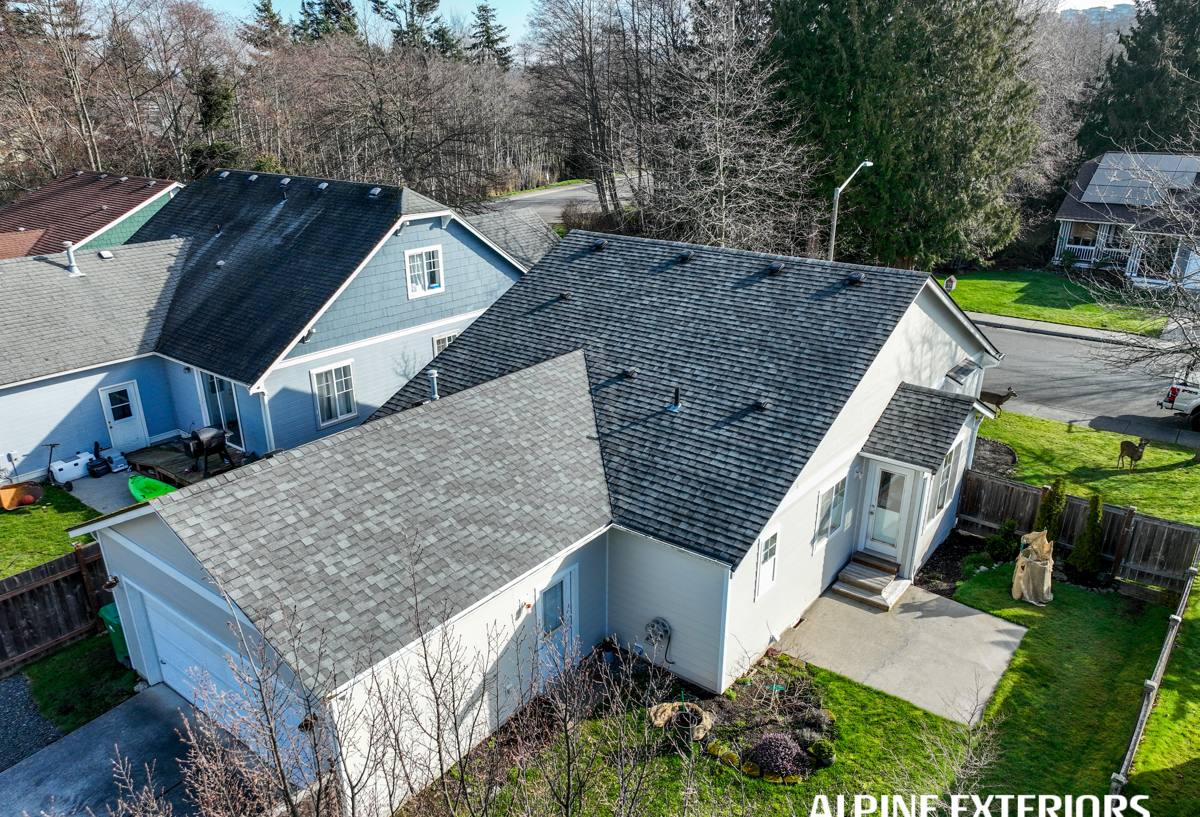
- Roof valleys and north-facing roof planes holding moss long after the rest of the roof has dried out
- Deck boards and ledger connections showing rot where debris and moisture collect against the house
Why We Only Install James Hardie Fiber Cement Siding
We made a decision a while back to stop installing several products that are common elsewhere in the Northwest — vinyl, LP SmartSide, Cemplank, Allura, primed spruce, and cedar — and to install James Hardie fiber cement exclusively. That's not a marketing position; it's a standard we hold because of what we've seen happen to exteriors in exactly this kind of climate.
Wood-based products, including engineered wood siding, rely on an intact factory coating and diligent caulk maintenance to keep moisture out. In a spot like California Creek, where shade and salt air extend the number of days a wall stays damp each year, that margin for error is thin. Once moisture gets past the surface on a wood-fiber product, the core material can swell, soften, or rot, and by the time it's visible the damage is often already done. Vinyl holds up to moisture fine, but it can warp in direct sun exposure and it doesn't offer the same fire performance or resale profile that fiber cement does — and it's simply not what we choose to stand behind.
James Hardie fiber cement is a cement-and-cellulose composite that doesn't rot, doesn't support moss growth the way wood does, and isn't a food source for insects. It's non-combustible, which matters increasingly in fire-rated building codes and insurance conversations across Washington. The factory-applied ColorPlus finish is baked on under controlled conditions and holds color longer than field-applied paint on wood siding, which reduces the repainting cycle homeowners have to manage. None of this means Hardie is maintenance-free — it still needs proper caulking, flashing, and periodic washing — but it removes the core vulnerability that wood-based products carry into a wet, shaded, salt-air environment like this one.
How Hardie's Climate Engineering Applies Here
James Hardie makes region-specific HZ5 and HZ10 product lines engineered for different moisture and freeze-thaw conditions across the country. For Western Washington's wet marine climate, that means a formulation designed around sustained moisture exposure rather than dry-climate conditions. It's a meaningful distinction for a property near Semiahmoo, where the exterior is rarely given a long dry stretch to fully recover between rain events.
Siding Installation Done Right for This Site Type
Correct installation matters as much as the product choice, maybe more. A lot of the siding failures we get called out to inspect aren't material failures at all — they're installation shortcuts: missing or undersized flashing, siding installed too close to grade or a deck surface, caulk used in place of proper flashing, or nailing patterns that don't match manufacturer spec. On a shaded, moisture-heavy lot like the ones common around California Creek, those shortcuts show up faster than they would on a drier, sunnier site.
Our installation approach for this kind of property includes:
- Proper water-resistive barrier and flashing details at every window, door, and penetration
- Correct clearances between siding and grade, decks, and roof lines to avoid moisture wicking
- Fastener spacing and type that match James Hardie's published specifications, which is what keeps the manufacturer warranty intact
- Attention to shaded and low-airflow wall sections, where extra care on flashing and drainage planes pays off over time
- Coordination with roofing, gutter, and deck work so water is actually carried away from the walls, not just past them
Roofing, Windows, and Decks in the Same Conditions
Siding rarely fails in isolation — it fails because something else near it let moisture in. That's why we look at the whole exterior on properties in this area rather than treating siding as a standalone project.
Roofing
North-facing roof planes and valleys in shaded lots hold moss the longest, and moss buildup is one of the more common causes of premature roof wear we see in this part of the county. Proper ventilation, underlayment, and moss-resistant roofing choices matter more here than on a more exposed, sun-drenched site.
Windows
Older windows near the water often show corroded hardware and failed seals well before their inland counterparts. Flashing at the window opening is one of the single most common leak points we find during siding tear-off, which is why window replacement and siding work often make sense to schedule together.
Decks
Decks on wooded, shaded lots hold debris and moisture against ledger boards and framing connections. Rot at the ledger-to-house connection is a structural issue, not just a cosmetic one, and it's worth a look any time siding work is happening nearby.
Cost Factors for California Creek Properties
Every property is different, but a few site factors consistently move the scope and cost of exterior work in this area up or down.
| Factor | Why It Matters Here |
|---|---|
| Tree cover and shade | More moss and algae removal, more careful drainage detailing, sometimes limb clearance before work starts |
| Distance from the water | Closer to Drayton Harbor/Semiahmoo Bay means more salt exposure and faster fastener/flashing wear |
| Existing siding condition | Hidden rot behind old wood or engineered wood siding adds sheathing repair before new siding goes on |
| Site access | Wooded, rural lots can mean longer material staging and setup than a straightforward in-town lot |
| Scope bundling | Combining siding with roofing, window, or deck work in one mobilization is usually more efficient than separate projects |
What to Check Before You Hire
Whether you go with us or another contractor, a few basics protect you on any exterior project in this area.
- Confirm the contractor is licensed and insured to work in Washington State
- Ask specifically what siding product they install and why — and whether they're a certified installer for that product
- Get a written estimate that specifies flashing, house wrap, and fastener details, not just "siding installation"
- Ask how they handle discovered rot or sheathing damage once old siding comes off
- Check that any manufacturer warranty is registered properly after installation — this step gets skipped more often than you'd think
Why a Local Crew Matters Here
A crew that works this stretch of Whatcom County regularly knows which walls on a California Creek property are going to stay wet the longest, which lots need extra drainage attention because of tree cover, and how far salt air reaches inland from Semiahmoo Bay on a given site. That's the kind of judgment that doesn't come from a spec sheet — it comes from having stood on enough roofs and pulled enough old siding in this specific area to know what actually happens to a house here over ten or twenty years.
If you're planning siding, roofing, window, or deck work on a California Creek property, we're glad to take a look and give you a straightforward, no-pressure estimate — just fill out the form below.