 Semiahmoo
 Wiser Lake Sits in a Tough Climate for Exteriors
Homes around Wiser Lake and the broader Semiahmoo area of Whatcom County deal with a specific combination of weather stress that a lot of siding, roofing, and trim products simply aren't built to handle over the long run. It's not one dramatic event that wears a house down out here — it's the steady accumulation of salt-tinged air moving in off the Strait of Georgia and Semiahmoo Bay, driving rain that comes in sideways during winter storms, and a moss season that can stretch from fall clean through spring in the shaded, moisture-heavy pockets around the lake and the surrounding tree line.
We work on homes throughout this part of Whatcom County, and the pattern repeats itself: north- and west-facing walls take the worst of the wind-driven rain, roof valleys and shaded rooflines grow moss faster than owners expect, and any exterior material with a weak moisture tolerance starts showing problems within a handful of years rather than decades. Understanding why that happens is the first step to choosing materials and a build approach that actually last here.
Salt Air: The Slow, Quiet Damage
Being close to the water means airborne salt gets carried inland on the wind, especially during winter systems. Salt doesn't announce itself the way a leak does. Instead it works gradually — corroding exposed metal fasteners, breaking down cheaper paint films faster than the manufacturer's warranty accounts for, and accelerating the breakdown of wood fibers in anything that isn't well-sealed. Over a few winters, homes with lower-grade siding or under-protected trim start to show chalking, fading, and soft spots that owners often mistake for normal aging rather than what it actually is: a material that wasn't matched to a coastal-influenced climate.
What This Means for Material Choice
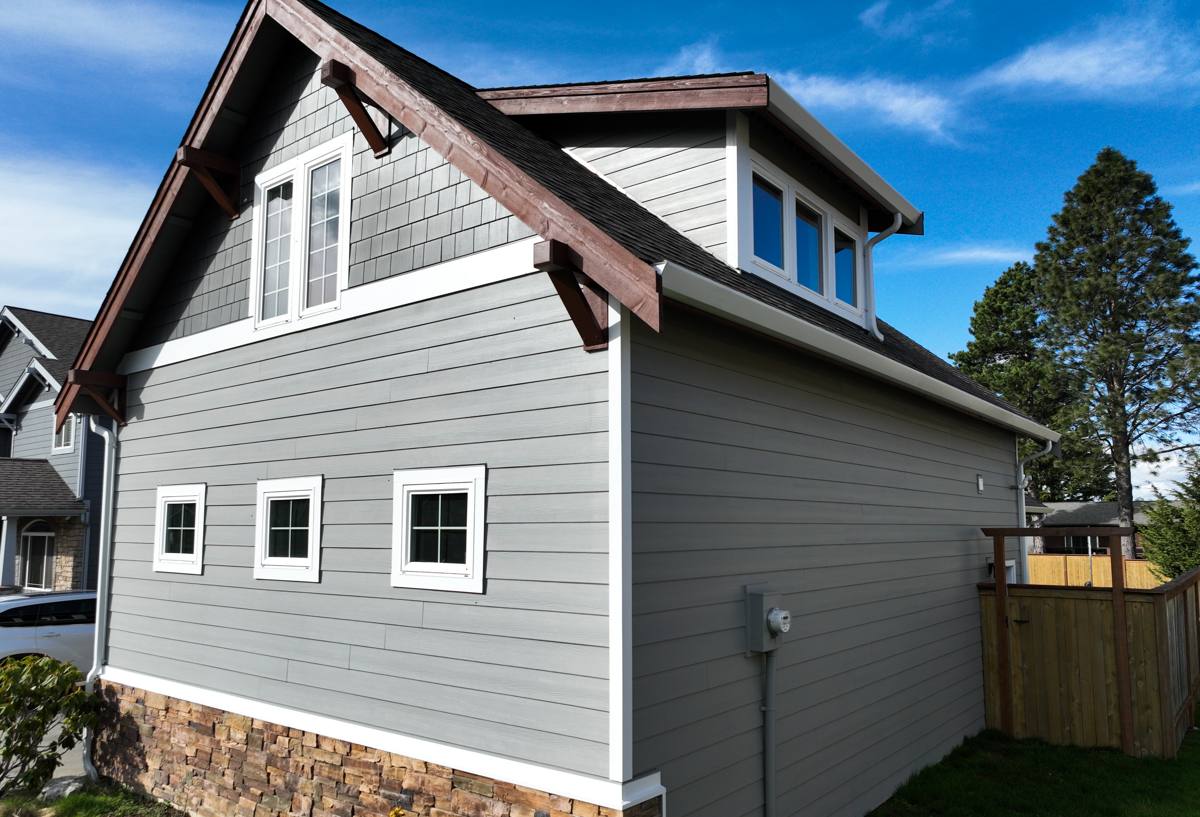
Any exterior product going on a home near Wiser Lake needs a finish and substrate that can shrug off salt exposure for years without stripping color or softening. This is one of the main reasons we standardized on James Hardie fiber cement with its factory-applied ColorPlus finish rather than field-painted alternatives — the finish is baked on and warrantied specifically against fading, and the fiber-cement substrate underneath doesn't corrode or rot the way wood or some engineered wood products can when salt-laden moisture gets involved.
Driving Rain and Moisture Management
Whatcom County gets a lot of rain, but volume alone isn't the real issue — direction is. Storms coming off the water push rain sideways into wall assemblies, which means siding, flashing, and window integration all have to work together as a system, not just individually. A siding product that's technically waterproof on its face can still fail a home if the installation behind it doesn't manage water that gets past the surface, or if the material itself absorbs and holds moisture at the seams and cut edges.
This is where installation quality matters as much as the product itself. Correct flashing at windows, doors, and roof-to-wall transitions; proper starter strips and butt joints; and rainscreen or drainage-gap detailing where the wall assembly calls for it — these are the details that keep driving rain from becoming a moisture problem behind the cladding. We see the results of skipped details on older homes throughout the area: staining, soft trim, and interior moisture issues that trace straight back to a wall that wasn't built to shed water the way this climate demands.
Moss Season and Roof Health
The tree cover and consistent moisture around Wiser Lake create ideal conditions for moss on north-facing roof slopes, in valleys, and anywhere shade keeps a roof from drying out between rain events. Moss isn't just cosmetic — it holds moisture against roofing material, works into shingle laps and granule surfaces, and can shorten the useful life of a roof significantly if it's left unaddressed for multiple seasons.
What Helps
- Keeping overhanging branches trimmed back so roof surfaces get more light and airflow
- Scheduling moss treatment and gentle removal before it establishes a thick mat, not after
- Making sure gutters and downspouts are clear so water isn't sitting against roof edges
- Checking flashing and valleys during moss removal, since these are the areas most prone to hidden wear
- Choosing roofing materials and colors that make it easier to spot moss early rather than blend it in
Roof problems in this area rarely show up as a sudden leak first — they usually show up as gradual granule loss, soft decking near valleys, or moss-driven staining that owners notice long after the underlying material has already started to degrade.
Why We Only Install James Hardie Siding Here
We get asked fairly often why we don't offer vinyl, LP SmartSide, or other engineered wood siding products, given that they're common and often cheaper up front. The honest answer is that we've made a professional call, based on what actually holds up in this climate, to install only James Hardie fiber cement siding.
The Trade-Offs We Weighed
Vinyl siding is affordable and low-maintenance in mild climates, but it can become brittle in cold snaps, expand and contract significantly with temperature swings, and — critically for this area — it doesn't offer the same impact resistance or fire performance as fiber cement. Engineered wood products like LP SmartSide perform reasonably well when installed and maintained precisely to spec, but they rely on an engineered wood core that is more sensitive to sustained moisture exposure than fiber cement, and a caulking or paint lapse at a seam can lead to swelling that's expensive to catch early. Given the amount of driving rain and salt-air moisture this area sees, we didn't want to put our name behind a product where a small maintenance gap turns into a structural problem.
James Hardie fiber cement is engineered from cement, sand, and cellulose fibers, which makes it non-combustible and dimensionally stable — it doesn't expand and contract with humidity and temperature the way wood-based products do, and it holds up to sustained moisture exposure without the swelling risk. Hardie also builds climate-specific HZ5 product formulations suited to the Pacific Northwest's freeze-thaw and moisture patterns, backs the product with a strong transferable warranty, and finishes most of its color lines at the factory with ColorPlus technology, which resists the fading and chalking that salt air accelerates on field-painted surfaces.
How the Materials Compare
| Factor | Vinyl Siding | Engineered Wood (LP SmartSide) | James Hardie Fiber Cement |
|---|---|---|---|
| Moisture tolerance | Doesn't absorb, but seams can trap water behind it | Vulnerable at seams/cuts if maintenance lapses | Resists sustained moisture; engineered for wet climates |
| Salt air / coastal exposure | Can chalk and become brittle over time | Finish needs diligent upkeep near salt air | Factory ColorPlus finish resists fading and chalking |
| Fire performance | Combustible, can melt/warp near heat | Combustible wood-based core | Non-combustible cement-based material |
| Dimensional stability | Expands/contracts noticeably with temperature | Moderate; sensitive to moisture swelling | Highly stable across temperature and humidity swings |
| Warranty structure | Varies widely by product tier | Manufacturer warranty, maintenance-dependent | Strong transferable warranty backing the product |
Roofing, Windows, and Decks Face the Same Climate Math
Siding gets most of the attention, but the same salt-air, rain, and moss conditions apply to every exterior surface on a Wiser Lake home. Roofing needs materials and installation detailing that shed driving rain and resist moss buildup on shaded slopes. Windows need proper flashing integration with the wall assembly so wind-driven rain doesn't find its way behind the frame — a huge percentage of "siding leaks" we're called out on actually trace back to window flashing, not the siding itself. Decks facing this exposure need fasteners and finishes rated for coastal moisture, since standard hardware can corrode faster here than it would further inland.
Because we handle siding, roofing, windows, and decks as one crew, we look at a home's exterior as a connected system rather than a series of separate trades — which matters a lot in a climate where the failure point is almost always where two systems meet.
Signs a Wiser Lake Home May Need Exterior Attention
- Moss or dark streaking building up on north-facing roof slopes or wall sections
- Soft, discolored, or bubbling siding near ground level or under downspouts
- Paint or finish that's chalking, fading unevenly, or peeling faster than expected
- Gaps or cracking caulk around windows and trim joints
- Musty smell or visible staining on interior walls near exterior corners
- Corroding fasteners or hardware on siding, gutters, or deck connections
What Drives Cost on a Project Like This
| Cost Factor | Why It Matters Here |
|---|---|
| Wall complexity and access | Homes near the lake often have wooded lots, slopes, or tight setbacks that affect staging and labor |
| Extent of moisture damage found | Sheathing or framing repair behind old siding adds scope once removal starts |
| Siding profile and trim detail | Board-and-batten, shake-style panels, and heavier trim packages take more labor than lap siding alone |
| Roof pitch and moss condition | Steep or heavily shaded roofs take longer to treat and repair safely |
| Window and door integration | Proper flashing at openings adds time but is not optional in this climate |
We give straightforward estimates based on what we actually find on the home, not a generic per-square-foot number that ignores the moisture damage or access issues specific to a wooded, water-adjacent property.
Why a Local Crew Matters Near Wiser Lake
A crew that works across Whatcom County and the Semiahmoo area regularly knows which walls take the worst of the weather, how aggressive the moss season really gets in the shaded pockets around the lake, and how salt air behaves differently here than it does even a short distance inland. That local pattern recognition shows up in small decisions — where to add extra flashing, which siding orientation needs closer joint detailing, when a roof needs treatment versus full moss removal — that a crew unfamiliar with this specific stretch of coastline might miss entirely. It also means someone is nearby if a question comes up after the work is done, rather than a company that installed once and moved on.
If you're noticing early wear on your siding, roof, windows, or deck — or you're planning ahead before a small issue becomes a bigger one — we're happy to take a look and give you a straightforward, no-pressure estimate using the form below.