 Semiahmoo
 Siding Built for Blaine's Coastal Climate
Blaine sits right where Semiahmoo Bay meets Drayton Harbor and the Strait of Georgia, and that location shapes everything about how a house ages here. Homes close to the water take on salt-laden air almost year-round, while the broader Whatcom County weather pattern layers on long stretches of driving rain, heavy dew, and a moss season that can run from fall through late spring. None of that is exotic or unusual for this part of Washington — it's just the baseline your siding has to survive, every single year, for decades.
Most siding failures we see in Blaine aren't dramatic. They're slow: a corner that stays damp two extra days after every storm, a north-facing wall that never quite dries out, moss creeping up from grade level, paint that chalks and fades faster than it should because of the constant salt exposure. Individually these look minor. Over ten or fifteen years they add up to soft trim, failing caulk joints, and siding that needs replacing well before it should have.
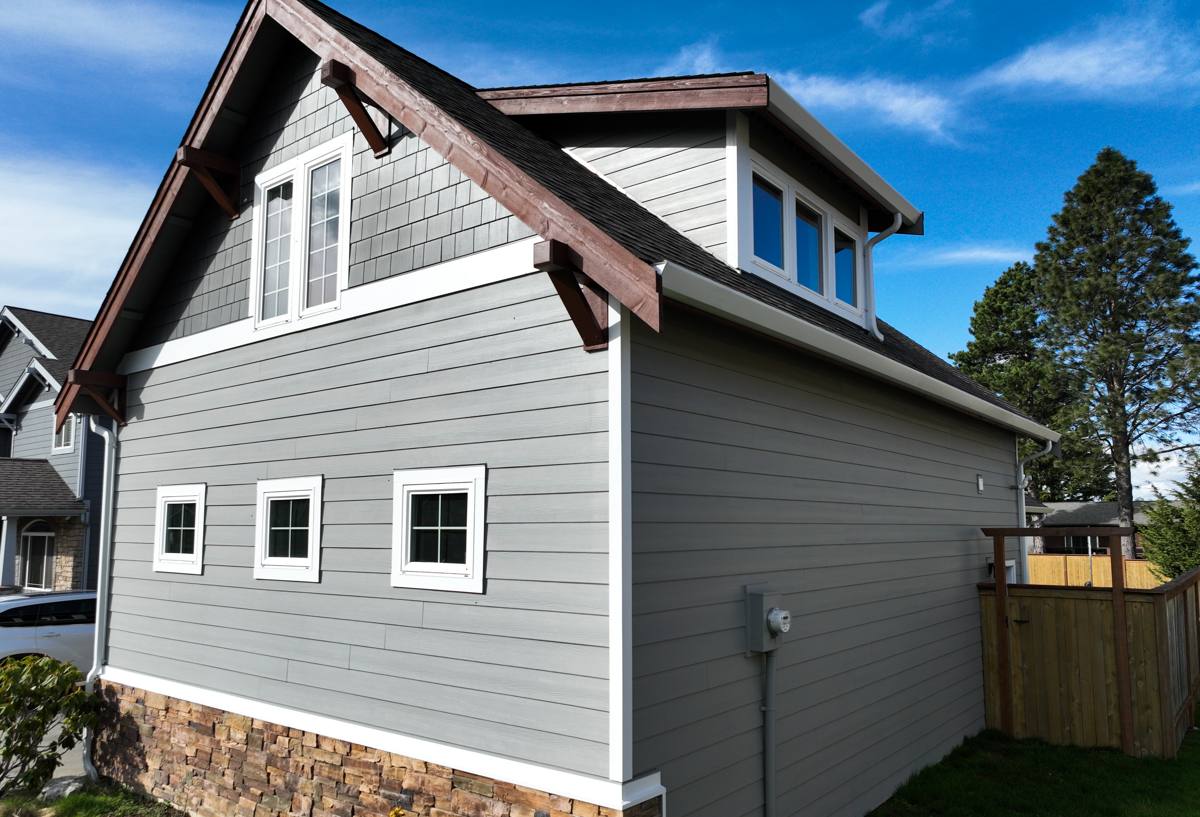
What Local Homes Are Actually Up Against
Salt Air
Airborne salt from the bay accelerates the breakdown of a lot of common siding finishes and fasteners. It's not that salt air destroys materials overnight — it's that it never really stops working on them. Coatings that would hold up fine forty miles inland can chalk, fade, or lose adhesion years earlier this close to the water.
Driving Rain and Wind-Driven Moisture
Storms coming off the Strait don't just drop rain straight down — wind pushes it sideways into walls, especially on west- and southwest-facing elevations. That means water is testing your flashing, your caulk joints, and your siding's ability to shed moisture far more often than in a sheltered inland location.
Moss and Persistent Dampness
Cool, damp conditions for much of the year give moss and algae plenty of opportunity to take hold, particularly on shaded walls, under eaves, and anywhere air doesn't circulate well. Moss holds moisture against the surface it's growing on, which is a problem for any siding material that isn't genuinely water-resistant at its core.
Why We Standardized on James Hardie Fiber Cement
We install James Hardie siding exclusively — not vinyl, not LP SmartSide, not Cemplank or Allura, not primed spruce or cedar. That's a deliberate call, not a default. In a climate like Blaine's, the material itself matters more than almost anywhere else in the state.
James Hardie's fiber cement is non-combustible and engineered specifically for regional climate exposure through its HZ product lines, which account for moisture cycling in exactly the conditions this area produces. The factory-applied ColorPlus finish is baked on under controlled conditions and backed by its own finish warranty, which matters a lot when you're fighting UV and salt exposure that fades and chalks weaker coatings years ahead of schedule. Fiber cement also doesn't feed moss and mildew growth the way wood-based products can, and it holds its shape and fastening in wind-driven rain far more consistently than vinyl, which can warp, buckle, or blow off in sustained coastal gusts.
We're not going to tell you every alternative product is bad — most of them have a legitimate place somewhere. But we've made a professional judgment that for homes exposed to salt air, driving rain, and a long wet season, fiber cement installed correctly is the material that holds up with the least maintenance and the fewest surprises. That's the standard we're willing to put our name behind.
How Siding Material Performance Compares in This Climate
| Material | Salt Air Resistance | Moisture/Moss Resistance | Maintenance Burden |
|---|---|---|---|
| James Hardie Fiber Cement | Strong, factory finish | Strong, non-organic core | Low |
| Vinyl Siding | Moderate, can chalk/fade | Moderate, can trap moisture behind panels | Low to moderate |
| LP SmartSide / Engineered Wood | Moderate, coating-dependent | Sensitive to sustained moisture at edges | Moderate |
| Cedar / Primed Spruce | Weak without diligent upkeep | Prone to moss, rot at joints | High |
This isn't a claim that other products fail outright — well-installed and well-maintained siding of almost any type can perform reasonably. It's a comparison of how much upkeep each material demands to keep performing in a coastal, high-moisture environment like Blaine's, and how much margin for error you have if maintenance slips for a year or two, which happens to every homeowner at some point.
Our Installation Process for Coastal Exposure
Correct installation matters more here than in a sheltered inland neighborhood, because the margin for a sloppy flashing detail or a missed clearance is much smaller. Our process on Blaine homes typically includes:
- An exterior moisture and condition assessment before any tear-off begins, looking specifically at grade clearance, existing rot, and problem areas that tend to correlate with wind exposure
- Correct water-resistive barrier and flashing detail at every window, door, and penetration — this is where most premature siding failures actually start, regardless of material
- Proper fastening and joint spacing per James Hardie's published installation guidelines, which account for the expansion and moisture cycling this climate produces
- Attention to elevation-specific exposure, since the wall taking the worst of the wind-driven rain often needs different detailing than a sheltered rear elevation
- A final walk-through so you understand what was done and what routine upkeep looks like going forward
Beyond Siding: The Full Exterior Envelope
Siding doesn't work in isolation. On a coastal Whatcom County property, the roof, windows, and any exterior decking all face the same salt air, rain, and moss pressure, and they all interact with each other. A roof with a failing edge detail can dump water directly onto a wall no matter how good the siding is. Window flashing that's slightly off sends moisture behind the wall assembly instead of away from it. A deck built with the wrong ledger connection or without proper flashing against the house creates a chronic wet spot right where siding meets structure.
Because we handle siding, roofing, windows, and decks, we look at these systems together rather than treating your siding project as isolated from everything around it. If we spot a roofing detail or a window flashing issue that's going to undermine new siding, we'll tell you before we start, not after the problem shows up as a stain on the wall two winters later.
Why a Local Crew Matters in Blaine
A crew that works this specific stretch of coastline regularly develops a feel for it that generic experience doesn't replace. That includes knowing which elevations on a typical Blaine lot take the worst of the wind, how permitting and inspection tend to run with the City of Blaine and Whatcom County, and what a wall that's been quietly absorbing moisture for years actually looks like once you open it up. It also means we're not guessing at seasonal timing — we know when the wet season realistically closes a window for exterior work and when it opens back up.
Local presence also matters after the job is done. If a warranty question comes up, or you want a second opinion on a maintenance issue five years down the road, you're dealing with a crew that's still working in your area, not a company that moved on to the next region.
Cost Factors for a Blaine Siding Project
Every home is different, but the variables that tend to move a siding project's scope and cost in this area are fairly consistent:
| Factor | Why It Matters Here |
|---|---|
| Extent of existing moisture damage | Hidden rot behind old siding is more common near the water and adds repair scope before new siding goes on |
| Home size and wall complexity | More corners, windows, and elevation changes mean more flashing detail and labor |
| Siding profile and trim selection | James Hardie offers multiple plank, shingle, and panel profiles at different price points |
| Access and site conditions | Waterfront and hillside lots around Blaine sometimes require more setup and staging |
| Scope beyond siding | Bundling roofing, window, or deck work into one project can be more efficient than separate projects later |
We won't quote a number without seeing the house, but we're happy to walk through these factors with you honestly during an estimate so there are no surprises.
Maintaining Your Siding Once It's Installed
Even low-maintenance fiber cement siding benefits from a little seasonal attention, especially this close to the water. A simple annual routine goes a long way:
- Rinse salt residue and grime off exterior walls once or twice a year, especially on elevations facing the water
- Keep gutters clear so overflow isn't running down the wall face during heavy rain
- Trim back vegetation and clear debris that traps moisture against the siding, particularly on shaded north-facing walls
- Check caulking at trim and penetrations periodically, since joint sealant wears out well before the siding itself does
- Address any moss growth early, before it has a chance to hold moisture against the surface for months at a time
None of this is heavy maintenance — it's the kind of routine upkeep that keeps a well-installed system performing for its full service life instead of fighting an uphill battle against the climate.
Let's Talk About Your Home
If your Blaine home is showing early signs of wear — fading, moss, soft trim, or siding that just looks tired before its time — it's worth having a local crew take a look before small issues turn into bigger repairs. We'll give you a straightforward, no-pressure estimate and an honest read on what your home actually needs. Use the form below to get started.