 Semiahmoo
 Why Peace Arch Homes Wear Out Faster Than the Brochure Says
Peace Arch sits close enough to the water and the border that its houses live under a slightly different set of rules than homes twenty miles inland. The combination of salt-laden air rolling in off Semiahmoo Bay and Drayton Harbor, near-constant wind, and a wet season that can stretch from October into May puts real, cumulative stress on exterior materials. It's not one dramatic storm that does the damage — it's the slow, repeated cycle of moisture soaking in, salt residue settling on surfaces, and short window of dry weather to fully recover before the next system rolls through.
Homeowners in this part of Whatcom County often notice the effects before they can name the cause: paint that seems to fail years ahead of schedule, trim that stays damp-looking even on dry days, or a north-facing wall that grows a green film every winter no matter how often it's cleaned. These aren't isolated problems. They're symptoms of a climate that's genuinely harder on siding, trim, roofing, and any exposed wood than most manufacturers' warranty language assumes.
The Three Things Actually Attacking Your Exterior
Salt Air
Proximity to Semiahmoo Bay means airborne salt is a constant, low-level presence, not an occasional coastal event. Salt is hygroscopic — it pulls moisture out of the air and holds it against whatever surface it lands on. On metal fasteners and flashing, that means accelerated corrosion. On painted wood and lower-grade composite siding, it means the finish breaks down faster and paint adhesion suffers, especially on west- and south-facing elevations that catch the prevailing weather.
Driving Rain
This isn't gentle Pacific Northwest drizzle. Wind off the water pushes rain sideways into wall assemblies, forcing water into joints, laps, and fastener penetrations that would stay dry in a calmer climate. Any siding product with weak seams, poor water-shedding detail, or a finish that isn't fully cured before installation is going to show it first at the horizontal joints and around windows.
Moss and Prolonged Dampness
Whatcom County's moss season is long — shaded north walls, areas under tree cover, and anything that doesn't get direct sun for weeks at a time stay damp long enough for moss and algae to take hold. Beyond the cosmetic issue, sustained moisture against a wall surface is exactly the condition that causes wood rot, delaminates weaker composite products, and holds paint failure in place instead of letting it dry out and stabilize.
Why We Install Only James Hardie Fiber Cement — Not LP SmartSide, Vinyl, or Cedar
We get asked regularly why we don't offer more siding options. The honest answer is that we looked at what actually holds up in this specific climate, and we stopped installing products that don't. That's not a knock on every use case for those materials — it's a statement about what we're willing to put our name behind on a Peace Arch home.
- Vinyl siding expands and contracts with temperature swings and can warp or become brittle over time; its seams and J-channels give wind-driven rain more opportunities to get behind the cladding.
- LP SmartSide and similar engineered wood products perform well in many markets, but they're wood-based — if moisture gets past the finish at a cut edge, joint, or fastener hole, the substrate can swell or degrade, and that risk is higher in a climate with this much sustained dampness.
- Primed spruce and cedar require a maintenance commitment — recoating, caulking, inspection — that most homeowners don't realize they've signed up for until the finish starts failing in year four or five, often faster on the salt-exposed side of the house.
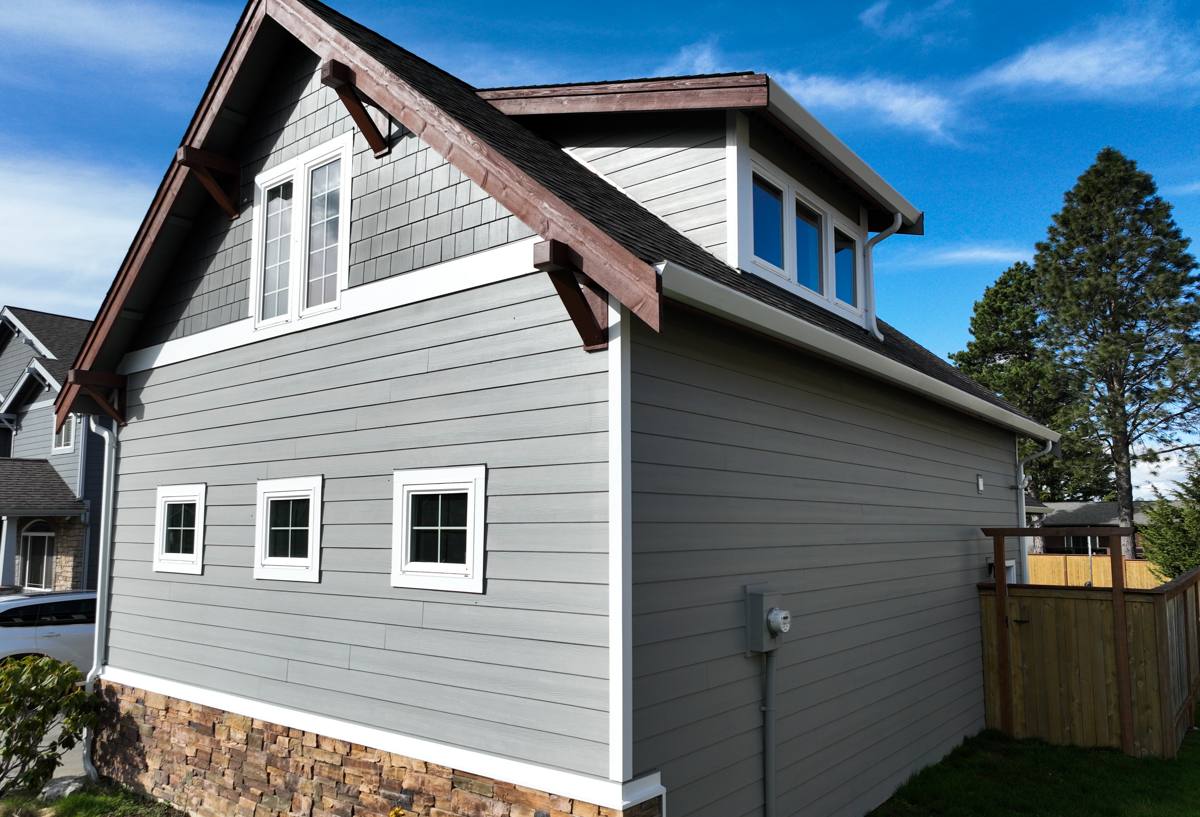
James Hardie fiber cement is cement, sand, and cellulose fiber — it doesn't absorb moisture the way wood-based products do, it's non-combustible, and it doesn't expand and contract with temperature the way vinyl does. Its ColorPlus factory finish is baked on and warranted separately from the substrate, which matters enormously in an area where field-applied paint is fighting salt air and rain from day one instead of curing in a controlled environment.
Matching the Product Line to This Specific Exposure
Hardie's HZ5 product line is engineered for climates with more moisture cycling and freeze-thaw stress — it's the appropriate specification for Whatcom County, and it's what we install here as a baseline rather than an upgrade. Beyond the product itself, correct installation matters just as much as the material choice:
- Proper starter strip and flashing at the foundation line, where splashback and standing water are most common
- Correct fastener placement and type — the wrong nail or the wrong depth is one of the most common causes of early siding failure, and it's invisible until it isn't
- Rain-screen or drainage-plane detailing behind the siding so any moisture that does get past the cladding has somewhere to go
- Tight, properly caulked joints at windows, corners, and penetrations, sized for this area's wind-driven rain rather than a calmer climate's assumptions
A product that's engineered correctly but installed poorly will still fail early in this environment. That's the piece a lot of estimates skip over.
It's Not Just Siding: The Full Exterior Envelope
Siding doesn't work in isolation. On a Peace Arch home, the roof, windows, and any exterior decking are all part of the same system fighting the same climate, and problems in one area routinely show up as damage in another.
Roofing
A roof with failing flashing or aging shingles sends water down behind siding and fascia long before a homeowner sees a leak indoors. Wind uplift from coastal gusts also puts more stress on roof edges and ridge lines than most inland homes experience.
Windows
Old or poorly flashed windows are one of the most common entry points for wind-driven rain. When we're already opening up a wall for siding work, it's often the most efficient time to address window flashing or replacement rather than waiting for a separate project.
Decks
Exterior decks in this climate deal with the same moss, moisture, and salt exposure as siding, just underfoot instead of on a wall. Framing and ledger board connections deserve the same attention to water management as any other part of the envelope.
Handling siding, roofing, windows, and decks under one crew means fewer seams between trades, fewer finger-pointing situations when something doesn't line up, and a contractor who's looking at the whole envelope rather than one component in isolation.
What a Siding Project Actually Involves
| Stage | What Happens | Why It Matters Here |
|---|---|---|
| Assessment | Inspect existing siding, trim, flashing, and any moisture or rot damage | Salt air and moss can hide damage until siding is removed |
| Prep & tear-off | Remove old siding, check sheathing and framing for hidden water damage | Long wet seasons mean hidden rot is common on older homes |
| Weather barrier & drainage plane | Install or repair house wrap and rain-screen detailing | Gives incidental moisture a path out instead of trapping it |
| Hardie installation | Install HZ5-rated boards, panels, or trim per manufacturer spec | Correct fastening and flashing prevent early failure |
| Finish & caulking | Seal joints, corners, and penetrations | Wind-driven rain finds any gap left unsealed |
| Final walkthrough | Review work, warranty paperwork, and care guidance | Sets expectations for maintenance in this climate |
Cost Factors Worth Understanding
Every home is different, and we don't quote sight-unseen, but these are the variables that most affect a Peace Arch siding project's scope and cost:
| Factor | Why It Affects Cost |
|---|---|
| Extent of hidden damage | Rot or moisture damage found during tear-off adds repair scope before new siding can go on |
| Home size and wall complexity | More corners, dormers, and trim detail mean more labor and material |
| Siding profile chosen | Lap siding, panel systems, and shingle-style Hardie products carry different material and install costs |
| Access and site conditions | Waterfront or sloped lots can affect staging and equipment access |
| Scope beyond siding | Bundling window, trim, or roofing work can improve overall efficiency but adds to project total |
Broad ranges only get you so far without seeing the actual walls, which is why an in-person estimate matters more here than a generic square-footage number.
What to Look for in a Local Contractor
Not every siding crew is set up to deal with this specific climate correctly, and the difference shows up years later, not on install day. Before hiring anyone for exterior work in this area, it's worth checking:
- Do they have documented experience with James Hardie or comparable fiber cement installation, not just general siding?
- Will they show you the flashing and drainage-plane details before covering them up, or just say "trust me"?
- Are they licensed and insured to work in Washington, and can they provide that documentation without hesitation?
- Do they talk about moisture management and this area's rain and salt exposure specifically, or give you the same pitch they'd give a homeowner three states away?
- Is the warranty they're offering tied to the manufacturer's actual terms, or is it a vague verbal promise?
Maintenance: What Ongoing Care Actually Looks Like
James Hardie siding is genuinely low-maintenance compared to wood or vinyl, but "low-maintenance" doesn't mean "no maintenance," especially in this climate. A realistic annual routine includes a gentle rinse to remove salt residue and organic buildup before it gets a chance to hold moisture against the surface, a visual check of caulking at joints and penetrations, and prompt attention to any trim or flashing that looks like it's holding water. None of this is labor-intensive, but skipping it for several years in a row is how small issues turn into bigger ones.
A Local Crew Working a Local Problem
A contractor based elsewhere in the region can install siding correctly on paper and still miss the details that matter for a home exposed to Semiahmoo's salt air and Whatcom County's driving rain. Knowing which elevations take the worst of the weather, how long moss season really runs, and what correct flashing looks like for wind-driven rain isn't something you get from a spec sheet — it's something you get from working on homes in this exact area, season after season.
If you're noticing early paint failure, moss that won't quit, or siding that's simply reached the end of its useful life, we're happy to take a look and talk through what's actually going on with your home — no pressure, no obligation. Use the form below to request a free estimate.