 Semiahmoo
 Why Bellingham Decks Take More Than a Standard Build
Bellingham sits close enough to the water that salt-laden air reaches most yards, and Whatcom County's wet season runs long — often eight or more months of the year with regular rain and low sun angles that keep shaded areas damp for days after a storm passes. A deck built to a generic national spec, without those conditions in mind, tends to show problems early: fasteners that weep rust stains, ledger boards that trap moisture against the house, and decking that grows a slick moss film by the second winter. None of that is inevitable. It's a function of material choice, fastener selection, and how the structure is detailed to shed water, not hold it.
A deck built for Bellingham needs to handle three things a drier or more inland climate doesn't stress nearly as hard: near-constant humidity cycling, salt-air corrosion on hardware, and moss and algae growth on any surface that stays shaded and damp. Get those three right and the deck ages the way it should. Skip them and you're looking at repairs well before the structure would otherwise need them.
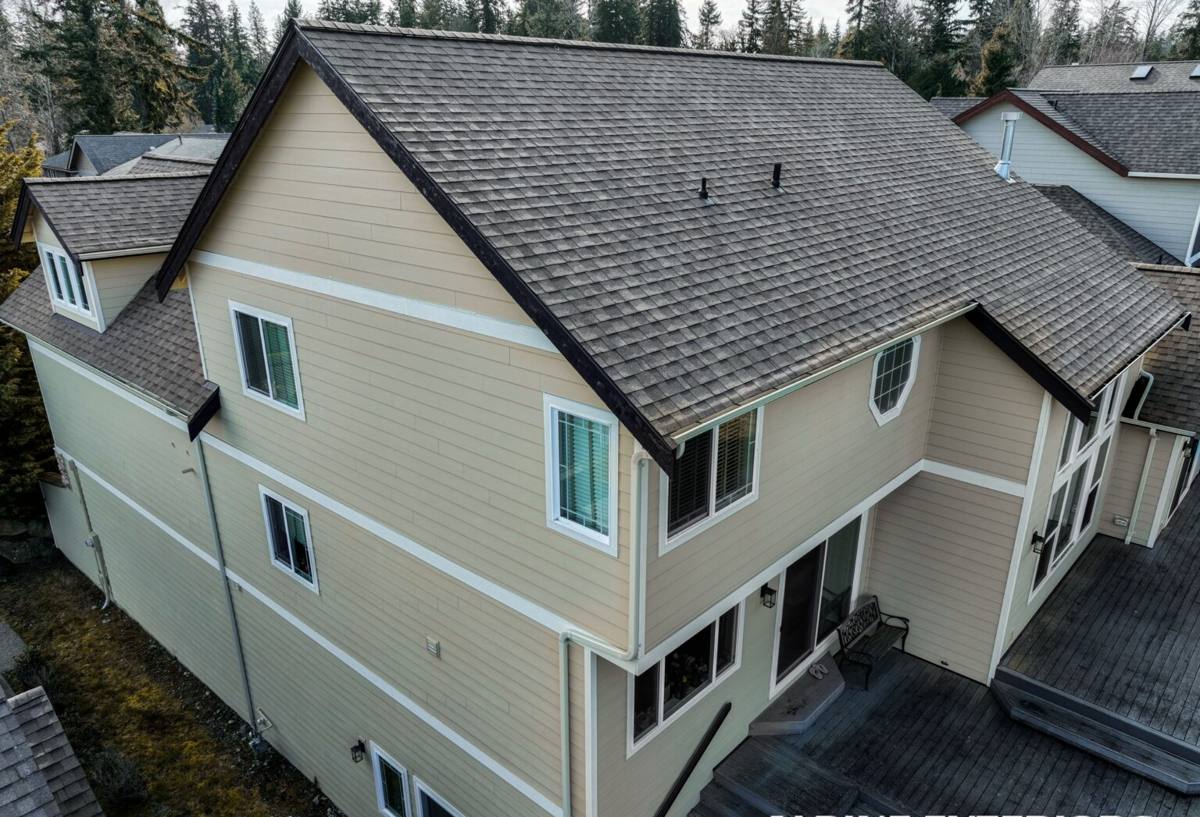
What a Correctly Built Deck Looks Like Here
Fasteners and Hardware
Salt air corrodes standard electro-galvanized fasteners faster than most homeowners expect, especially within a few miles of Semiahmoo Bay or Bellingham Bay. We use stainless steel or hot-dip galvanized hardware rated for coastal exposure on every structural connection — joist hangers, post bases, and structural screws — not just at the water-facing side of the house. Mixing metals (aluminum flashing against untreated steel fasteners, for example) sets up galvanic corrosion that can eat through hardware in a fraction of its rated life, so matching compatible metals throughout the connection is part of the spec, not an afterthought.
Ledger Attachment and Flashing
The ledger board — where the deck attaches to the house — is the single most common failure point on decks in wet climates, because it's the one structural member sitting directly against a wall that's already managing its own moisture load. Correct detailing means a code-compliant ledger flashing system (metal flashing plus a water-resistant barrier behind it), proper lag bolt or through-bolt spacing rated for the structure's span and load, and a small air gap or flashing tape detail that keeps water from wicking into the house's sheathing. This is also where we look closely at the existing siding and trim during the estimate — if there's already moisture damage behind the attachment point, that gets addressed before a single ledger bolt goes in.
Framing and Drainage Below the Deck
Joists spaced and sized for the actual load (furniture, hot tub, gathering space) rather than the bare minimum, with drainage planned underneath so water doesn't pool against posts or footings. In a region with this much annual rainfall, standing water at the base of a support post is a slow but steady path to rot, even with treated lumber.
Choosing Decking Material for This Climate
There's no single "best" decking material — the right call depends on budget, how much upkeep you want to do, and how exposed the deck is to shade and moisture. Here's how the common options actually perform in Whatcom County conditions:
| Material | Moss/Algae Resistance | Maintenance | Typical Lifespan Here | Relative Cost |
|---|---|---|---|---|
| Cedar (untreated) | Moderate — needs regular cleaning | Annual cleaning + re-sealing/staining | 15–20 years with upkeep | $$ |
| Pressure-treated pine | Low — prone to moss in shaded spots | Cleaning, periodic sealing | 15–20 years with upkeep | $ |
| Composite decking | Good — capped boards resist growth better | Occasional washing, no sealing | 25–30 years | $$$ |
| PVC decking | Best — non-porous surface | Occasional washing | 25–30+ years | $$$$ |
Cedar still gets requested a lot in this area for its look, and it's a reasonable choice as long as the homeowner is realistic about the maintenance — it needs cleaning and resealing on a schedule, or moss and gray weathering set in fast on shaded sections. Composite and PVC cost more up front but largely take the moss problem off the table, which matters most on decks under tree cover or on the north/shaded side of a house. We'll walk through the actual trade-offs for your specific yard and sun exposure rather than pushing one material across the board — a full-sun deck and a shaded one under fir trees genuinely call for different answers.
Design Choices That Matter More Here Than Elsewhere
- Board spacing and gapping — slightly wider gaps between boards help water and debris clear faster instead of collecting in the joints, where moss gets its start.
- Surface texture — smooth-faced boards look great but get slicker with algae film; a grooved or brushed-texture board holds footing better through the wet months.
- Railing and post materials — matching the decking's moisture resistance so the whole structure ages at the same rate, rather than a durable deck surface paired with railing hardware that corrodes early.
- Covered vs. open sections — a partial roof or pergola over part of the deck reduces standing water and moss growth in that zone, and extends usable outdoor time given how much of the year sees rain.
- Sun exposure at design stage — we look at where the deck will sit relative to the house and any tree cover before finalizing material and layout, since shaded areas need different handling than sections that get regular sun.
Our Process for a Bellingham Deck Project
The process is straightforward, but each step is where the climate-specific decisions actually get made:
- Site visit and assessment — we look at drainage, sun/shade exposure, existing siding condition at the ledger point, and what the space needs to actually be used for.
- Design and material selection — sizing, layout, and a material recommendation based on your budget and how much maintenance you want to take on, not a one-size answer.
- Permitting — most decks above a certain height or attached to the house require a permit through the local jurisdiction; we handle that paperwork so it's not on you to figure out.
- Construction — proper footings for our soil and frost conditions, coastal-rated fasteners, correct ledger flashing, and framing built to actual load, not minimum code.
- Final walkthrough and inspection — including the local building inspection where required, plus our own check of every connection before we call it done.
Living With a Deck in a Long Moss Season
Even a well-built deck needs some seasonal attention in this climate — that's true of any outdoor structure in Whatcom County, not a flaw specific to decks. A yearly wash-down (a stiff brush and a deck-safe cleaner, or a gentle pressure wash on non-wood materials) before moss gets established in fall and again after the wettest months keeps most problems from taking hold. Wood decking benefits from a moisture-sealing product reapplied on the manufacturer's recommended schedule, usually every one to three years depending on sun exposure. Composite and PVC decks skip the sealing step entirely, which is a big part of why they cost more up front but less in ongoing labor over a couple of decades.
The one thing worth checking every year regardless of material: the area right under the deck and around post bases. That's where debris collects, drainage problems show up first, and moss or rot gets a foothold long before it's visible from the top surface.
Why a Crew That Already Works This Area Matters
Deck-building fundamentals don't change from region to region, but the details that determine how long a deck actually lasts do. A crew that regularly builds and repairs decks around Semiahmoo and Bellingham has already seen which fastener grades hold up to the salt air here, which ledger details fail on this area's siding types, and how shaded, tree-covered lots in this part of Whatcom County behave differently than an open lot a few miles inland. That's knowledge that shows up in the build quality years down the line, not on day one — which is exactly when it's hardest to fix after the fact.
It also means someone local is available for the small stuff after the build — a warranty question, a hardware check, a maintenance recommendation — without needing to track down a contractor who was only in the area for one job.
Questions Worth Asking Before You Hire
- Do they pull permits and schedule the required inspections, or leave that to you?
- What fastener and hardware grade do they use, and is it specified for coastal/salt-air exposure?
- How do they detail the ledger flashing, and will they show you the existing wall condition before covering it up?
- Do they size footings and framing for your area's soil and frost depth, or use a generic minimum spec?
- Can they explain the real maintenance difference between wood and composite/PVC for your specific yard, not just push the higher-margin product?
- Do they carry the licensing and insurance required to do structural deck work in Washington?
If you're planning a new deck or replacing one that's showing its age, we'd be glad to take a look and walk you through what your yard and budget actually call for. Fill out the form below for a free, no-pressure estimate — there's no obligation, and you'll get a straight answer about what the job involves.