 Semiahmoo
 Marietta's Exterior Climate, In Plain Terms
Marietta sits in the corner of Whatcom County where marine weather off the water meets a long, wet Pacific Northwest winter. Homes here don't get one kind of weather stress — they get three, layered on top of each other for most of the year. There's salt-laden air blowing in off the water, driving rain that comes in sideways during winter storms, and a moss and algae season that can run eight or nine months if a home sits under trees or on the shaded side of a lot. None of these problems are dramatic on their own. They're slow. That's exactly why so many houses in this area end up with siding damage the owner didn't see coming until a repaint stopped holding or a soft spot showed up near the bottom trim.
Salt air is corrosive to fasteners and hard on paint film, even a few miles inland from open water. Driving rain finds every seam, lap joint, and butt joint that wasn't sealed and flashed correctly — it doesn't take a hurricane, just a normal Whatcom County winter with wind out of the south or southwest. And moss doesn't just sit on a roof; it colonizes north-facing and shaded wall sections too, holding moisture against the siding surface long after a storm has passed. Over years, that combination is what separates siding that still looks good at 20 years from siding that's chalking, cupping, or rotting at year eight.
Why the Material Underneath the Paint Matters
A lot of siding problems in this area aren't installation mistakes — they're material limitations that installation can't fully compensate for. Wood-based products, including primed spruce and cedar, need paint film integrity to stay dry, and that film is exactly what salt air and constant damp cycling attacks first. Once the film cracks or lets go at a seam, the substrate underneath starts absorbing water, and wood-based products don't recover well from repeated wetting and drying. Vinyl doesn't rot, but it doesn't stand up to the intensity of driving rain and wind the way a heavier, denser material does, and it can't be repainted to refresh a faded finish — it just gets replaced.
This is the core of why we standardized on James Hardie fiber cement and stopped installing everything else, including LP SmartSide, vinyl, Cemplank, Allura, and primed wood products. It's not that those products are without merit — some perform reasonably well in drier climates or lower-exposure applications. But for a marine, high-moisture, moss-prone environment like Marietta and the rest of Whatcom County's coastal edge, fiber cement's density, factory-cured finish, and non-combustible composition consistently outperform the alternatives over a 20-to-30-year ownership window, which is how long most people actually keep their homes.
| Material | Moisture & Moss Resistance | Salt Air Durability | Maintenance | Typical Lifespan |
|---|---|---|---|---|
| James Hardie Fiber Cement | Excellent — non-organic, won't rot | Strong, factory ColorPlus finish | Occasional wash, no repainting on ColorPlus | 30+ years, often longer with care |
| Vinyl | Good, but can trap moisture behind it | Can fade/chalk faster in salt exposure | Low, but not repaintable | 15-25 years |
| Engineered Wood (LP SmartSide) | Moderate — treated, but still wood-based | Moderate, paint-dependent | Repainting and edge sealing over time | 15-25 years, variable |
| Primed Spruce / Cedar | Weak once paint film fails | Weak — organic material, absorbs moisture | Frequent repainting, caulking, spot repair | 10-20 years, heavily maintenance-dependent |
James Hardie: What We Actually Install
James Hardie fiber cement is made from cement, sand, and cellulose fibers, pressed and cured into a dense, stable board that doesn't feed mold, doesn't rot, and doesn't burn the way wood-based siding can. For this region we typically spec Hardie's HZ5 product line, engineered specifically for cold, wet, high-moisture climates like the Pacific Northwest coast — it's built to resist the freeze-thaw and moisture-cycling conditions that are routine here, not exceptional.
The other piece that matters in a salt-air, high-UV coastal environment is the ColorPlus factory finish. Instead of field-applied paint that has to cure on-site and is only as good as the weather conditions during installation, ColorPlus is baked on in a controlled factory process, which gives it better fade and chip resistance than most site-applied coatings. That translates to fewer repaints over the life of the siding, which matters a lot to homeowners who don't want to be back on a ladder with a paint sprayer every five to seven years. Hardie also backs its products with a strong transferable warranty, which carries real weight if you ever sell the home — buyers and their inspectors notice fiber cement siding with documented, professional installation.
It's Not Just Siding — The Whole Exterior Works Together
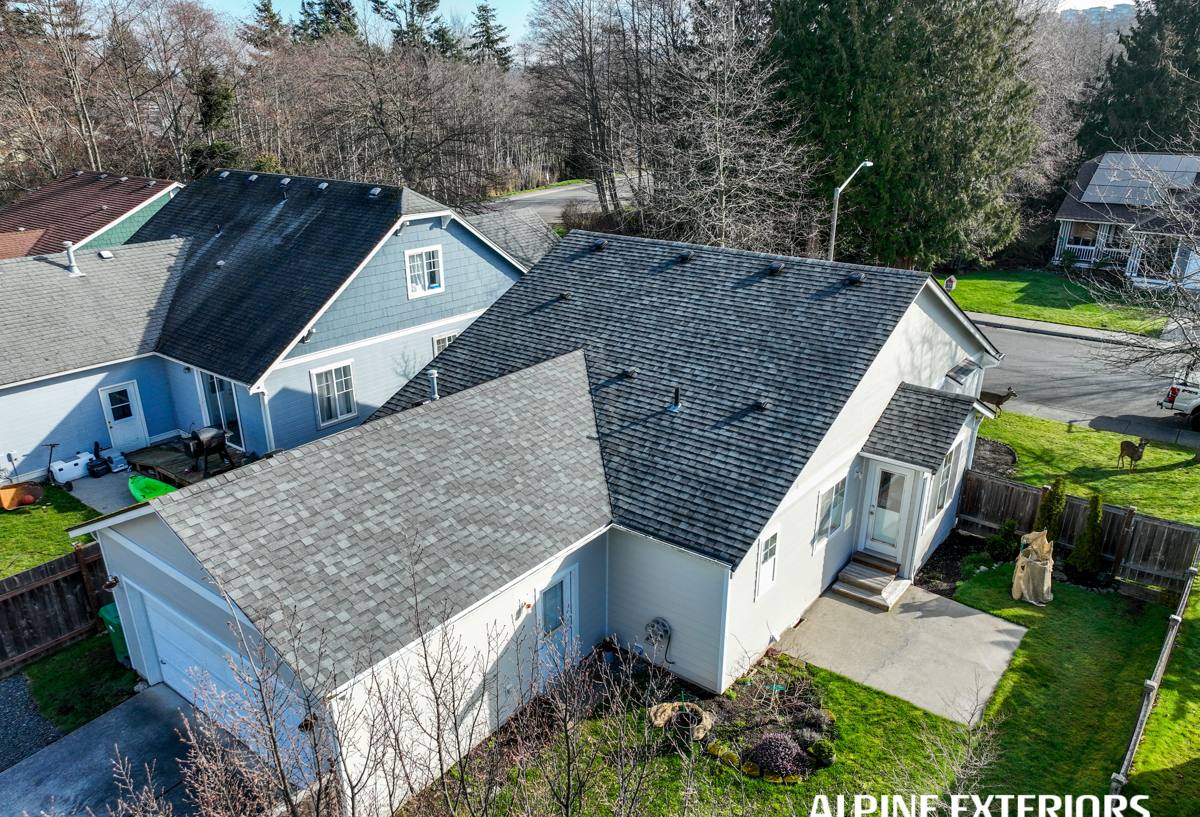
Siding doesn't operate in isolation. Roofing, windows, siding, and decking all interact at the same joints and transitions, and in a wet climate like this, that's exactly where problems start if any one of them is out of sync with the others.
Roofing
Roof-to-wall flashing details are one of the most common failure points we see on older homes in this area. If the roofing and siding weren't installed with the same water-management logic, driving rain finds its way behind the wall assembly no matter how good the siding itself is.
Windows
Window flashing and the siding cut lines around each opening are a major source of long-term leaks when they're not integrated properly. Replacing siding is a natural point to also address window flashing, especially on a home with aging original windows.
Decks
Decks in this climate take a similar beating to siding — constant damp, shaded ground-level moisture, and the same moss pressure. Ledger board connections where a deck meets the house are another place where water management has to be done right, or it becomes a hidden rot problem behind the siding.
Signs Your Current Siding Is Losing the Fight
Most siding failure in this climate is gradual, which means most homeowners catch it late. Here's what to watch for, especially heading into another wet season:
- Paint that's chalking, peeling, or bubbling, particularly on the sides of the house that get the most weather
- Soft or spongy spots when you press on the siding near the bottom courses or around windows
- Persistent moss or algae staining that comes back within weeks of cleaning
- Visible gaps, cracking, or separation at seams, corners, and trim boards
- Warping, cupping, or boards that no longer sit flat against the wall
- Rising heating bills that suggest moisture or air infiltration behind the siding
- Musty smells or visible interior staining near exterior walls
Any one of these on its own might just need a repair. Several together usually mean the siding system as a whole is past the point where patching makes sense.
What Drives Cost on a Siding Project
Every home is different, but the same handful of factors tend to move the price on a siding job in this area:
| Factor | Why It Matters |
|---|---|
| Home size and wall complexity | More corners, dormers, and cutouts mean more labor and material waste |
| Extent of existing damage | Rotted sheathing or framing found during tear-off adds repair scope |
| Siding profile and trim choice | Lap width, shingle-style accents, and trim detail affect material cost |
| Access and site conditions | Steep lots, tight setbacks, or limited staging area affect labor time |
| Scope beyond siding | Bundling window, trim, or flashing work with siding is often more efficient than separate projects |
Why a Local Crew Matters Here
Whatcom County's coastal edge has its own microclimate logic — how far a home sits from open water, how much tree cover it has, which direction it faces into prevailing wind and rain — and that logic changes flashing details, fastener choices, and where extra attention needs to go on a given wall. A crew that works this specific area regularly recognizes those patterns immediately: which elevations take the worst of the driving rain, which lots hold moss no matter what, where salt exposure is a real factor versus a minor one. That local pattern recognition is hard to replicate for an out-of-area crew doing a one-off job, and it's part of why installation quality varies so much between contractors even when they're using the same material.
Our Process
We start with an honest look at what's actually happening on the house — not just the siding surface, but the sheathing, flashing, and trim underneath it where problems usually originate. From there we walk through material and color options, explain what correct installation involves for the specific exposures on your home, and give you a straightforward scope and timeline before any work starts. We don't push add-ons that aren't needed, and we don't cut corners on flashing and water management to save a day of labor — those details are what determine whether siding actually performs for 30 years in this climate or just looks good for the first five.
If your Marietta home is starting to show any of the wear this climate causes, or you're planning ahead for a replacement, we're happy to take a look and give you a straightforward, no-pressure estimate. There's a form right below this page to get that conversation started.