 Semiahmoo
 Cemplank Is a Real Fiber Cement Product — Here's Where It Fits
Cemplank is fiber cement lap siding, panels, and trim, manufactured for the building supply channel as a lower-cost alternative to James Hardie. It's made from the same basic recipe as most fiber cement products — Portland cement, sand, and cellulose fiber, pressed and cured into planks. That base chemistry means it shares fiber cement's core strengths: it doesn't burn, it doesn't attract termites, and it holds up better than wood or vinyl against the kind of driving rain that comes off the Strait of Georgia every fall and winter.
We're not writing this page to tell homeowners in Semiahmoo that Cemplank is a bad product. It isn't. It's a legitimate fiber cement siding that plenty of contractors install with good results. Our reasoning is narrower and more specific: after comparing what Cemplank offers against what James Hardie offers, for the climate we work in here on the Semiahmoo Peninsula, we decided to standardize on one product line rather than carry two. This page explains the trade-offs that drove that call.
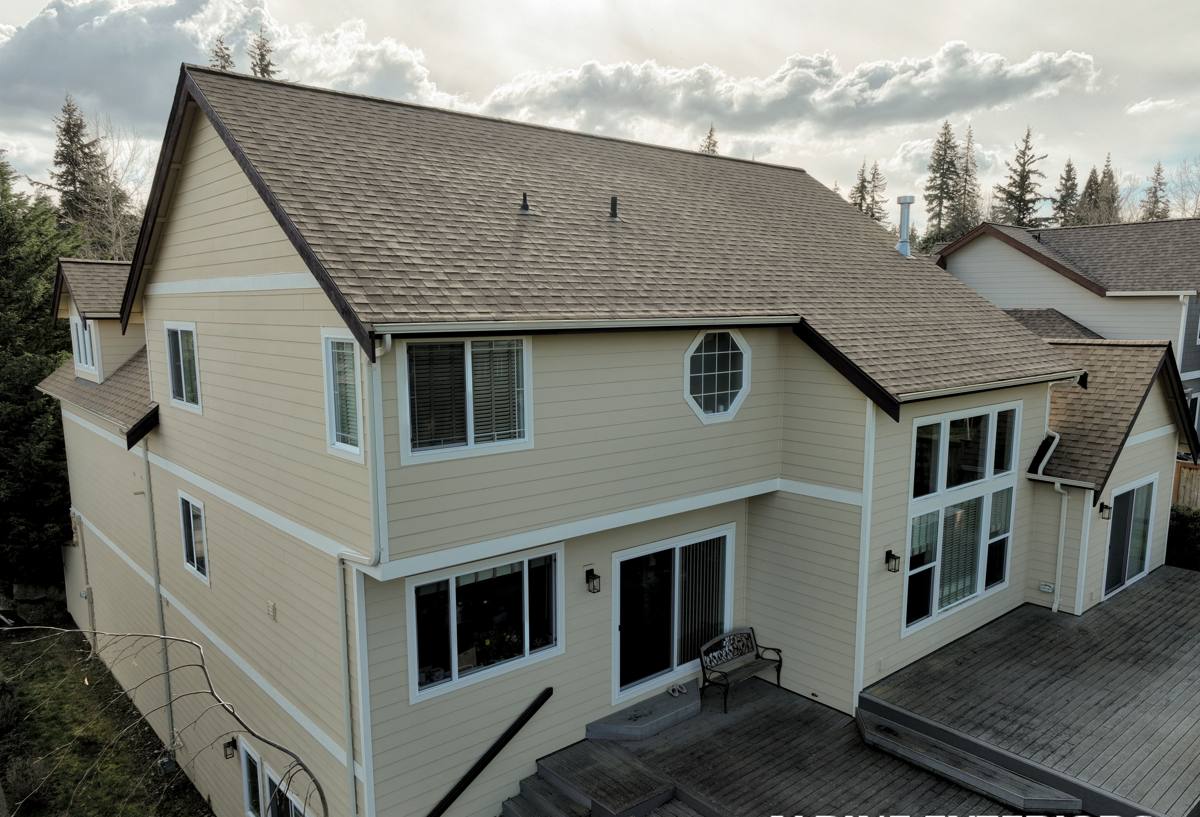
The Semiahmoo Climate Doesn't Give Siding Much Room for Error
Whatcom County's coastal exposure is a specific kind of hard on a house. Salt-laden air off Semiahmoo Bay and Drayton Harbor accelerates corrosion on fasteners and hardware. Driving rain off the water pushes water sideways into laps and seams, not just straight down. And the long, damp shoulder seasons here mean moss and algae get months of favorable growing conditions on north-facing and shaded walls every single year. None of that is unique to any one siding brand — every product sold in this market has to survive it. But it does mean that finish quality, moisture detailing, and long-term color stability matter more here than they would in a drier inland climate.
That's the lens we use when we evaluate a fiber cement product before deciding whether to put our name behind installing it.
Where the Differences Show Up
The core fiber cement formula is similar across brands, but how a manufacturer finishes the board, engineers it for a specific climate zone, and backs it with a warranty is where real differences appear. Those are exactly the areas where we found Cemplank falling short of what we wanted to offer Semiahmoo homeowners.
Factory Finish vs. Field-Applied Paint
This is the biggest practical difference for a homeowner. Cemplank is typically sold primed, not factory-finished in color. That means the color coat gets applied on site, after installation — by a painting crew, under whatever weather conditions happen to be available that week.
Field-applied paint on fiber cement has real drawbacks in a marine climate like ours:
- Paint adhesion and cure quality depend on site temperature and humidity at the time of application — conditions that are hard to control on the Peninsula for large stretches of the year.
- Color and sheen consistency depend on the painting crew, not a factory process, so board-to-board uniformity is harder to guarantee.
- A field-applied finish generally needs repainting sooner than a factory-cured finish, which means scaffolding, prep, and labor costs recur on a shorter cycle.
- Cut edges and field seams need the same careful sealing and back-priming a primed product always requires, and that step is easy for a crew in a hurry to shortchange.
James Hardie's ColorPlus finish, by contrast, is baked on in a factory under controlled conditions before the boards ever reach the jobsite. That's not a marketing distinction — it changes how the siding weathers on a house that's getting salt air and driving rain for eight or nine months of the year.
Climate Engineering: One Product vs. Zone-Specific Lines
James Hardie engineers its HZ (HardieZone) product lines for specific climate zones — a version built for humid, wet, coastal conditions like ours, and a different version for hot, dry inland climates. The formulation, moisture resistance, and freeze-thaw performance are tuned to the zone the siding is actually going on.
Cemplank does not offer that same zone-specific engineering. It's a general-purpose fiber cement product sold the same way in Whatcom County as it is in Arizona. For a lot of climates that's not a meaningful gap. For a peninsula getting salt spray, sustained damp, and heavy moss growth, we'd rather install a product that was specifically formulated for exactly those conditions.
Warranty Structure
Warranty terms matter more on siding than on almost any other exterior product, because siding failures are often slow — a coating that dulls a few years early, a plank that takes on moisture at a poorly sealed cut edge — and by the time they're visible, you want to know exactly what's covered and for how long.
| Factor | What to Ask About | Why It Matters Here |
|---|---|---|
| Coverage length | Non-prorated years on the substrate vs. the finish | Marine air shortens the useful life of a weak finish faster than it does the fiber cement itself |
| Finish warranty | Is it a factory finish warranty or does it rely on a separate paint manufacturer's warranty | Field-applied paint puts two different warranties in play instead of one integrated one |
| Transferability | Does coverage transfer to a new owner, and how | Affects resale value on Semiahmoo homes, where buyers ask about exterior condition |
| Labor coverage | Materials only, or materials plus reinstallation labor | Labor is usually the larger cost if a claim ever needs to be made |
James Hardie's warranty structure, including the factory ColorPlus finish warranty, is one of the more thorough in the fiber cement category. That gives us — and the homeowner — a clearer, simpler answer if a problem ever comes up years down the road.
Installer Network and Product Support
James Hardie runs a certified installer program with training on flashing, fastening, clearances, and joint treatment specific to their product. That doesn't mean every Hardie installer does the job right, but it does mean there's a manufacturer-backed training standard and a support line to call when a detail question comes up mid-project.
Cemplank doesn't have an equivalent nationwide certified-installer network. Installation quality ends up depending almost entirely on the individual contractor's own standards, with less manufacturer backing if something goes sideways. For a product where correct flashing and sealing are the difference between fifty years of service and a moisture problem in year eight, we'd rather work inside a system with that extra layer of accountability.
Availability for Repairs and Matching
Fiber cement siding sometimes needs a plank replaced — storm damage, an accidental impact, a utility line trenched through a wall. When that happens years after the original install, you need to be able to source a matching plank in the same profile, color, and finish.
James Hardie's national distribution and long production runs make that kind of match realistic even a decade after installation. Cemplank's distribution is narrower and more regional, which raises the odds that an exact match becomes difficult to find later, especially for a specific color or discontinued profile. That's a maintenance consideration most homeowners never think about at the time of installation, but it matters when the repair call actually comes.
What We Install Instead, and Why
We standardized on James Hardie fiber cement for every siding job we take on in Semiahmoo and across Whatcom County. The reasons line up directly with the trade-offs above:
- Non-combustible fiber cement core, same as the broader fiber cement category
- ColorPlus factory finish cured under controlled conditions, not weather-dependent field painting
- HZ5 climate-engineered formulation built for wet, humid, coastal exposure like ours
- A stronger, more integrated warranty covering both substrate and factory finish
- A certified installer training standard we hold our own crews to
- Long-term product availability for future repairs and color matching
Standardizing on one product also means our crews aren't relearning flashing details, fastener schedules, and clearance requirements for a second or third fiber cement brand — they install Hardie correctly because that's the only system they install.
How to Evaluate Any Fiber Cement Bid, Not Just Ours
If you're collecting quotes and one includes Cemplank or another budget fiber cement brand, that's not automatically a red flag — it can be a legitimate, lower-cost option depending on your priorities. Ask these questions of any bid before deciding:
- Is the siding factory-finished or does it need to be painted on site, and who's warrantying that finish?
- Is the product engineered for this specific climate zone, or is it a general-purpose formulation?
- What does the manufacturer's warranty actually cover — materials, finish, labor, all three?
- Is the installer certified or trained by the manufacturer on that specific product's details?
- How available will matching material be five, ten, twenty years from now if a repair is needed?
Those five questions will tell you more about the real long-term cost of a siding job than the per-square-foot bid number will.
If you're weighing siding options for a home in Semiahmoo or anywhere in Whatcom County, we're happy to walk your house, talk through what we'd install and why, and put together a free, no-pressure estimate.