 Semiahmoo
 Deck Replacement Built for Wiser Lake's Weather
Wiser Lake sits inland enough from the water that people sometimes assume it's spared the worst of what Whatcom County throws at outdoor structures. It isn't. The lake itself keeps humidity high year-round, the surrounding tree cover means shade and moss on north- and east-facing decks almost year-round, and the same driving rain and salt-tinged air that batters the coastline around Semiahmoo still reaches inland on a west wind. A deck that looks fine from the yard can be quietly failing underneath — soft joists, rusted fasteners, ledger boards holding moisture against the house. Replacement, done right, means rebuilding the whole system, not just swapping out worn boards.
We work Wiser Lake regularly, which matters more than it sounds. A crew that's replaced decks up and down this part of the county knows which lots drain poorly, which tree lines keep a deck wet three extra hours a day, and which older homes were built with ledger connections that don't meet current code. That local pattern recognition changes how we spec a job before we ever cut a board.
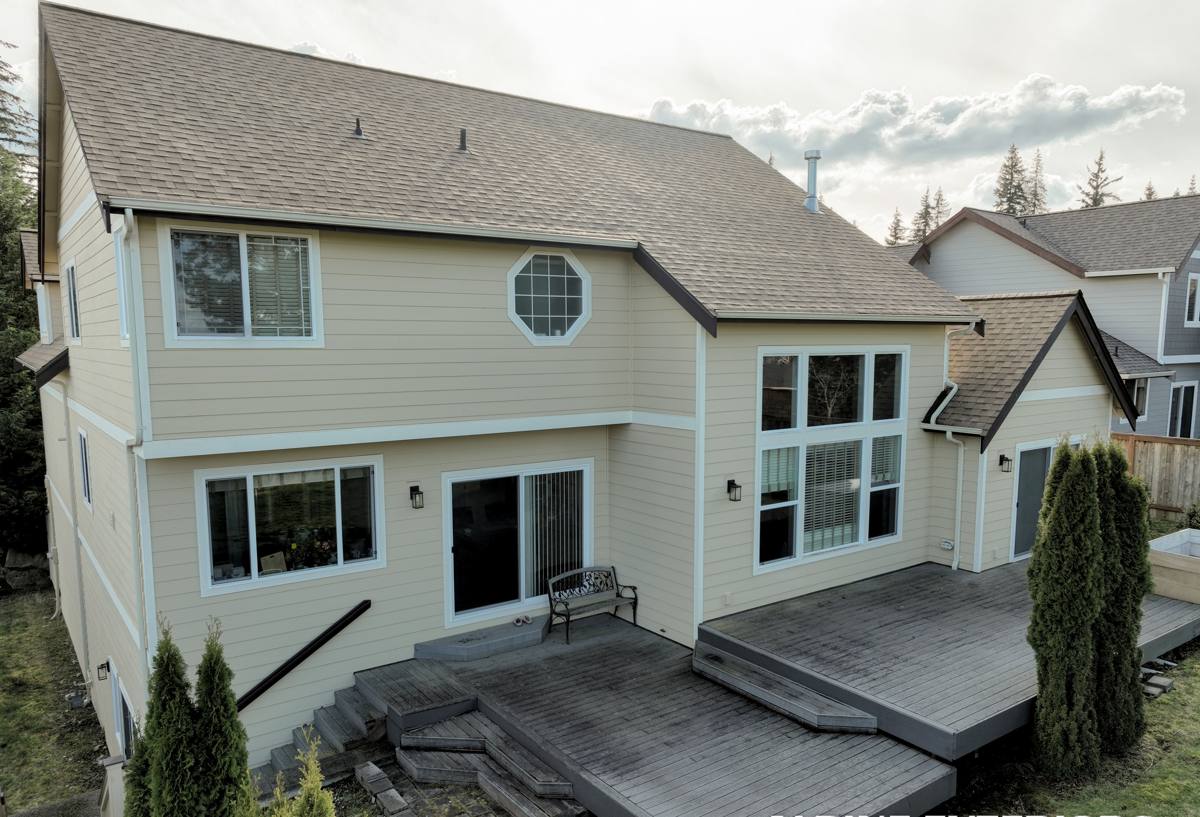
What Wiser Lake's Climate Does to a Deck
Moss and Constant Moisture
Whatcom County's moss season runs long — often eight or nine months out of the year on shaded surfaces. On a deck, moss isn't just cosmetic. It holds water against wood and composite decking alike, and on wood it accelerates rot in the boards and in the framing underneath if drainage gaps have closed up over time. A deck near the lake with heavy tree cover will grow moss faster than the same deck in an open, sunny yard a mile away.
Driving Rain and Wind-Driven Water
Rain here rarely falls straight down. Wind pushes it sideways into ledger connections, under railing posts, and into any gap where flashing was skipped or installed wrong the first time. Most of the rot we find on a deck replacement isn't in the decking boards people can see — it's at the ledger board where the deck meets the house, and around post bases that sit in standing water after every storm.
Salt Air Reaching Inland
Semiahmoo and the surrounding shoreline deal with salt air directly, and prevailing winds carry a measurable amount of that salt inland toward Wiser Lake. Salt speeds up corrosion on any exposed metal — screws, joist hangers, bolts, railing hardware. A fastener rated for a dry inland climate somewhere else in the state won't hold up the same way out here.
Signs a Deck Needs Replacement, Not Repair
- Soft or spongy spots when you walk across the decking, especially near the house or stair landing
- Visible gaps or dark staining where the deck ledger meets the siding
- Railing posts that wiggle at the base, even slightly
- Rust streaks running down from screws, bolts, or joist hangers
- Persistent moss or algae that comes back within weeks of cleaning
- Boards that have crowned, cupped, or split along the grain
- A musty smell coming from underneath the deck
- Fasteners backing out or spinning freely in their holes
One or two of these on their own might mean a repair. Several together, especially anything involving the ledger board or the framing, usually means the structure has reached the point where replacement is the honest recommendation.
What a Correct Deck Replacement Actually Involves
Full Structural Assessment First
Before any demo, we check the ledger connection, the post footings, and the framing for rot and undersized members. Wiser Lake's soil holds moisture longer than sandier ground closer to the shoreline, so footings here need to be evaluated for settling and frost movement, not just visual rot.
Proper Ledger Flashing
The ledger board is where the deck attaches to the house, and it's the single most common failure point we see in this area. A correct replacement uses continuous flashing that directs water away from the house framing, not just caulk over the old connection. This is also where a lot of shortcut repairs fail — caulk breaks down, flashing doesn't.
Fastener and Hardware Selection
Given the salt exposure and constant moisture, we use corrosion-resistant hardware rated for coastal and wet-climate use throughout — hangers, screws, and structural connectors alike. Mixing metals or using a lower-grade fastener to save a few dollars is exactly the kind of shortcut that shows up as rust streaks in two or three years.
Decking Material That Matches the Site
Wood decking is still a solid, honest choice for many homeowners, and it's more affordable up front, but it needs regular maintenance — cleaning, sealing, and moss treatment — to hold up under this much shade and moisture. Composite decking costs more initially and needs far less upkeep, but it still needs proper ventilation underneath and correct spacing, since trapped moisture under composite boards can damage the framing even if the boards themselves don't rot. We'll walk through both honestly based on how much sun and shade your specific lot gets.
Drainage and Airflow Underneath
A deck built tight to the ground, or over a slope that holds water, will always struggle in this climate. Part of a correct replacement is making sure water actually has somewhere to go and air can move underneath to dry things out between storms.
Wood vs. Composite for a Wiser Lake Property
| Factor | Wood Decking | Composite Decking |
|---|---|---|
| Upfront cost | Lower | Higher |
| Maintenance in this climate | Annual cleaning and sealing needed to fight moss and moisture | Occasional washing; no sealing required |
| Moss resistance | Lower — porous surface holds moisture | Higher, though still needs airflow underneath |
| Salt air / corrosion impact | Affects fasteners more than the wood itself | Affects fasteners; boards themselves are largely unaffected |
| Typical lifespan with proper care | 15–20 years | 25–30 years |
| Repair simplicity | Easier to replace individual boards | Board matching can be harder over time |
Neither option removes the need for good framing, flashing, and drainage underneath — the material on top is only part of what determines how long a deck lasts out here.
Our Process for a Wiser Lake Deck Replacement
- On-site assessment: We inspect the existing deck, ledger connection, footings, and framing, and take note of sun exposure, tree cover, and drainage on your specific lot.
- Honest scope and estimate: We tell you plainly whether repair is realistic or if replacement is the better long-term value, and walk through material options based on your budget and how much upkeep you want to take on.
- Permitting: Deck replacements of most sizes require a permit through the county; we handle that process so you don't have to chase it down yourself.
- Demolition and disposal: Old decking, framing, and hardware are removed and hauled off site.
- Structural rebuild: Ledger flashing, footings, framing, and hardware are installed or replaced to current code and to standards suited for this climate, not just the minimum.
- Decking and railing installation: Boards and railing are installed with proper spacing for drainage and airflow.
- Final walkthrough: We go over the finished deck with you, including what maintenance it does and doesn't need going forward.
Why a Local Crew Matters for This Job
A deck replacement crew unfamiliar with Whatcom County conditions can build something that looks correct and still underperforms here — wrong fastener grade, decking that doesn't account for the shade pattern, drainage that works fine on paper but not on a lot that holds water like Wiser Lake's does. We've built and replaced decks throughout this area long enough to know the difference between a spec that works in a drier part of the state and one that actually holds up next to the lake, under tree cover, with salt air drifting in off the water. That's not marketing — it's just the practical result of doing this work locally, on lots with these exact conditions, over and over.
It also means we're a short drive away if something needs a look after a big storm, and we're not disappearing once the invoice is paid.
What to Expect Cost-Wise
Deck replacement costs vary a lot based on size, material choice, height off the ground, and how much of the existing structure needs to be rebuilt versus reused. Wood decking replacements tend to run less upfront than composite, but the gap narrows over the life of the deck once you factor in maintenance. Rather than throw out a number that doesn't reflect your actual deck, we'll give you a firm, itemized estimate after seeing the site in person.
Factors That Move the Price
- Total square footage and deck height (elevated decks need more structural work)
- Whether footings and framing are reused or fully replaced
- Wood versus composite decking material
- Railing style and material
- Stair configuration
- Extent of existing rot or ledger damage discovered once demo starts
If your deck near Wiser Lake is showing soft spots, rust, or moss that won't quit, it's worth having a local crew take a real look before you decide between repair and replacement. Reach out for a free, no-pressure estimate — we'll give you a straight answer about what your deck actually needs.