 Semiahmoo
 Why Birch Bay Roofs Take a Different Kind of Beating
A roof in Birch Bay works harder than a roof twenty miles inland. Sitting on the water off Semiahmoo Bay and Boundary Bay puts homes here in a near-constant mix of salt-laden air, wind-driven rain, and shade from mature Douglas fir and cedar that keeps roof surfaces damp long after a storm has passed. None of these on their own would wreck a roof quickly. Together, over years, they wear down flashing, fasteners, and shingles in ways an inland Whatcom County home just doesn't experience at the same rate.
Salt Air and Metal Fatigue
Salt air accelerates corrosion on anything metal — nails, flashing, vent boots, gutter fasteners. A fastener that would hold for decades in a dry inland climate can start weeping rust streaks and losing grip years earlier this close to the water. Once a fastener backs out or a piece of flashing corrodes through, water has a direct path into the roof deck, and the damage often shows up as a ceiling stain well before anyone notices the actual failure point on the roof itself.
Moss: Slow but Serious
Whatcom County's wet, mild winters give moss a long growing season, and Birch Bay's tree cover and coastal humidity make it worse than most. Moss isn't just cosmetic. It holds moisture against the roofing material, works its way under shingle tabs and shakes, and physically lifts edges as it grows — creating openings for wind-driven rain that a dry roof surface wouldn't have. Left unaddressed for a few seasons, moss growth turns a simple repair into a much bigger one.
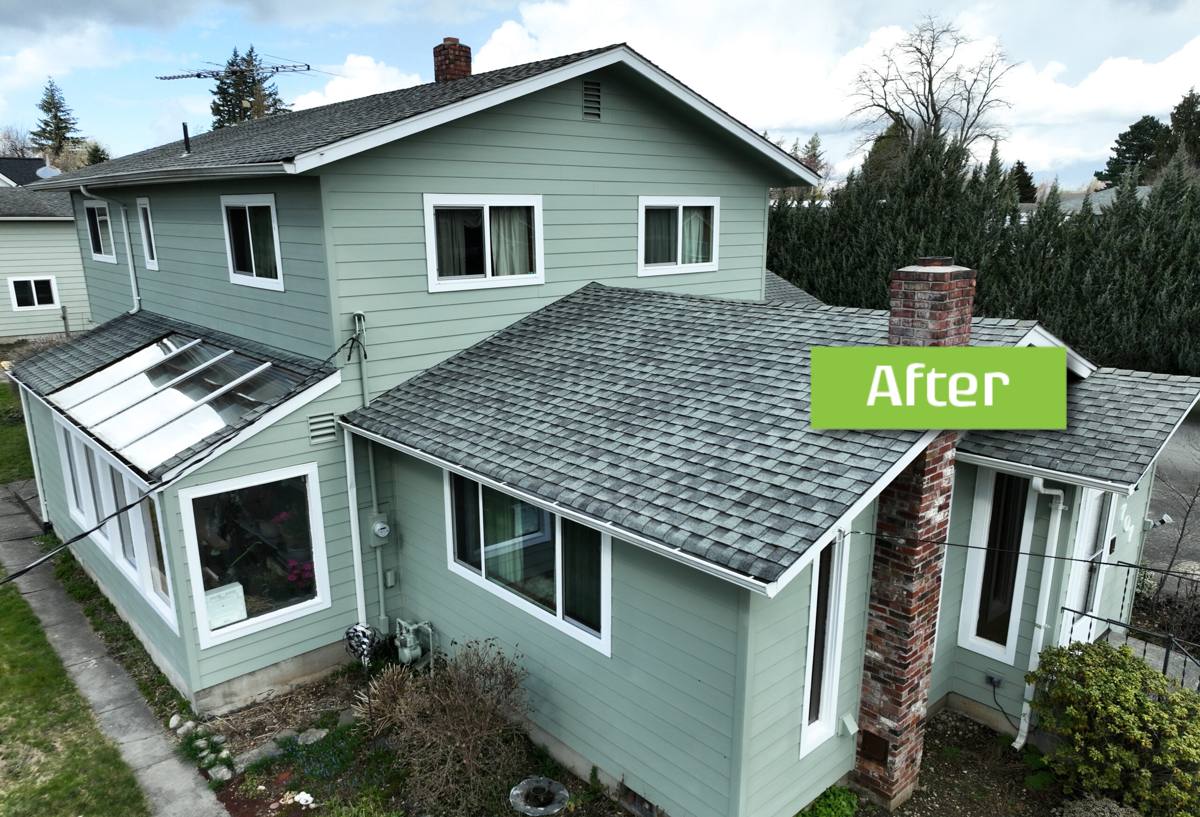
Signs Your Birch Bay Roof Needs Repair (Not Replacement)
Most roofs don't fail all at once — they fail in specific, localized spots first. Catching those spots early is the difference between a repair bill and a full replacement bill. Walk your property periodically and watch for:
- Granules collecting in gutters or at downspout outlets — a sign shingles are wearing thin
- Curling, cracked, or missing shingle tabs, especially on the side of the roof facing prevailing wind and rain
- Dark streaking or thick moss mats, particularly on north-facing or heavily shaded slopes
- Rust stains or visible corrosion around vent pipes, chimney flashing, or valley metal
- Soft or spongy spots when walked (only assessed by a professional — never test this yourself)
- Ceiling stains, especially ones that appear or worsen after a wind-driven rain event
- Daylight visible through the roof deck from inside an attic or crawlspace
- Gutters pulling away from the fascia, which is often a sign of trapped moisture behind them
Any one of these on its own is usually a repair, not a replacement. The trouble comes from ignoring several of them at once for multiple seasons.
What a Proper Roof Repair Actually Involves
Diagnosing the Real Problem, Not Just the Symptom
A ceiling stain in one room doesn't always mean the leak is directly above it — water travels along rafters, sheathing, and underlayment before it shows up inside. A repair that only patches the visible spot without tracing the water's actual path tends to come back within a season or two, usually worse. Correct diagnosis means getting on the roof, checking the deck for soft or delaminated sheathing, and inspecting flashing, valleys, and penetrations before deciding on a repair plan.
Matching Materials and Getting Flashing Right
The weak points on almost every roof are the transitions — where the roof meets a chimney, a wall, a skylight, or a valley. These are handled with flashing, not shingles, and flashing that's improperly lapped, under-sized, or sealed with caulk instead of properly integrated metal is one of the most common causes of repeat leaks we see on coastal Whatcom County homes. A correct repair reintegrates flashing with the surrounding roofing material in the right shingle order — not just sealant smeared over a gap.
Repair vs. Replacement: How We Help You Decide
Not every roof problem calls for a full tear-off, and not every roof is a good candidate for another round of patching. We look at the roof as a whole before recommending either option.
| Factor | Favors Repair | Favors Replacement |
|---|---|---|
| Age of roofing material | Well within its expected service life | At or past the age where most roofs of that type start failing broadly |
| Extent of damage | Isolated to one section, penetration, or slope | Spread across multiple slopes or recurring in different spots |
| Deck condition | Solid, dry sheathing under the damaged area | Soft, delaminated, or water-stained decking found during inspection |
| Moss and organic growth | Surface growth only, roofing material intact underneath | Growth has lifted shingles or shakes and damaged the material itself |
| Number of prior repairs | First or second repair in this area | Same spot repaired repeatedly without resolving the root cause |
We'll walk you through where your roof falls on each of these before recommending a scope of work — and we'll tell you honestly if a smaller repair is the right call, even if a bigger job would be more profitable for us.
Our Roof Repair Process
- Inspection. We get on the roof (weather permitting) and check the deck, flashing, penetrations, and surrounding shingles or shakes — not just the spot you called about.
- Written scope and estimate. You get a clear explanation of what's actually wrong, what we plan to do about it, and an honest price before any work starts.
- Repair. We remove and replace damaged material, correct flashing where needed, and address any deck issues found underneath — not just cover them.
- Moss and debris treatment. Where moss or heavy debris contributed to the problem, we clear it and discuss options for slowing regrowth.
- Final check. We confirm the repair is watertight and that surrounding shingles and flashing are properly integrated, not just patched around.
Materials We Use — and Why We're Selective
Most Birch Bay homes are roofed in asphalt composition shingle, cedar shake, or metal, and each has a different tolerance for salt air and sustained moisture. For repairs, our standard is to match the existing material as closely as possible in type, profile, and where feasible, color — a mismatched patch is not just a cosmetic problem, it can behave differently in wind and rain than the surrounding roof.
Where a homeowner asks about switching materials during a repair — say, patching a cedar shake roof with composition shingle — we'll walk through the trade-offs honestly: how the two materials age differently, how they handle moss and moisture differently, and what that means for maintenance down the road. We'd rather explain the real trade-offs up front than sell a mismatched fix that causes problems later.
Why Hire a Crew That Already Works in Birch Bay
A roofer who mostly works inland can still do competent work, but they're guessing at things a Birch Bay-based crew already knows from repeated experience: which slopes on coastal homes take the worst of the wind-driven rain, how fast moss actually comes back on shaded, humid lots here versus a drier inland yard, and which flashing details tend to fail first on homes exposed to salt air off the bay. That local pattern recognition shortens the diagnosis and reduces the odds of a repair that looks right but fails again in the next big windstorm.
It also means a shorter response time when something urgent comes up — a storm-loosened shingle or a flashing failure during a heavy rain event doesn't wait for a good time, and a crew already working in the area can typically get to it faster than one driving in from farther away.
Maintenance That Extends the Life of a Repair
A repair holds longer when it's not fighting the same conditions that caused the original damage. A few habits make a real difference on Birch Bay roofs specifically:
- Clear gutters and downspouts at least twice a year — clogged gutters back water up under the roof edge
- Trim back tree limbs that shade roof sections and keep them damp longer than the rest of the roof
- Address moss while it's still a light surface growth, before it lifts shingles or shakes
- Have flashing and penetrations checked after any major windstorm, even if nothing looks obviously wrong from the ground
- Don't ignore small granule loss or minor curling — these are cheaper to address early than after another wet season
If you're seeing any of the warning signs above, or it's simply been a while since your roof was looked at, we're happy to come take a look. Reach out for a free, no-pressure estimate using the form below — we'll tell you honestly what we find and what it would take to fix it.