 Semiahmoo
 Birch Bay's Coastal Climate Puts Extra Wear on Roofs
A roof in Birch Bay works harder than a roof twenty miles inland. Sitting right on the water at the top of Whatcom County, homes here take on salt-laden air, wind-driven rain off the Strait of Georgia, and a moss season that can run most of the year. None of that is dramatic on its own, but stacked together over a decade or two, it shortens the life of a roofing system that was never built with this exposure in mind.
Salt Air and Metal Fasteners
Airborne salt accelerates corrosion on exposed metal — nails, flashing, vent boots, and fastener heads. Standard-grade fasteners and thin flashing can start rusting years before their inland counterparts, and once a fastener corrodes, it loses its grip and the shingle or panel around it starts to work loose. This is one of the most common causes of premature leaks we see on Birch Bay roofs, and it's largely invisible from the ground until water starts showing up inside.
Driving Rain and Wind-Driven Wet
Birch Bay gets exposed to weather systems moving in off the water, and rain here doesn't always fall straight down — it comes in sideways under eaves, around chimneys, and into any flashing detail that isn't sealed correctly. A roof that would perform fine in a sheltered location can leak here if the underlayment, flashing laps, and ventilation weren't installed with that wind-driven exposure in mind.
A Long Moss Season
Whatcom County's mild, wet climate means moss and algae have a long growing window — often close to year-round on north-facing slopes and shaded sections of roof. Moss holds moisture against the roofing material, lifts shingle edges as it grows, and shortens the effective life of the roof even when the shingles themselves are structurally fine. Left unmanaged, it's one of the biggest drivers of early roof failure we see in this area.
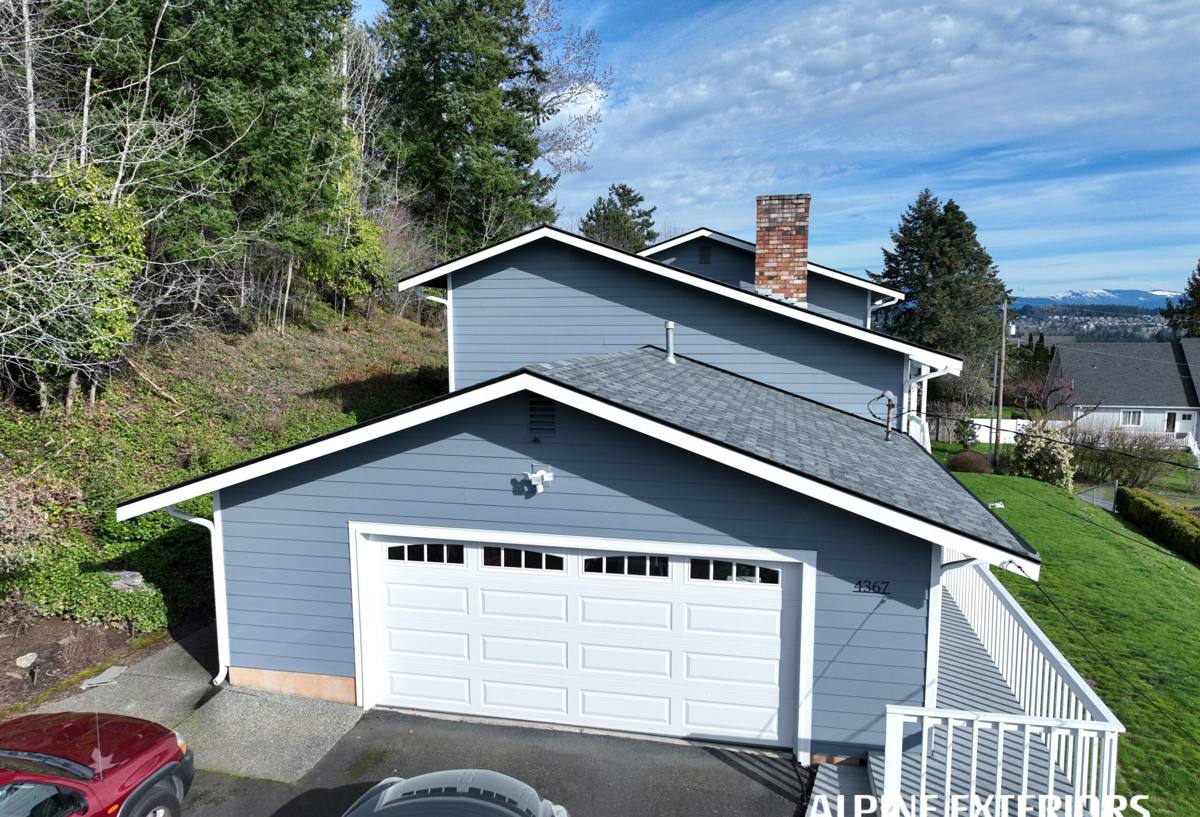
Signs It's Time for a Roof Replacement, Not Another Repair
Not every roof problem calls for a full replacement — plenty of issues are legitimately fixable with a targeted repair. But there's a point where patching stops making financial sense and starts throwing good money after bad. Here's what tells us a Birch Bay roof has crossed that line:
- Granule loss heavy enough that you're finding grit in gutters and downspouts every season
- Shingles that are cupping, curling, or cracking across large sections rather than one isolated area
- Soft spots or sagging in the roof deck when walked, which usually means water has reached the sheathing
- Repeated leaks in different spots after previous repairs — a sign the underlayment has failed broadly, not just locally
- Heavy, established moss or algae growth that keeps coming back after cleaning
- Flashing around chimneys, skylights, and valleys that's visibly corroded, lifted, or improperly sealed
- The roof is at or past the manufacturer's expected service life for this climate, even if it "looks okay" from the driveway
If you're seeing two or more of these, it's worth having a full roof inspected rather than chasing individual leaks one at a time.
What a Correct Roof Replacement Actually Involves
A roof replacement is more than swapping old shingles for new ones. The parts you don't see — deck condition, underlayment, flashing, and ventilation — determine whether the new roof actually holds up to Birch Bay's weather or fails early the same way the last one did.
Tear-Off and Deck Inspection
We remove the existing roofing down to the deck rather than layering new material over old — layering traps moisture and hides deck damage that needs to be addressed. Once it's stripped, we inspect the sheathing for soft spots, delamination, or rot, most commonly found near valleys, chimneys, and eaves where water has been getting in. Any compromised decking gets replaced before anything new goes down; installing new roofing over a weak deck just resets the clock on the same failure.
Underlayment and Ice/Water Protection
Given how much wind-driven rain Birch Bay sees, underlayment choice matters more here than in drier inland areas. We use synthetic underlayment for its tear resistance and water-shedding performance, with self-adhering ice-and-water membrane at vulnerable points — eaves, valleys, and around roof penetrations — where wind-driven rain and ice damming are most likely to force water backward under the shingles.
Flashing Details
Flashing failures are the single most common source of roof leaks, and they're almost always an installation problem, not a material one. Chimneys, skylights, sidewalls, and valleys all need step flashing, counter-flashing, or valley metal installed and lapped correctly so water is directed out and away rather than channeled toward a seam. Given the corrosion pressure from salt air, we use corrosion-resistant flashing and fasteners rated for coastal exposure rather than standard-grade hardware.
Ventilation
A roof needs balanced intake and exhaust ventilation to let moisture escape the attic space. Without it, humid air condenses against the underside of the deck, which rots sheathing from the inside and feeds the same moss and algae growth we're trying to prevent on the outside. Ventilation is easy to overlook because it doesn't show up as a visible defect right away — it shows up years later as deck rot or premature shingle failure.
Choosing a Roofing Material for Birch Bay Conditions
There's no single "best" roofing material — the right choice depends on your home's exposure, your budget, and how much long-term maintenance you're willing to do. Here's how the common options compare for a coastal Whatcom County home:
| Material | Salt Air / Coastal Durability | Moss & Algae Resistance | Typical Lifespan | Maintenance |
|---|---|---|---|---|
| Architectural asphalt shingle | Good, with corrosion-resistant fasteners and flashing | Moderate — improved with algae-resistant granules | 25–30 years | Periodic moss removal recommended |
| Standing seam metal | Very good when properly coated and detailed | Very good — smooth surface resists moss attachment | 40–50+ years | Low; occasional fastener/seam check |
| Synthetic/composite shingle | Good | Good, varies by product line | 30–50 years | Low to moderate |
Standing seam metal tends to perform best against moss because there's no rough shingle surface for spores to take hold on, but it comes at a higher upfront cost. Architectural asphalt with algae-resistant granules remains a solid, budget-conscious choice as long as fasteners and flashing are upgraded for coastal exposure. We'll walk through the trade-offs for your specific roof, orientation, and budget rather than push one product across the board.
Moss, Algae, and Long-Term Roof Care
Even the best-installed roof will grow moss in Whatcom County if it's shaded and exposed to enough moisture. The goal isn't to eliminate that risk entirely — it's to install a system that resists it well and to keep up with the light maintenance that keeps moss from taking hold. That means keeping gutters and valleys clear so water and debris don't sit against the shingles, having moss physically removed (not just power-washed, which can damage granules) rather than left to spread, and considering zinc or copper strips near the ridge on north-facing slopes, which release trace metals that discourage regrowth as rain washes over them.
Our Roof Replacement Process
Every roof is different, but the sequence we follow on Birch Bay homes stays consistent:
- On-site inspection and estimate — we look at the current roof, attic ventilation, and any signs of deck damage before quoting anything.
- Material selection — we go over the trade-offs in the table above based on your home's exposure and budget.
- Scheduling around weather — we plan the tear-off and dry-in around forecasted dry windows to minimize the time your deck is exposed.
- Tear-off and deck repair — old roofing comes off, the deck is inspected, and any damaged sheathing is replaced.
- Underlayment, flashing, and ventilation install — the details covered above, done to the specs your roof actually needs, not a generic minimum.
- New roofing installation — installed to manufacturer specification so your warranty stays intact.
- Cleanup and final walkthrough — site cleared of debris and nails, and we walk the finished roof with you.
Why Hiring a Crew That Already Works Birch Bay Matters
A roofing crew that mostly works inland doesn't always think to upgrade fasteners for salt exposure, plan flashing details for wind-driven rain, or budget extra ventilation for a moss-prone shaded slope — because they don't need to on most of their jobs. Working Birch Bay and the surrounding Whatcom County coastline regularly means those decisions are standard practice, not an afterthought. It also means we're familiar with the local permitting process and the practical realities of scheduling around this area's weather patterns, so your project moves without surprises.
Ready to Talk About Your Roof?
If your roof is showing its age, or you just want an honest read on how much life it has left, we're happy to take a look. Use the form below to request a free, no-pressure estimate — we'll inspect the roof, explain what we find in plain terms, and give you options that fit your home and your budget.