 Semiahmoo
 Why Custer Siding Takes More Punishment Than People Expect
Custer sits in that stretch of Whatcom County where Pacific weather systems come ashore and stall against the foothills, which means homes here see a lot of sideways rain, long stretches of gray damp weather, and air that carries a faint but constant salt load off Semiahmoo Bay and the Strait of Georgia. None of that is dramatic on its own. The problem is what it adds up to over years: siding that's almost never fully dry, fasteners and trim that corrode faster than they would inland, and north- and west-facing walls that grow moss almost as a matter of course.
Most siding materials can handle a bad storm. What they struggle with is the combination Custer actually delivers — driving rain that gets pushed under laps and around trim, followed by weeks of humid, low-sun conditions that never let anything dry out completely. That's the environment that turns a small gap in caulking into a soft spot behind the wall, and it's why siding repair out here needs to be diagnosed differently than a repair call in a drier part of the state.
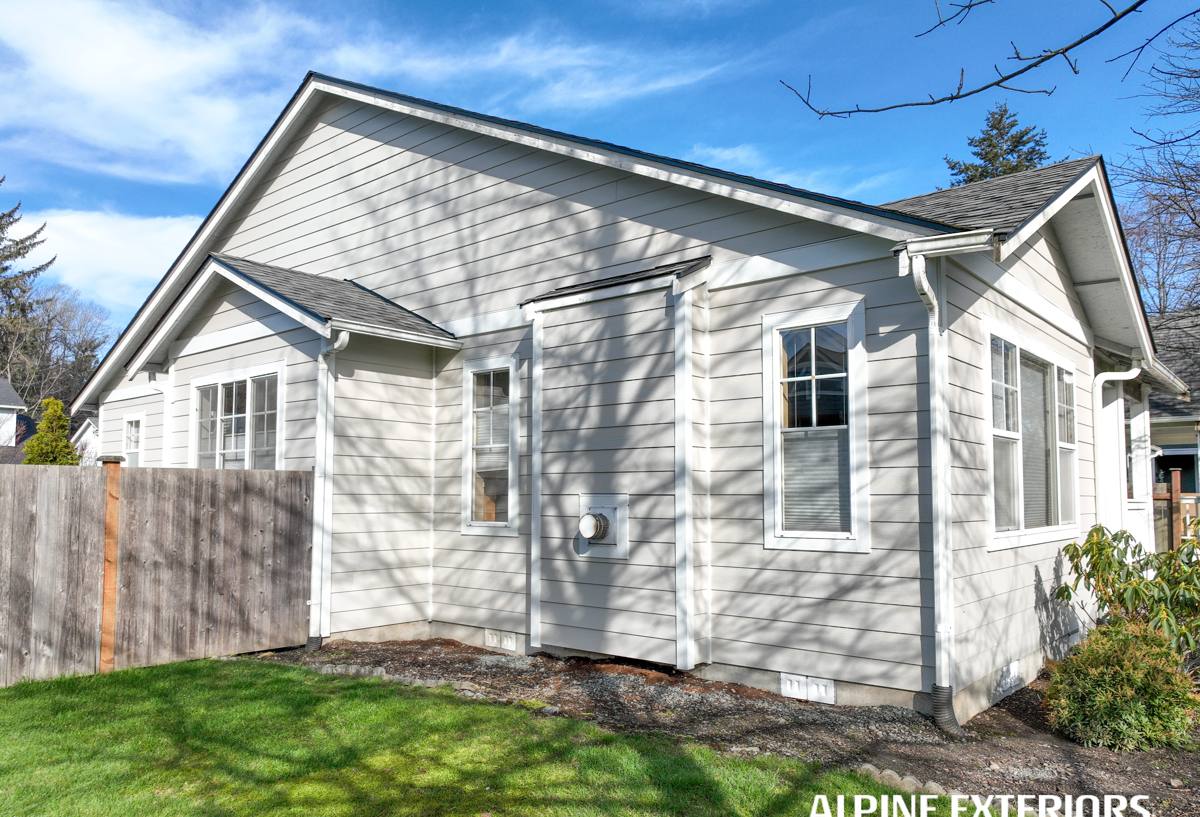
Common Siding Damage We See in Custer Homes
The specific problems we get called out for in this area tend to repeat themselves:
- Moss and algae staining on shaded and north-facing walls, especially under overhangs and tree cover, which holds moisture against the surface longer than open, sun-exposed walls.
- Failed caulking and sealant joints around windows, doors, and trim — UV breakdown plus constant damp cycling shortens the life of sealant here compared to drier climates.
- Corroded or popped fasteners, particularly on older installations where standard nails or screws were used instead of corrosion-resistant fasteners rated for coastal-influenced air.
- Soft or delaminating panels on wood-based or engineered wood siding where water has been getting behind the surface for longer than anyone noticed.
- Cracked or warped boards from repeated wet-dry cycling, especially on lower-quality or improperly primed materials that were never designed for this level of sustained moisture exposure.
None of these show up overnight. They're the result of small failures — a gap, a missed flashing detail, a fastener that shouldn't have been used — being worked on continuously by Custer's weather for a few seasons.
Signs Your Siding Needs Repair, Not Just a Paint Job
A fresh coat of paint or a pressure wash can make tired siding look better for a season, but it doesn't fix what's underneath. Homeowners in Custer should watch for signs that point to an actual repair need:
- Soft or spongy spots when you press on the siding, especially near the bottom of walls or below windows
- Visible gaps, cracks, or separation at seams, corners, or trim joints
- Persistent moss or dark streaking that comes back within weeks of cleaning
- Bubbling, peeling paint that keeps recurring in the same spots
- Rust streaks running down from fastener heads or metal trim
- Musty smell or visible staining on interior walls that share an exterior wall with damaged siding
- Warped, bowed, or buckled panels, especially on lower stories or near ground contact
Any one of these on its own might be minor. Two or three together, especially on the same wall, usually means water has already found a way behind the siding and the repair needs to address the cause, not just the visible symptom.
What a Correct Siding Repair Actually Involves
A repair that just replaces the damaged board and re-caulks the edge often looks fine for a year or two and then fails again in the same spot. That's because the board wasn't usually the actual problem — it was where the water finally showed itself. A repair done right in a climate like Custer's has a few non-negotiable steps:
Find the water's actual path
Before anything gets removed, we trace how moisture is getting in. That might be a missing kick-out flashing above a roofline, a window that was never properly flashed, a caulking joint that's failed, or siding that was installed without the right gap at grade. Replacing the board without fixing the entry point just resets the clock on the same failure.
Check what's behind the siding
Once panels come off, we look at the house wrap, sheathing, and framing underneath. If there's rot in the sheathing or framing, that gets addressed before any new siding goes back on — patching over compromised structure is how small repairs turn into much bigger ones a few years later.
Match the material correctly
New siding needs to match the existing product's profile, exposure, and thickness closely enough that it doesn't create a visible patchwork or, worse, a new place for water to collect at the transition. This is one of the reasons material choice matters even for repair work, not just full re-sides.
Use fasteners and flashing built for this environment
Given the salt-air exposure in this part of Whatcom County, we use corrosion-resistant fasteners and properly lapped flashing details rather than whatever was originally on the house if the original spec was under-built for the conditions.
Our Siding Repair Process for Custer Homeowners
We keep the process straightforward because homeowners don't need jargon, they need to know what's wrong and what it'll take to fix it properly.
- On-site inspection. We walk the exterior, check the areas you're concerned about, and look at adjacent walls and trim that often show early signs of the same problem before it becomes obvious.
- Moisture testing where warranted. If there's any question about how far water intrusion has spread, we probe or use a moisture meter rather than guess from the surface.
- Honest scope and options. We tell you plainly whether this is a spot repair, a section replacement, or something that's pointing toward a larger issue — and why.
- Repair with matched, climate-appropriate materials. We don't mix incompatible products just to save a trip back to the supplier.
- Final check on flashing and sealant. Every repair gets its water-management details verified before we call it done — that's usually the step that determines whether a repair lasts five years or fifteen.
Repair, Patch, or Full Replacement?
Not every damaged wall needs full re-siding, but sometimes a patch is genuinely the wrong call. Here's how we think through it:
| Situation | Typical Fix | What Drives the Decision |
|---|---|---|
| Isolated damage, sound siding elsewhere | Spot repair / board replacement | Damage is contained, surrounding material and structure are dry and sound |
| Damage repeats in the same area after prior repairs | Section replacement with corrected flashing | Underlying water-management detail was never fixed, not just the board |
| Rot or soft sheathing found behind multiple panels | Section replacement, possibly wall-wide | Structural moisture damage extends beyond the visible siding failure |
| Siding is widely aged, brittle, or an outdated/failing product across the whole house | Full re-side | Repairs would be chasing failures across a material nearing the end of its service life |
We'll always recommend the smallest scope that actually solves the problem — but we won't recommend a patch we don't think will hold up through another Custer winter just to keep the estimate low.
Why We Only Repair With James Hardie Fiber Cement
When we're patching or replacing sections of siding, we do it with James Hardie fiber cement — the same product line we install on full re-sides. We don't install or repair with LP SmartSide, vinyl, Cemplank, Allura, primed spruce, or cedar, and that standard applies to repair work too, for a simple reason: mixing a repair material that behaves differently than the surrounding siding under moisture and temperature cycling tends to create new problems at the seams.
Hardie's fiber cement is non-combustible, engineered specifically for wet climates through its HZ5 product line, and finished with the factory-baked ColorPlus finish, which holds up to UV and moisture far better than field-applied paint touch-ups on a repaired section. It also carries a strong transferable warranty when installed to spec, which matters on a repair the same way it matters on a full job — a patch is only as good as the material and the workmanship behind it.
We understand this means we sometimes have to explain to a homeowner why we won't just staple a piece of whatever's on the house back on. We'd rather have that conversation upfront than hand back a repair we don't believe in.
Why Hiring a Crew That Already Works Custer Matters
Siding repair is one of those jobs where local knowledge actually changes the outcome. A crew that regularly works this stretch of Whatcom County already knows which wall orientations hold moss longest, which older installations in this area tend to have under-flashed windows, and how the local salt-air exposure has aged fasteners and trim on homes of a given age. That's the difference between a repair that treats the visible symptom and one that catches the actual cause on the first visit.
It also means a faster response. Water intrusion doesn't wait for a slow season, and a crew based in the area can get eyes on a soft spot or a failed seam before it works its way into the wall assembly over another wet Custer winter.
If you've noticed a soft spot, persistent moss, or a caulk line that keeps failing, it's worth having it looked at before another rainy season works on it further. We offer free, no-pressure estimates for siding repair in Custer — an honest look at what's actually going on, and what it'll take to fix it right.