 Semiahmoo
 A Peninsula With Its Own Weather Problem
Point Roberts sits on its own small peninsula, surrounded by water on three sides and separated from the rest of Washington by the Canadian border. That geography is part of what makes it a special place to live — and part of what makes it one of the harder places in Whatcom County to keep siding looking good and performing well. Homes here take a steady diet of salt-laden air off Boundary Bay and the Strait of Georgia, wind-driven rain that hits walls at an angle instead of falling straight down, and long stretches of gray, damp weather that never really lets siding dry out completely between storms.
None of that is unusual for the Pacific Northwest coast. What's different about Point Roberts is how much of it a home absorbs at once, on every side, with very little shelter from surrounding buildings or terrain. That combination — salt, wind-driven moisture, and a moss season that can run most of the year — is exactly the set of conditions James Hardie fiber cement was engineered to handle, and exactly the conditions where a mediocre installation shows its weaknesses fastest.
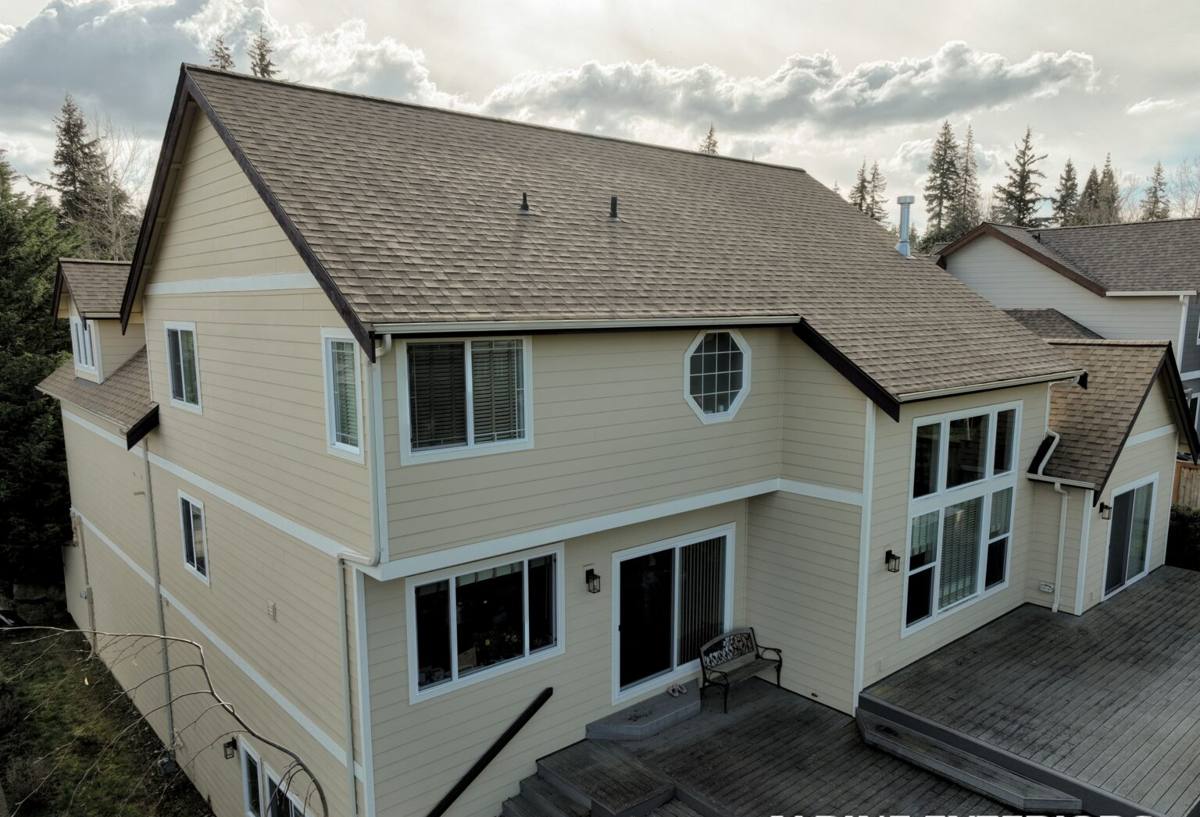
What Salt Air, Driving Rain, and Moss Actually Do to a House
These three stresses don't act alone — they compound each other, and understanding how helps explain why we install siding the way we do out here.
Salt Air
Airborne salt is corrosive to exposed metal fasteners, flashing, and trim, and it accelerates the breakdown of lower-grade coatings and caulks. Over years, a finish that would hold up fine twenty miles inland can chalk, fade, or fail early this close to the water.
Driving Rain
Wind off the water pushes rain sideways into wall assemblies, not just down. That means the details that keep water out — flush joints, proper flashing, correctly lapped house wrap, sealed penetrations — matter more here than they would on a sheltered inland lot. A siding product can be excellent and still leak if those details are wrong.
Moss and Algae Season
Point Roberts stays damp for a large part of the year, and shaded or north-facing walls in particular hold moisture long enough for moss, algae, and mildew to take hold. On absorbent or poorly finished materials, that growth stains permanently and can hold moisture against the wall, which shortens the life of everything underneath it.
What Point Roberts Siding Actually Needs to Deliver
- A material that doesn't absorb and hold water the way wood-based products can
- A factory finish that resists salt, UV, and moisture better than field-applied paint
- Fasteners, flashing, and joint details rated for coastal exposure, not just standard exterior use
- A surface and finish that resists moss and algae staining, or at least doesn't feed it
- Enough dimensional stability to handle repeated wet-dry cycling without warping, cupping, or splitting
- A warranty structure that actually accounts for coastal climates rather than assuming a mild, dry site
This is the checklist we use to evaluate every product line before it goes on a Point Roberts wall, and it's the reason our company installs James Hardie fiber cement exclusively rather than offering a menu of vinyl, LP SmartSide, or other lower-cost alternatives. Those products aren't installed anywhere on our jobs, on Point Roberts or elsewhere, because they don't clear this bar as reliably as Hardie does in this exposure.
Why James Hardie Fits This Exposure
James Hardie fiber cement is cement, sand, and cellulose fiber — it's non-combustible, dimensionally stable, and doesn't rot or delaminate the way wood-based sidings can when they take on repeated moisture. James Hardie also builds climate-specific "HZ" product engineering into its lines, and the version specified for the Pacific Northwest is formulated for a wet, moderate coastal climate rather than a dry, hot one. That's a meaningful distinction — a siding product engineered for the desert Southwest and one engineered for a marine climate are not interchangeable, even if they look identical on a sample board.
The other half of the equation is the factory-applied ColorPlus finish. Instead of being painted on site, ColorPlus is baked on in a controlled factory process, which gives it better adhesion and better resistance to fading, chipping, and salt exposure than field-applied paint typically achieves — especially on a home that's catching salt air off the water most days of the year. For Point Roberts specifically, that finish durability is one of the biggest practical differences between a Hardie installation and the alternatives.
Product Line Comparison
| Factor | James Hardie Fiber Cement (HZ engineered) | Vinyl Siding | Untreated / Primed Wood |
|---|---|---|---|
| Moisture absorption | Does not absorb or swell | Doesn't absorb, but seams and J-channels trap moisture | Absorbs readily; prone to rot without diligent upkeep |
| Salt air resistance | Strong with ColorPlus finish | Can chalk and become brittle over time | Coating fails faster; wood beneath is exposed |
| Moss/algae resistance | Good; smooth factory finish sheds growth better | Moderate; textured panels can hold spores | Poor; porous surface feeds growth |
| Fire performance | Non-combustible | Combustible, can melt/deform | Combustible |
| Typical repaint interval | Rarely needed if ColorPlus is maintained | Doesn't need paint, but fades and can't be color-matched easily | Every 5-8 years in this climate, often sooner |
What a Correct Installation Involves Here
Hardie siding is only as good as the installation underneath it, and coastal exposure has zero tolerance for shortcuts. A correct job on Point Roberts includes:
- Properly lapped and sealed weather-resistive barrier behind the siding, with no gaps at seams or penetrations
- Rain screen or drainage gap detailing so any moisture that does get behind the panels can drain and dry rather than sit against the wall
- Corrosion-resistant fasteners driven to Hardie's specified pattern and depth — not just "close enough"
- Flashing at every window, door, and roofline transition, installed to shed water outward rather than trap it
- Correct joint gaps and quality sealant at butt joints, sized and caulked to Hardie's published specifications
- Field-cut edges primed or sealed per manufacturer instructions so the factory finish isn't the only thing standing between raw material and moisture
Skipping any one of these doesn't usually show up as a failure in year one. It shows up in year five or eight, as a stain, a soft spot, or a warranty claim that gets denied because the installation didn't meet spec. That's a common story with siding in coastal climates generally, and it's exactly what we're trying to prevent by controlling every step of the install rather than treating it as a quick panel-nailing job.
Working on a Peninsula: Logistics That Actually Matter
Point Roberts' geography isn't just a climate factor — it's a logistics factor too. Because the peninsula is only reachable by road through Canada, or by water, every delivery of siding, trim, and fastening materials has to be planned around that crossing, and so does crew scheduling. A contractor who hasn't worked here before can lose real time figuring out lead times for material delivery, coordinating a crew's border crossings, and sequencing a job so weather-sensitive stages (like an open wall waiting on siding) aren't left exposed longer than necessary.
Working this area regularly means we already have that logistics figured out — we know how far ahead materials need to be ordered and staged, how to sequence a job so open walls aren't sitting exposed during a Point Roberts rain event, and how to keep a crew's schedule realistic given the crossing. None of that changes the siding itself, but it changes how smoothly your project actually goes.
Why Local Experience Matters for This Specific Job
Two homes with identical Hardie products can age very differently depending on how they were installed and where they sit relative to prevailing wind and rain. A crew that's done multiple jobs on this peninsula has already seen which elevations take the worst of the driving rain, which walls stay damp longest and need extra attention to moss resistance, and how salt exposure plays out over a few years on ColorPlus finishes locally. That's the kind of judgment that doesn't come from a manufacturer's install manual alone — it comes from doing the work in this specific environment and paying attention to how it holds up.
It also matters for something less visible: many homes on Point Roberts are used seasonally, which means siding problems can go unnoticed for weeks or months between visits. Getting the installation right the first time — correct flashing, correct fastening, correct finish — matters more here than in a neighborhood where an owner would spot a leak or a failing seam within days.
Cost Factors to Expect
Every home is different, but a few factors consistently drive the cost of a Point Roberts Hardie project up or down:
| Factor | Effect on Project |
|---|---|
| Home size and wall complexity | More corners, gables, and trim detail mean more labor and cutting |
| Current siding removal and substrate condition | Rot or water damage found underneath adds repair scope before new siding goes on |
| Product line and profile chosen | Lap width, shingle-style panels, and specialty trim vary in material cost |
| Access and staging on site | Tight lots or limited equipment access can add labor time |
| Scheduling around weather windows | Timing work to avoid extended open-wall exposure during wet stretches |
We walk through all of this in a straightforward, itemized estimate — no vague allowances, no surprise change orders for things we should have caught on the initial walk-through.
Signs Your Current Siding May Already Be Failing
- Persistent dark streaking or moss growth that returns quickly after cleaning
- Soft or spongy spots when you press on the siding, especially near the bottom edge or trim
- Paint that's chalking, peeling, or fading unevenly across different walls
- Visible gaps, warping, or buckling panels, particularly on the sides that take the most wind and rain
- Rising energy bills that could point to moisture getting into the wall assembly
If you're seeing any of these, it's worth having the siding and the substrate underneath it looked at before deciding whether repair or full replacement makes more sense.
Get a Straightforward Look at Your Home
If you're weighing a siding project on Point Roberts, we're happy to come take a look, walk the exterior with you, and give you an honest read on what your home actually needs — no pressure, no inflated scope. Use the form below to request a free estimate.