 Semiahmoo
 Why Peace Arch Homes Need a Different Window Strategy
Homes in the Peace Arch area sit close enough to Semiahmoo Bay and the Strait of Georgia that salt-laden air is part of daily life, not an occasional nuisance. That air finds every gap in a window assembly — around hardware, in weep holes, along frame seams — and over years it corrodes metal components, breaks down cheap sealants, and dulls finishes faster than it would a few miles inland. Add Whatcom County's driving rain, which comes in sideways during winter storms off the water, and a window that isn't properly flashed and sealed will eventually let water into the wall cavity, not just past the glass.
Then there's moss season, which around here isn't really a season — it's most of the year. Constant damp and shade on north- and west-facing walls keep window sills, sashes, and the siding around them wet longer than homeowners in drier parts of the state ever have to think about. Wood trim that isn't detailed correctly starts to soften. Vinyl frames that trap moisture behind them mildew. None of this means windows here are doomed to fail — it means the install has to account for what this climate actually does to a house, not just what the product brochure promises.
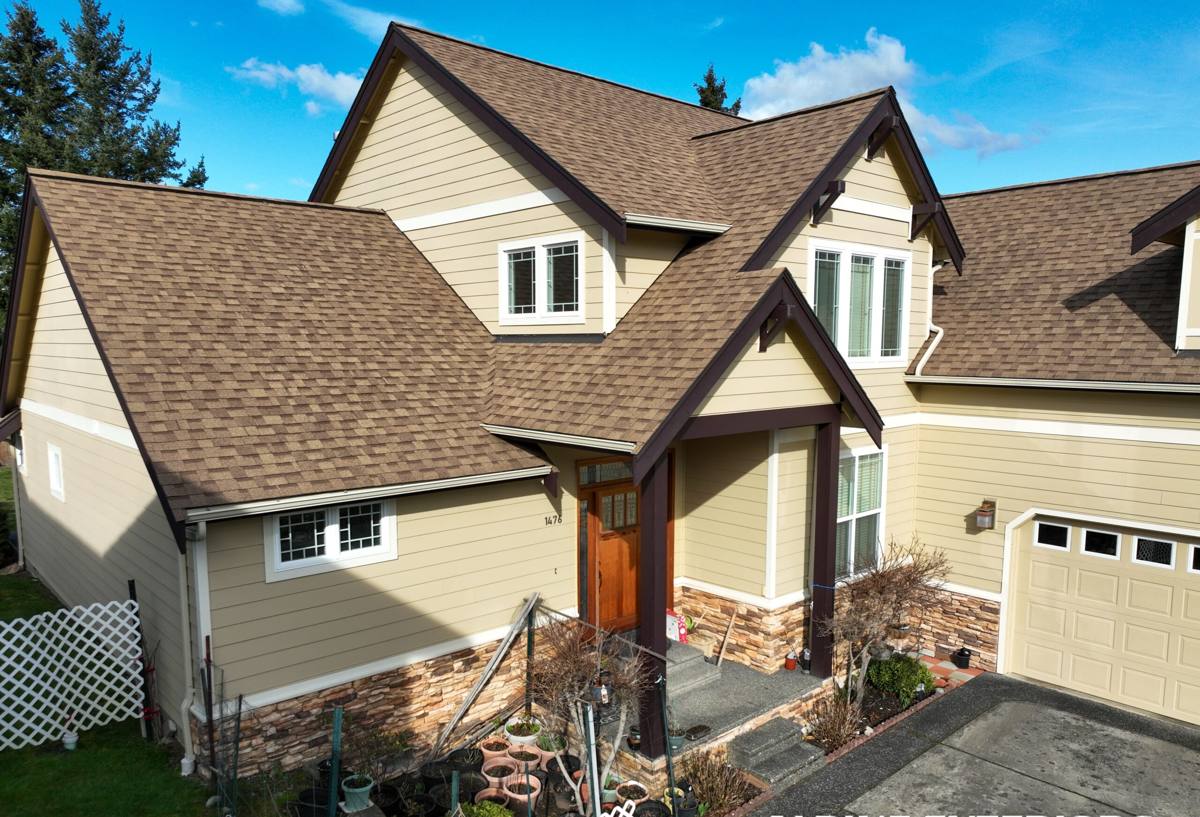
What "Energy-Efficient" Actually Means for This Climate
Energy efficiency isn't just a U-factor number on a sticker. For Peace Arch homes, an efficient window has to do three jobs at once: keep conditioned air in, keep wind-driven moisture out, and survive years of salt exposure without the seals or hardware degrading. A window can have excellent lab-rated performance and still underperform on a real house if it's installed with the wrong flashing sequence or the wrong sealant for a marine environment.
The Three Things We're Actually Solving For
- Air leakage — drafts around the sash and frame that make heating and cooling systems work harder
- Water management — proper flashing and sill pans so wind-driven rain sheds away from the wall assembly instead of pooling
- Material durability — frame, hardware, and sealant choices that hold up to salt air and near-constant damp without early failure
A homeowner shopping on U-factor alone can end up with a window that's efficient on paper but poorly integrated into the wall, which defeats the purpose within a few winters.
What a Correct Installation Involves
Replacing a window is not a matter of pulling the old unit and dropping in a new one that fits the opening. Done right, it's a sequence, and skipping steps is exactly how water problems start showing up two or three years down the road, usually as stains or soft trim that homeowners assume is a new problem when it's actually a symptom of an install shortcut.
Our Sequence
- Remove the old window and inspect the rough opening for existing rot, moisture damage, or inadequate flashing before anything new goes in
- Repair or rebuild the opening if the sheathing or framing has been compromised
- Install a sloped sill pan so any water that gets past the window drains outward, not into the wall
- Apply flashing tape and building paper in the correct shingle-lap order — this is the single most common step done wrong on cheap installs
- Set the window plumb, level, and square, then fasten per the manufacturer's specified pattern
- Seal and insulate the gap around the frame with the right material — not just spray foam alone, which shouldn't be the sole air/water barrier
- Finish exterior trim and caulking with products rated for marine/coastal exposure
Any one of these steps done poorly can undermine an otherwise excellent window. It's why we treat the installation itself as the main variable in long-term performance, not just the product being installed.
Choosing the Right Frame Material for a Salt-Air Environment
Frame material matters more here than in a lot of the state, because salt air and constant moisture stress every material differently. There's no single right answer for every home — it depends on budget, the home's style, and how exposed the elevation is to weather off the water.
| Frame Material | Coastal/Salt-Air Behavior | Maintenance | General Cost Position |
|---|---|---|---|
| Vinyl | Doesn't corrode; good sealed units hold up well, but cheaper vinyl can warp with sun/temperature swings near reflective water | Low — occasional cleaning | Most affordable |
| Fiberglass | Very stable dimensionally, resists corrosion and moisture absorption, holds paint well if a color change is wanted later | Low | Mid to upper |
| Wood-clad | Good insulator and classic look, but the exterior cladding and any exposed wood detailing need real attention in this much moisture | Higher — periodic inspection of seals and finish | Higher |
| Aluminum | Conducts cold and can corrode over time in salt air unless properly coated; generally not our first recommendation for this specific exposure | Moderate | Varies |
We'll walk through these trade-offs honestly for your specific elevation and exposure rather than pushing one material for every job — a sheltered wall facing away from the water doesn't need the same spec as a wall taking direct wind off the bay.
Glass and Hardware Details That Matter Locally
Double-pane, low-E glass with argon gas fill is standard for this climate and handles Whatcom County's mild-but-damp winters well. Triple-pane can make sense on north-facing walls that take the worst of the wind and rain, but it's not automatically worth the added cost on every elevation — we'll tell you honestly where it pays off and where it doesn't for your home.
Hardware is where salt air does the most damage over time. Cheap locks, hinges, and balances corrode and stiffen years before the glass unit itself fails. We look at hardware plating and material as closely as we look at the glass package, because a beautiful window with hardware that seizes up in five years isn't actually a good long-term investment.
Signs Your Current Windows Are Underperforming
Homeowners often live with a slowly failing window for years because the signs are subtle at first. Worth checking before winter storm season:
- Condensation forming between the panes (a sign the seal has failed, not something that can be cleaned away)
- Visible drafts you can feel by hand near the frame on a windy day
- Soft or discolored trim or sill wood, especially on north- or west-facing walls
- Difficulty opening, closing, or locking the sash
- A noticeable jump in heating costs without another explanation
- Fogging or a chalky film on the glass or frame that doesn't wipe off
- Visible moss or dark staining forming on the sill or surrounding trim
Any one of these on its own isn't necessarily an emergency, but a combination usually means the window or its installation has reached the end of useful life.
Why Hiring a Crew That Already Works This Area Matters
A window contractor who mostly works drier inland areas of Washington will spec and install differently than one who works the Whatcom County coastline regularly. The flashing details, sealant choices, and even the fastener coatings that hold up near Semiahmoo Bay aren't always the default in a manufacturer's standard install guide written for a national market. We work this area because we live in it, and we've seen firsthand what shortcuts cost homeowners a few winters later — stained trim, soft sheathing behind a window that looked fine from outside, hardware seized from corrosion nobody expected.
That local experience also means we're not guessing at what your home's exposure requires. A window on a wall that catches driving rain off the water needs a different level of detail than one tucked under a deep eave on a sheltered side, and knowing the difference without over-selling or under-building is exactly what years of installing in this specific climate teaches you.
What to Expect From an Estimate
We assess each window individually — the opening, the current flashing condition, the exposure of that particular wall — rather than quoting a flat per-window price sight unseen. Every home's mix of sheltered and exposed elevations is different, and that affects both material recommendations and the level of flashing detail each opening needs. We'll walk the exterior with you, point out anything we find, and explain the reasoning behind what we recommend so you're deciding with full information, not just a sales pitch.
If you're noticing drafts, moisture, or aging windows on a Peace Arch area home, we're happy to take a look and give you a straightforward, no-pressure estimate using the form below.