 Semiahmoo
 Siding Installation Built for Lynden's Climate
Lynden sits inland from the coast but still lives under the same wet, marine-influenced weather pattern that defines Whatcom County — long stretches of driving rain in the fall and winter, damp air off the Nooksack lowlands, and a moss season that can run eight months or more if a home's siding gives it the chance to take hold. Add in the salt-laden air that reaches this far inland on strong westerly winds, and you have a set of conditions that will find every weak point in a siding system: unsealed seams, thin coatings, caulked joints that were never meant to be permanent, and house wraps that were installed as an afterthought rather than a system.
We install James Hardie fiber cement exclusively. Not because it's the only product that exists, but because after years of tearing old siding off Whatcom County homes, it's the one system we're willing to put our name behind in this climate. This page covers what a correct siding installation looks like specifically for a Lynden home, why the details matter more here than in a drier climate, and how our process protects the investment you're making.
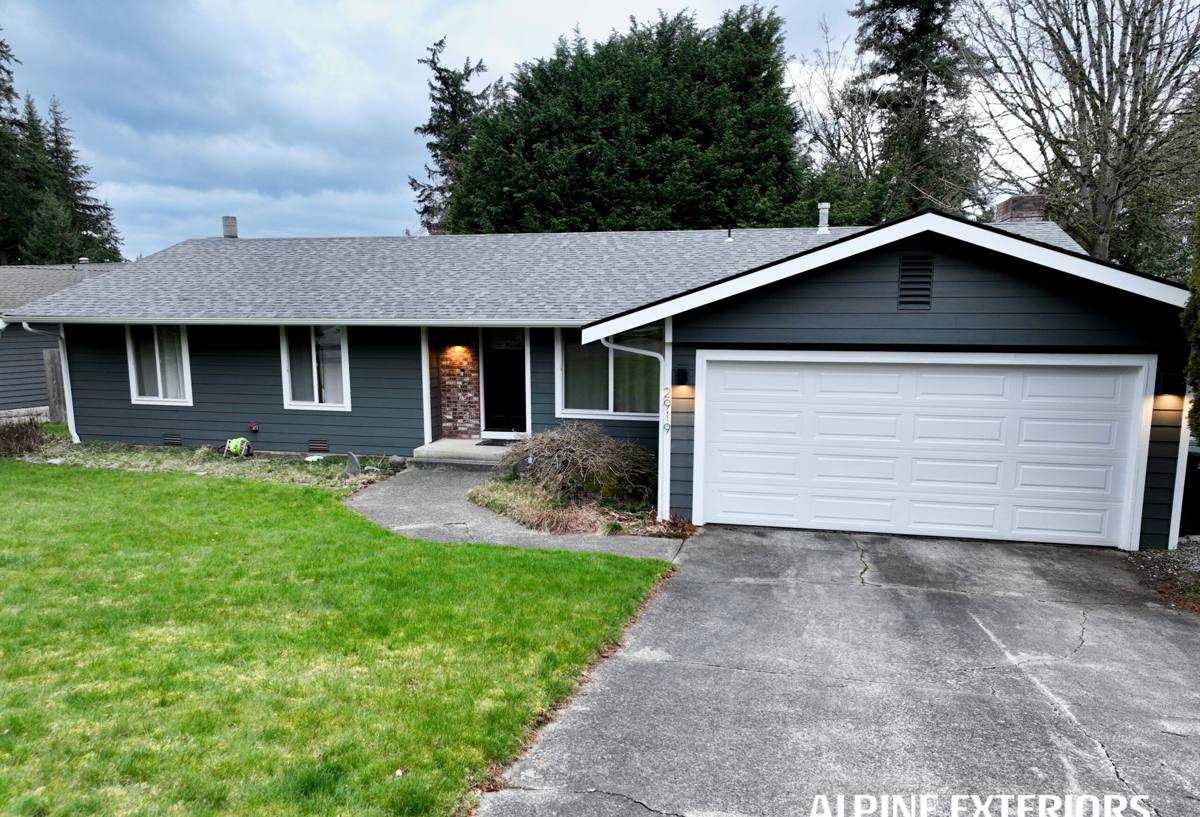
What Lynden Homes Actually Need From Their Siding
Every siding job has to do two things: shed water and survive the weather cycle without failing early. In Lynden, that second part is harder than it sounds. The freeze-thaw swings here aren't extreme, but the moisture load is constant — siding rarely gets a long dry stretch to fully release the water it's picked up, which means whatever's installed underneath the cladding has to manage moisture, not just block it.
Moisture Management, Not Just Water Resistance
A siding system that merely repels rain on the surface but traps moisture behind it will rot the sheathing, delaminate the coating, or grow mold in wall cavities — all while looking fine from the curb for a year or two. What Lynden homes need is a system with a drainage plane behind the cladding, correctly lapped house wrap, and a rain screen gap where conditions call for it, so any moisture that does get past the siding has somewhere to go besides your wall studs.
Resistance to Moss and Organic Growth
Moss doesn't just grow on roofs here — it colonizes any siding surface that stays damp and shaded, especially north-facing walls and areas under mature trees, which describes a lot of Lynden lots. Once moss or algae gets a foothold in a porous or poorly finished surface, it holds moisture against the substrate and accelerates whatever damage is already happening underneath. A dense, factory-finished surface is far harder for organic growth to grip onto than a field-primed or unfinished substrate.
Standing Up to Salt-Influenced Air
Lynden isn't beachfront, but Whatcom County's proximity to the Salish Sea means salt-bearing air reaches well inland on windy days, especially in fall and winter storms. Over years, that salt exposure accelerates corrosion of fasteners and trim metal and can degrade coatings that weren't engineered for it. It's a slower, quieter version of what full coastal towns deal with — but it adds up on a 20- or 30-year timeline.
Why We Only Install James Hardie
James Hardie fiber cement is engineered specifically for problems like these. It's non-combustible, dimensionally stable in wet climates (it doesn't swell and shrink with moisture the way wood-based products do), and it comes from the factory with a baked-on ColorPlus finish rather than a coat of field-applied paint. That factory finish matters here — it's more consistent and better bonded than what you get from priming and painting boards on site, and it holds its color and its seal against the kind of weather Lynden sees for a lot longer.
Hardie also builds region-specific product lines through its HZ5 engineering, tuned for climates with more moisture exposure — which is exactly the environment we're installing into. Combined with a strong transferable warranty, that's the combination we've decided is worth standardizing on rather than offering a menu of products with different risk profiles.
What We Don't Install, and Why
We get asked about LP SmartSide, vinyl, and cedar fairly often, so it's worth being direct about where we land on each:
- Vinyl siding is affordable and low-maintenance in the sense that it doesn't need painting, but it's a thin plastic product that can warp, fade, and crack over time, and it doesn't offer the same fire performance or impact resistance as fiber cement. In a wet climate, its seams and J-channels are also common points where water finds a way behind the cladding.
- LP SmartSide is an engineered wood product with real strengths, but it's still wood-based at its core, which means it's more sensitive to sustained moisture exposure than fiber cement, and any breach in its coating or caulking is a faster path to substrate damage.
- Cedar looks great and has a long tradition in the Northwest, but it demands ongoing maintenance — refinishing, caulking, and vigilant moisture management — to hold up in a climate this wet, and it's combustible.
None of these are "bad" products in every application. They're just products we've decided carry more long-term risk and maintenance burden than we're willing to install on a Lynden home, where the weather doesn't give a marginal installation much room for error.
What a Correct Installation Actually Involves
The siding material is only part of the equation. A huge share of siding failures we get called out to inspect trace back to installation shortcuts, not the product itself. Here's what we consider non-negotiable on every job:
Tear-Off and Sheathing Inspection
We remove the old siding rather than installing over it, because covering up existing damage just hides a problem instead of fixing it. Underneath, we inspect the sheathing for rot, soft spots, or prior water intrusion — especially around window and door openings, which is where we most often find it.
House Wrap and Flashing
Every seam in the house wrap gets properly lapped and taped, water-resistive barrier is installed shingle-style so gravity works in your favor, and flashing goes in at every window, door, and horizontal trim transition — the places where water pressure concentrates during a driving rain event.
Fastening and Joint Treatment
Hardie siding has to be fastened correctly to perform as designed — proper fastener type, spacing, and embedment depth all matter, and butt joints need to be treated (caulked and painted, or flashed) rather than left as a raw seam for water to work into over the years.
Clearance and Drainage Details
We keep the bottom edge of the siding at the manufacturer-specified clearance above grade, decks, and roof lines, and we make sure kick-out flashing is in place wherever a roof line meets a wall — a detail that's easy to skip and one of the most common sources of hidden rot when it's missed.
| Detail | Why It Matters in Lynden |
|---|---|
| Rain screen / drainage gap | Gives moisture that gets behind the siding somewhere to drain and dry instead of sitting against the sheathing |
| Properly lapped house wrap | Directs water downward and outward rather than letting it wick behind seams during sustained rain |
| Factory-finished ColorPlus coating | Resists moss/algae adhesion and holds color and seal better than field-applied paint |
| Correct fastener spacing and type | Prevents panel movement and cracking through repeated wet-dry cycles |
| Kick-out flashing at roof-wall intersections | Stops concentrated roof runoff from being driven directly into the wall assembly |
Our Process for Lynden Projects
1. On-Site Assessment
We walk the exterior with you, look at the current siding's condition, check for signs of existing moisture damage, and talk through what's driving the project — failing siding, a remodel, or just wanting something that'll hold up better long-term.
2. Scope and Product Selection
We help you choose the right Hardie profile and color for the home — lap siding, panel, or shingle-style — and walk through what tear-off will involve given the home's age and current siding type.
3. Written Estimate
You get a clear, itemized estimate before any work starts — no surprise change orders for things that should have been caught during the assessment.
4. Installation
Full tear-off, sheathing inspection and repair as needed, house wrap and flashing installed to spec, and Hardie siding installed to manufacturer fastening and clearance requirements.
5. Final Walkthrough
We walk the finished job with you before we consider it done, so anything you want addressed gets handled while we're still on site.
What to Check Before Hiring Any Siding Crew
- Are they licensed and insured to do exterior work in Washington State?
- Do they tear off old siding, or install over it?
- Can they explain their house wrap and flashing details, not just the visible siding product?
- Do they have experience specifically with fiber cement fastening requirements, which differ from wood or vinyl?
- Will you get a written warranty that covers both the material and the labor?
- Do they have a track record working in this specific climate, not just siding in general?
Why Local Experience in Whatcom County Matters
A crew that mostly works drier climates can install siding to a generic spec and it will hold up fine there. That same generic spec, applied in Lynden's rain and moss cycle, is where corners cut on flashing and drainage details start to show up — sometimes not for a few years, which is exactly when it's most expensive to fix. Working this area consistently means we've seen where water actually gets in on homes like yours, not in a textbook, but on tear-offs across Whatcom County. That's the difference between siding installed to a checklist and siding installed for the weather it's actually going to face.
Cost Factors for a Lynden Siding Project
Every home is different, but the main cost drivers on a Lynden siding job are consistent:
| Factor | Impact |
|---|---|
| Extent of tear-off and sheathing repair | Hidden rot or damage found during tear-off adds scope but prevents installing over a bad substrate |
| Home size and wall complexity | More corners, gables, and trim transitions mean more labor and detail work |
| Siding profile chosen | Lap, panel, and shingle-style Hardie products carry different material and labor costs |
| Trim and accessory scope | Fascia, soffit, and trim replacement alongside siding affects total project cost |
| Site access | Tight lots, fencing, or landscaping that limits equipment access can add labor time |
We give you the real number for your home during the on-site assessment, not a rough guess over the phone — every property's tear-off and detail work is different enough that a generic estimate isn't useful to you.
If your Lynden home's siding is showing its age, growing moss it shouldn't, or you're just planning ahead for a replacement, we're happy to walk the exterior with you and give you a straight, no-pressure estimate using the form below.