 Semiahmoo
 Bellingham's Marine Climate Puts Real Demands on Exterior Siding
Bellingham sits close enough to the water that salt-laden air is a daily fact of life for the exterior of a house, not an occasional nuisance. Add Whatcom County's long wet season — driving rain that comes sideways off Bellingham Bay and the Strait, low winter sun angles that leave north- and west-facing walls damp for weeks at a stretch, and a moss and algae season that can run eight or nine months of the year — and you get a set of conditions that punishes weak siding systems fast. Paint chalks and peels early. Seams that were never properly flashed start taking on water behind the cladding instead of shedding it. Wood-based products swell, soften, and eventually rot from the inside where nobody can see it until the damage is done.
None of this is unique to any one street or subdivision in Bellingham — it's the nature of installing siding this close to the Salish Sea. What it means practically is that the siding material and the installation details matter more here than they would in a drier inland climate. A product that performs fine in Spokane or Yakima can fail years early in Bellingham if it wasn't engineered for constant moisture and salt exposure.
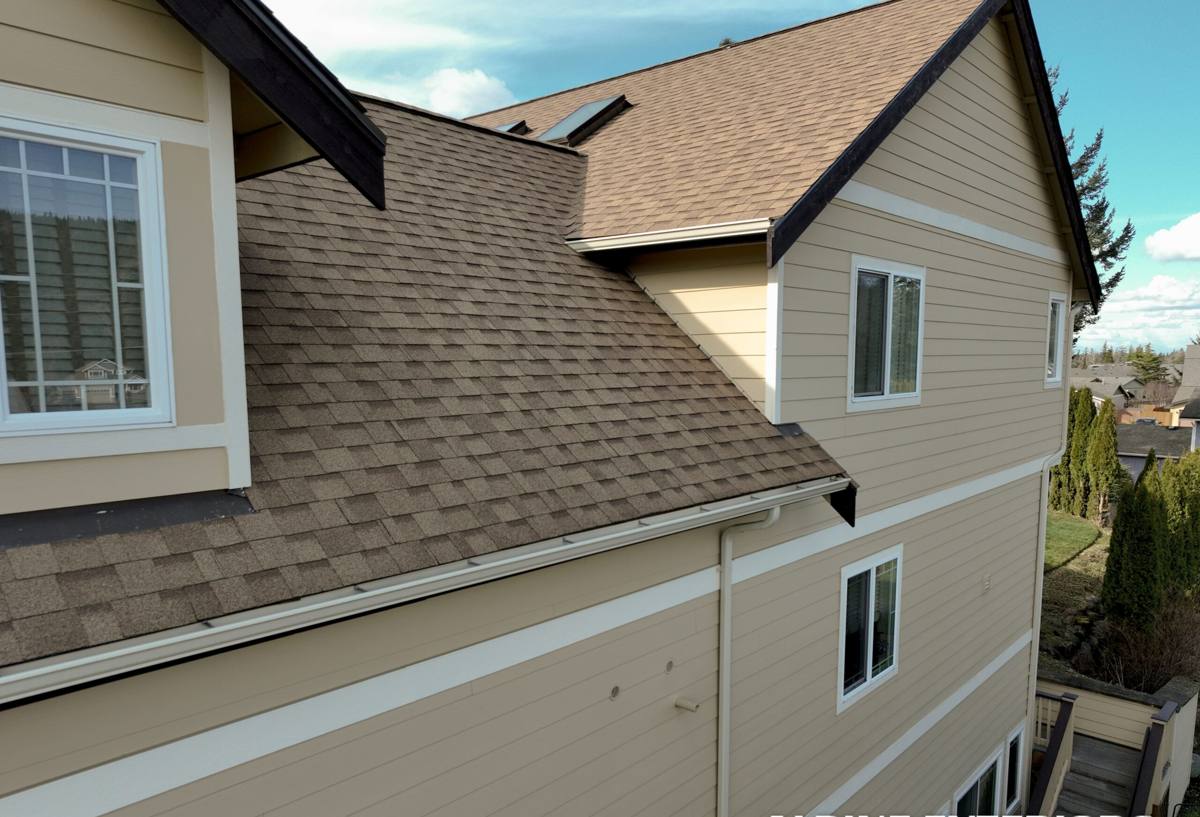
Why We Only Install James Hardie Fiber Cement
We made a decision a long time ago to install one siding system and install it well, rather than offer a menu of products and let cost be the deciding factor. James Hardie fiber cement is what we put on homes. We don't install vinyl, LP SmartSide, Cemplank, Allura, primed spruce, or cedar, and that's a professional standard, not a sales pitch — each of those products has real strengths, but each also carries a maintenance burden, a moisture vulnerability, or an installation sensitivity that we're not willing to warranty our work against in a climate like this one.
Fiber cement is cement, sand, and cellulose fiber pressed and cured into a dense, stable board. It doesn't swell with humidity the way wood-based sidings can, it doesn't become brittle in the cold, and it's non-combustible — a genuine advantage during wildfire smoke season, which has become a regular late-summer event even here on the wet side of the state. James Hardie backs its boards with a long, transferable limited warranty and a factory-applied ColorPlus finish that's baked on rather than field-applied, which matters enormously in a place where a house can go weeks without a fully dry day for repainting.
What This Means Specifically for Bellingham Homes
James Hardie manufactures its HardieZone products in different formulations for different climate zones. Homes in this part of Washington fall into the HZ5 zone, engineered for regions with sustained moisture exposure and freeze-thaw cycling. That's not a marketing detail — it's the difference between a board formulated to handle a wet Pacific Northwest winter and one formulated for a drier climate that happens to be sold nationally under the same name.
What a Correct James Hardie Installation Requires
The board itself is only part of the equation. Fiber cement siding installed poorly will still leak, buckle, and fail early — we see it on tear-offs regularly. A correct installation in a wet marine climate comes down to details that are easy to skip and expensive to fix later.
Flashing and Water Management
Every window, door, and penetration needs proper head flashing and a drainage plane behind the siding — not just caulk. In a climate with as much driving rain as Bellingham gets, water will find any gap in the water-resistive barrier eventually. The house wrap or building paper underneath the siding has to be lapped correctly, taped at seams, and integrated with the flashing so water sheds outward instead of tracking behind the boards.
Fastening and Gapping
James Hardie specifies exact nailing patterns, fastener types, and minimum gaps between boards, trim, and adjoining surfaces. Boards installed tight against trim or butted with no expansion gap will eventually crack or trap moisture at the joint. This is one of the most common shortcuts we find when we're asked to look at a previous installer's work.
Caulking and Trim Details
Not every joint should be caulked, and not every caulked joint is done with a product rated for exterior fiber cement. Over-caulking can trap moisture as easily as under-caulking lets it in. Getting this right is a judgment call that comes from having installed a lot of Hardie board in this exact climate, not from following a generic checklist.
- Weather-resistive barrier installed and lapped correctly before any siding goes up
- Flashing integrated at every window, door, and penetration
- Manufacturer-specified fastener type, spacing, and embedment depth
- Correct expansion gaps at butt joints, trim, and corners
- Factory-primed cut edges sealed or back-primed before installation
- ColorPlus touch-up used only where the finish was actually disturbed
James Hardie Product Lines for Bellingham Homes
James Hardie makes several distinct product lines, and the right choice depends on the home's style, exposure, and how much of the existing siding profile the homeowner wants to keep. We walk through this with every homeowner before quoting anything.
| Product Line | Best Suited For | Notes for This Climate |
|---|---|---|
| HardiePlank Lap Siding | Most single-family homes; traditional lap look | Most common choice locally; handles driving rain well when lapped and flashed correctly |
| HardieShingle | Craftsman or cottage-style homes, accent gables | Staggered or straight-edge options; good where a textured look is wanted without cedar's upkeep |
| HardiePanel | Modern facades, board-and-batten looks | Vertical panel option that pairs well with trim accents on garages and gables |
| HardieTrim | Corner boards, window and door trim, fascia | Matched to the siding line so trim and field don't age or fade differently |
Our Process, Start to Finish
Every project starts with an on-site look at the existing siding and the sheathing underneath it, not just a measurement for a quote. On older Bellingham homes especially, we want to know what condition the wall assembly is in before we commit to a scope of work — moisture trapped behind old siding is common enough that we plan for the possibility of finding it.
- Walk-through and assessment, including a look at trim, flashing, and any visible moisture damage
- Written estimate with product line, color, and scope spelled out plainly
- Removal of existing siding and inspection of sheathing, replacing any compromised sections before new material goes up
- Installation of the water-resistive barrier and flashing system
- Installation of James Hardie siding and trim to manufacturer specification
- Final walk-through and warranty registration
What Bellingham Siding Replacement Typically Costs
Costs vary by home size, current condition, and product line, and we won't quote a number without seeing the house — but the factors that move the price are consistent from project to project.
| Cost Factor | Why It Matters |
|---|---|
| Home size and number of stories | More square footage and taller walls mean more material and labor, plus added scaffolding or lift access |
| Condition of existing sheathing | Rot or moisture damage found during tear-off adds repair work before new siding can go up |
| Product line and profile | Lap, shingle, and panel products differ in material cost and installation time |
| Trim and detail work | Homes with more corners, windows, and architectural trim take longer to flash and finish correctly |
| Color selection | Standard ColorPlus colors versus custom or premium finishes carry different material costs |
Signs Your Siding Needs Attention Now
Marine climate damage doesn't always announce itself with an obvious hole or crack. A lot of what we find on Bellingham homes shows up first as subtle staining or softness that homeowners have lived with for a season or two before calling anyone.
- Persistent moss or algae streaking that returns within a few months of cleaning
- Soft or spongy spots when you press on the siding, especially near the bottom courses
- Paint that's peeling or bubbling rather than just fading
- Visible gaps or warping at butt joints and corners
- Higher heating bills that suggest air or moisture infiltration through the wall assembly
- Interior drywall staining on exterior walls, which often points to a siding or flashing failure
Why Hire a Crew That Already Works in Bellingham
Installing James Hardie correctly in Yakima and installing it correctly in Bellingham are not quite the same job, even though the product is identical. A crew that works this area regularly already knows how much rain exposure a west-facing wall gets in a typical winter, how aggressively moss establishes itself on north-facing siding under tree cover, and how salt air near the water accelerates corrosion on fasteners and flashing if the wrong hardware gets used. Those are lessons learned from doing the work here repeatedly, not from a manufacturer's install guide, and they show up in details like fastener selection and flashing sequencing that a homeowner won't notice until years later, when the difference between a correct install and a rushed one becomes obvious.
If you're weighing a siding replacement in Bellingham or elsewhere in Whatcom County, we're glad to come take a look and talk through what your home actually needs — no pressure, no obligation. A free estimate is the easiest way to find out what correct James Hardie installation would look like on your house.