 Semiahmoo
 Fiber Cement Siding on the Point Roberts Peninsula
Point Roberts sits at the tip of a small peninsula, cut off from the rest of Whatcom County by an international border that runs across the road. It's a U.S. exclave — the only way in or out by land runs through Canada — and the peninsula is exposed to open water on more than one side. That geography makes Point Roberts one of the more demanding places in Whatcom County to keep a home's exterior in good shape, and it's a big part of why we install exactly one siding system here: James Hardie fiber cement. We're based in Semiahmoo, and Point Roberts has been regular territory for our crew long enough that we've seen firsthand how differently a house ages on this peninsula compared to more sheltered towns just a few miles inland.
This page is specifically about fiber cement siding for Point Roberts homes — what the local climate demands from a siding system, what a correct installation actually involves, how our process works on this particular stretch of coastline, and why the logistics of this location make local experience worth more here than in most towns.
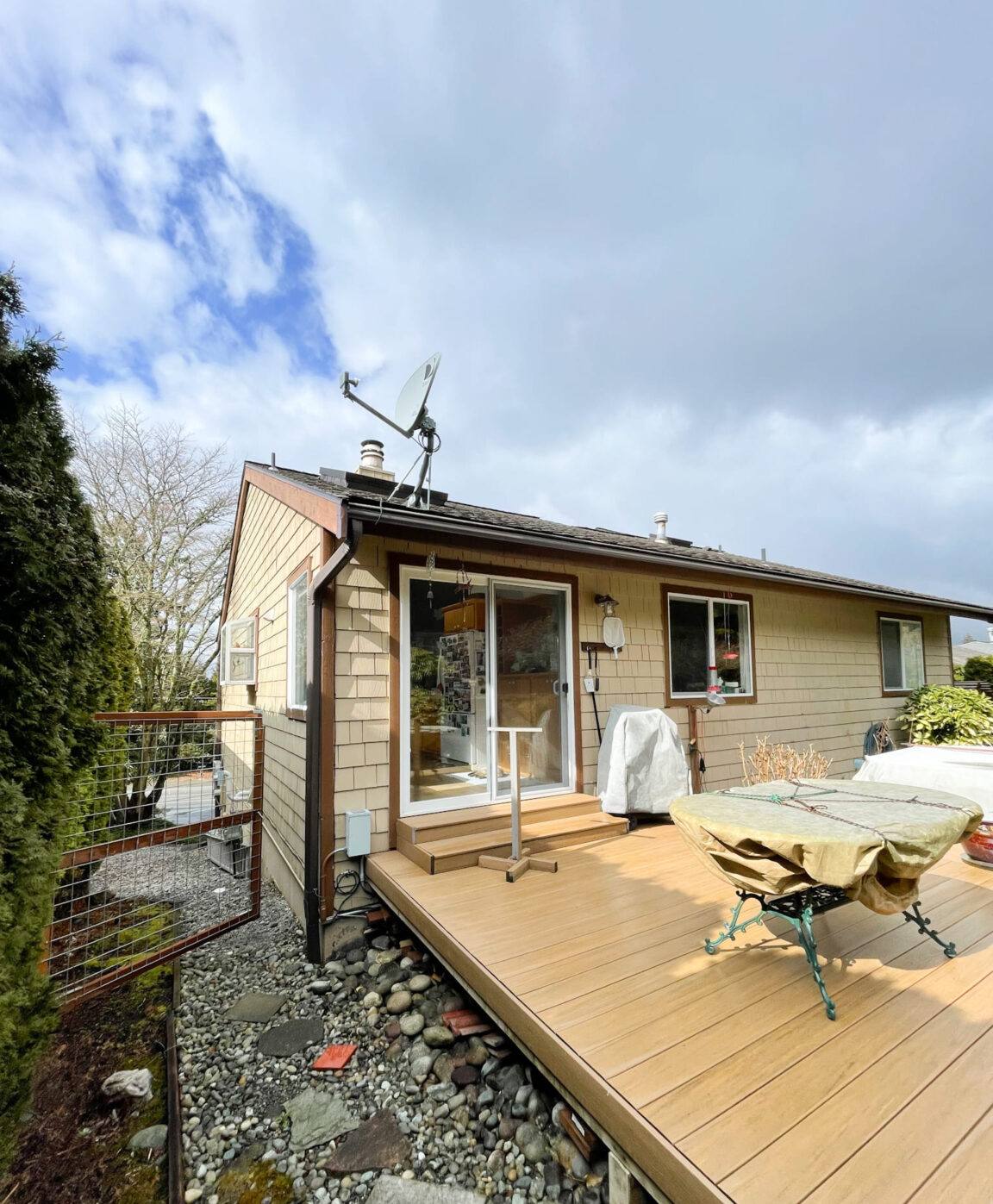
What the Peninsula Climate Does to Siding
Salt Air From More Than One Direction
Most Whatcom County towns take salt exposure off a single body of water. A peninsula home on Point Roberts can catch it off more than one direction depending on the wind, which means a steadier, more constant salt load on fasteners, flashing, and any exposed trim. Salt accelerates corrosion and wears down lower-grade paint and coatings faster than a home with more inland shelter would ever experience, so material and hardware choices carry more weight here than they would a few miles inland.
Driving Rain Off Open Water
Wind coming off open water doesn't drop rain straight down — it pushes it sideways into wall assemblies, window returns, and the seams where trim meets siding. A peninsula home has fewer windbreaks to slow that wind down than a house set back from the water, so wind-driven rain here tests flashing laps and joints harder and more often than it would in a calmer inland setting.
A Moss Season That Runs Most of the Year
Mild temperatures and near-constant moisture keep moss and mildew active on shaded, north-facing walls for most of the year on the peninsula. Any siding material with even a little surface porosity becomes a growth surface under that much sustained dampness, and it shows up earliest on tree-shaded lots and walls that don't get much direct sun through the fall and winter.
Why James Hardie Fiber Cement Fits This Location
We install James Hardie exclusively, and on a peninsula this exposed, that standard means more than it would in a drier part of the state. A few of the reasons it holds up here:
- Non-combustible core: Fiber cement doesn't feed a fire the way wood-based siding products can, which matters for both safety and insurance considerations.
- Factory-applied ColorPlus finish: The color is baked on under controlled factory conditions instead of brushed on in the field, so it holds up longer against fading and chalking under steady salt and UV exposure.
- HZ5 formulation: Hardie's HZ5 product line is engineered for sustained moisture and freeze-thaw cycling, which describes peninsula conditions better than a general-purpose siding product.
- Dimensional stability: Fiber cement doesn't swell, cup, or warp the way engineered wood products can after repeated wetting off the water.
- Strong transferable warranty: Hardie backs the product with one of the stronger warranty structures in the industry, provided the installation follows their spec.
We don't install LP SmartSide, vinyl siding, Cemplank, Allura, primed spruce, or cedar on Point Roberts homes. Each has a place in the market and homeowners who are satisfied with them elsewhere. But on a peninsula that takes this much direct salt and wind-driven moisture, we've made a professional call to stand fully behind one system rather than offer something cheaper that quietly shifts maintenance risk onto the homeowner a few years down the road.
What Correct Installation Involves Here
Fiber cement performs the way it's supposed to only when it goes on correctly, and on an exposed peninsula the details matter more than they would in a milder setting. A few of the basics we won't skip:
- Rain screen drainage gap: A small cavity behind the siding lets any moisture that gets past the exterior surface drain and evaporate instead of sitting against the wall sheathing.
- Correct fastener type and spacing: Hardie specifies corrosion-resistant fasteners and precise placement for a reason — loose spacing or the wrong fastener is one of the more common causes of early siding failure we find on tear-offs in salt-exposed towns.
- Properly lapped house wrap and flashing: Every seam and penetration needs to shed water downward and outward, especially on walls that catch wind-driven rain directly off open water.
- Sealed butt joints and trim transitions: Open or poorly sealed joints are where salt-laden moisture finds its way behind the siding first.
None of this is exotic — it's the manufacturer's own installation spec, followed consistently rather than shortcut on the parts that are hardest to see once the job is finished.
Our Process for a Point Roberts Siding Project
Assessment First
We walk the property before quoting anything. On a peninsula home, that means checking which walls take the most direct wind and rain, how much shade and tree cover feed the moss problem, and whether moisture has already worked its way behind the existing siding. Two homes a short distance apart can need very different scopes once we're actually pulling old siding off.
Staging Materials and Crew
Because Point Roberts is only reachable by land through Canada, we plan material deliveries and crew scheduling around that ahead of time rather than figuring it out mid-project. A crew that hasn't worked the peninsula before can lose a good weather window just sorting out logistics that we've already got a system for.
Tear-Off and Substrate Check
Once old siding comes off, we check the sheathing underneath for moisture damage before anything new goes up. Covering a compromised substrate with new siding just hides a problem instead of fixing it, and that's especially true on a peninsula wall that's been catching salt-laden rain for years.
Installation to Spec and Final Walkthrough
We install to Hardie's spec on fastening, flashing, and drainage, then walk the finished job with the homeowner before calling it done.
Why Hiring a Crew That Already Works Point Roberts Matters
Point Roberts' exclave status changes practical logistics that a crew unfamiliar with the area often doesn't plan for: border crossings for both crew and delivery vehicles, coordinating material drops so a job doesn't stall halfway through a tear-off, and scheduling around a peninsula's exposed wind and rain patterns rather than a typical inland forecast. A crew that already has a system for that gets more done inside a good weather window than one that's figuring it out for the first time. It also means knowing which walls on a peninsula home take the worst of the weather and building the install plan around that instead of applying the same generic approach used on a sheltered inland lot.
Timing a Siding Project Around Peninsula Weather
The driest, most workable stretch on this part of the coast generally runs through spring and summer, and that matters more for fiber cement than it might for other materials. Hardie panels, house wrap, and flashing all perform better when they're installed and allowed to set up under stable, dry conditions rather than squeezed between storm systems moving in off the water. Point Roberts' exposure to wind and rain off open water on more than one side makes that dry window a little shorter and a little less predictable than it is further inland, which is part of why we build in buffer time when scheduling peninsula jobs. None of that means a home with active moisture intrusion should wait for the ideal season — a wall that's already taking on water needs attention on its own timeline, not the calendar's.
Cost Factors for Point Roberts Fiber Cement Siding
| Factor | What Drives It | Peninsula Consideration |
|---|---|---|
| Home size and siding profile | Square footage, lap vs. shingle vs. panel style | More wall area exposed to open water increases material and labor scope |
| Tear-off vs. overlay | Condition of existing siding and sheathing | Substrate repair is common where moisture has already gotten behind old siding |
| Trim and corner complexity | Number of window and door openings, corners | Extra flashing detail needed on the walls that take wind-driven rain directly |
| Logistics and access | Material delivery and crew scheduling | Border crossing adds lead time that has to be built into the project schedule |
These are general drivers, not a quote. We walk every property before putting a real number on the work, since two homes on the same street can need very different scopes once we're actually up close to the walls.
Signs a Point Roberts Home Needs New Siding
- Moss or dark staining on siding that comes back quickly after cleaning
- Soft or spongy panels, especially low on the wall or around window trim
- Rust staining or corroded fasteners and trim
- Peeling paint or visible warping on shaded, north-facing walls
- Gaps or separation at trim, corners, or window returns
- Higher heating bills that may point to a wall assembly no longer keeping moisture out
If your Point Roberts home needs new siding, or you're not sure whether what's on the walls now is still doing its job, we're glad to take a look and give you a straightforward, honest assessment. Reach out using the form below to schedule a free, no-pressure estimate.