 Semiahmoo
 Why Birch Bay Siding Has to Work Harder
Birch Bay sits close enough to the water that salt air is part of daily life on a home's exterior, not an occasional visitor. Add Whatcom County's long, wet winters and the shoulder-season drizzle that can linger for weeks, and you have a climate that tests siding in three ways at once: corrosion from airborne salt, sustained moisture exposure from driving rain off the Strait, and the slow, quiet damage of moss and algae that never fully dries out between storms. A lot of siding products handle one of those stresses reasonably well. Very few hold up to all three, year after year, without babysitting.
That's the lens we use on every Birch Bay siding job: not "does this look good going up," but "what does this wall assembly look like in twelve years, after twelve wet winters and twelve moss seasons." Fiber cement, installed correctly, is the answer we've settled on for this stretch of coastline. This page is about what that actually means for a Birch Bay home.
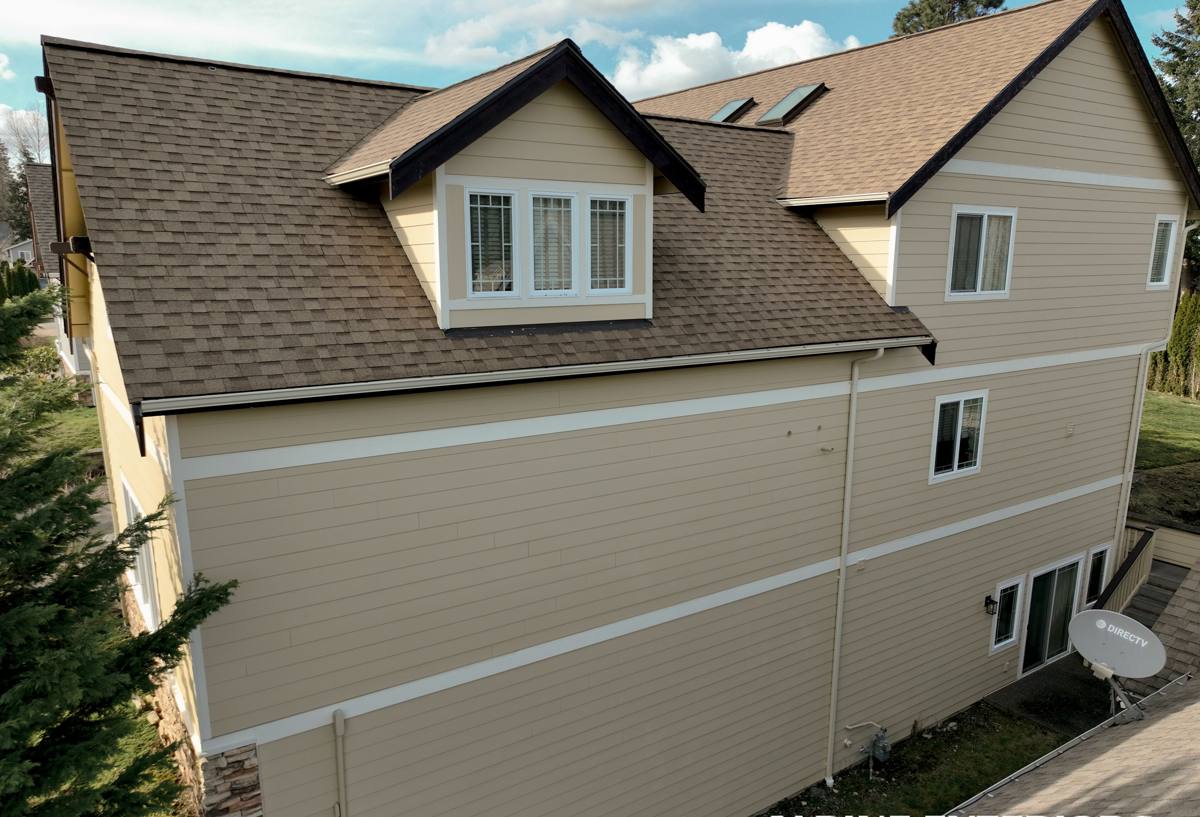
What Salt Air, Rain, and Moss Actually Do to Siding
Salt Air
Airborne salt is corrosive to exposed metal fasteners, trim flashing, and lower-quality coatings. It also accelerates the breakdown of paint films that aren't formulated to resist it, leading to chalking, fading, and premature repainting cycles closer to the water.
Driving Rain
Storms coming off the water don't just fall straight down — wind-driven rain gets pushed sideways into siding laps, corner boards, and window trim. Any product that relies on a tight, unbroken paint film to stay watertight is vulnerable here; once that film is compromised, water finds its way behind the cladding.
Moss and Algae
Long stretches of overcast, damp weather mean north-facing and shaded walls rarely get a full dry-out. Organic growth isn't just cosmetic — moss holds moisture against the siding surface, which extends the time wood-based or moisture-sensitive products spend saturated, and that's when rot and delamination take hold.
Why We Install James Hardie and Nothing Else
We're a Hardie-only siding contractor. We don't install vinyl, LP SmartSide, primed spruce, cedar, or other fiber cement brands, and we're upfront about why: in a climate like Birch Bay's, the material itself needs to be inherently resistant to moisture and non-combustible, not just protected by a coating that has to be perfectly maintained to keep working.
James Hardie fiber cement is cement, sand, and cellulose fiber — it doesn't absorb and swell the way wood-based products can, and it isn't a petroleum-based product that softens, fades, or becomes brittle in UV and salt exposure the way vinyl can over a long enough timeline. Hardie's ColorPlus factory finish is baked on in a controlled environment, which gives it better film integrity and fade resistance than field-applied paint, and it comes with its own finish warranty. For a wall that's going to take wind-driven rain and salt air for the next several decades, that combination is why we standardized on it and stopped installing alternatives.
We'll say plainly what Hardie isn't: it's not the cheapest option on the shelf, and it's heavier and more labor-intensive to install correctly than vinyl. Those are real trade-offs. We think they're worth it for a coastal Whatcom County home, and we'd rather tell a homeowner that upfront than sell a lighter-duty product and let the climate sort it out over ten years.
The HZ5 Question for This Climate
James Hardie engineers its siding in climate-specific "HZ" formulations rather than a single one-size-fits-all product. The Pacific Northwest's wet weather pattern is exactly what the HZ5 engineering targets — it's built with moisture and freeze-thaw cycling in mind, which lines up with what a Birch Bay wall actually experiences. Getting the climate-appropriate product line specified correctly at the start of a job matters more than most homeowners realize; it's one of the first things we confirm before ordering material.
What Correct Installation Looks Like Here
Fiber cement performs the way it's rated to perform only when it's installed to Hardie's specifications — and in a wet coastal climate, the installation details matter more, not less. The material itself resists moisture; the assembly behind it still has to manage water that reaches the wall.
- Weather-resistive barrier and flashing first. A correctly lapped house wrap, properly integrated window and door flashing, and flashing at every horizontal trim transition — done before a single piece of siding goes up.
- Rainscreen gap where it's called for. A drainage gap behind the siding lets any incidental moisture drain and the wall assembly dry, which matters more in a climate that doesn't get long dry stretches to catch up.
- Correct fastener spacing and type. Corrosion-resistant fasteners, driven to the manufacturer's spacing and depth — not overdriven, which cracks the board's edge and creates a moisture entry point.
- Proper clearances. Minimum gaps from grade, roofing, decks, and horizontal surfaces so the bottom edge of the siding isn't sitting in standing water or splashback.
- Caulked and painted cut edges. Factory-finished ColorPlus boards still expose raw fiber cement at field cuts; those cut edges get sealed so they don't wick moisture.
- Tight, consistent joints. Butt joints and corners done with the right hardware and sealant, not gapped or caulked as an afterthought.
Skip or rush any one of these steps and you can end up with premature moisture problems on a product that's otherwise rated to last decades — which is exactly why we treat installation quality as inseparable from the material choice.
Fiber Cement vs. the Alternatives, for This Property Type
| Factor | James Hardie Fiber Cement | Vinyl | Wood-Based / LP SmartSide |
|---|---|---|---|
| Moisture behavior | Cement-based, doesn't absorb and swell | Doesn't absorb water, but relies on seams and coatings staying tight | Engineered wood strand core, vulnerable if edges/seals fail |
| Salt air / coastal exposure | Factory finish holds up well; material itself is inert | Can chalk and become brittle over time in UV/salt | Coating maintenance is critical near salt air |
| Moss/algae resilience | Doesn't feed organic growth or degrade from prolonged dampness | Surface growth is a maintenance issue, not a structural one | Prolonged dampness against wood-based core is the main failure risk |
| Fire resistance | Non-combustible | Combustible | Combustible |
| Upfront cost | Higher material and labor cost | Lowest | Mid-range |
| Long-term maintenance | Low, if installed correctly | Low, but limited lifespan in coastal exposure | Higher — coating and edge sealing upkeep matters |
What a Birch Bay Fiber Cement Job Involves
Every home is different, but a typical siding replacement in this area follows a similar arc: an on-site walkthrough to assess the existing wall assembly and any moisture or rot already present, removal of the old siding, repair of any damaged sheathing found underneath, correct installation of the weather-resistive barrier and flashing, the rainscreen gap where appropriate, and then the Hardie boards, trim, and corners — finished with sealed cut edges and touch-up as needed. We don't cover over existing rot or skip the sheathing inspection to move faster; in a climate this wet, whatever's hidden behind the old siding matters as much as what goes on in front of it.
Signs a Birch Bay Home Needs Siding Attention
- Persistent moss or algae staining that returns shortly after cleaning
- Soft or spongy spots when pressed, especially near the bottom courses or under windows
- Paint that's peeling, bubbling, or chalking faster than expected for its age
- Visible gaps, warping, or separation at seams and corners
- Musty smell or staining on interior walls that share an exterior wall with visible siding issues
- Siding that was never rated for coastal/high-moisture exposure to begin with
Why Local Experience Matters Here
A crew that mostly works inland jobs can install fiber cement competently and still miss the details that matter specifically near the water — the extra attention to flashing on north- and west-facing walls that take the brunt of driving rain, the clearance details that keep moss from taking hold at grade, the fastener and finish choices that hold up to salt air over time. Working Whatcom County's coastal properties regularly means those details become routine, not an afterthought discovered on a callback.
If you're weighing a siding replacement or repair for a Birch Bay home, we're glad to walk the property, look at what's actually happening with your current siding, and give you a straightforward assessment — no pressure, no upsell to a product we don't stand behind. Reach out for a free estimate using the form below.