 Semiahmoo
 Why Board & Batten Works So Well in Ferndale
Board and batten has become one of the most requested siding styles in Whatcom County, and Ferndale is no exception. The look — wide vertical panels with narrow battens covering each seam — reads clean and modern on newer builds, and it also pairs naturally with the farmhouse and craftsman styles that are common on older Ferndale lots. Homeowners like it for accent gables, full elevations, and additions where they want strong vertical lines instead of traditional horizontal lap.
But board and batten isn't just a style choice here. In a marine climate like ours, the way a siding profile sheds water matters as much as how it looks. Vertical panels with battens can perform very well against wind-driven rain if the material underneath is stable and the installation details are right — or they can trap moisture and fail early if either of those things is missing. That's the part of the job that doesn't show up in a photo.
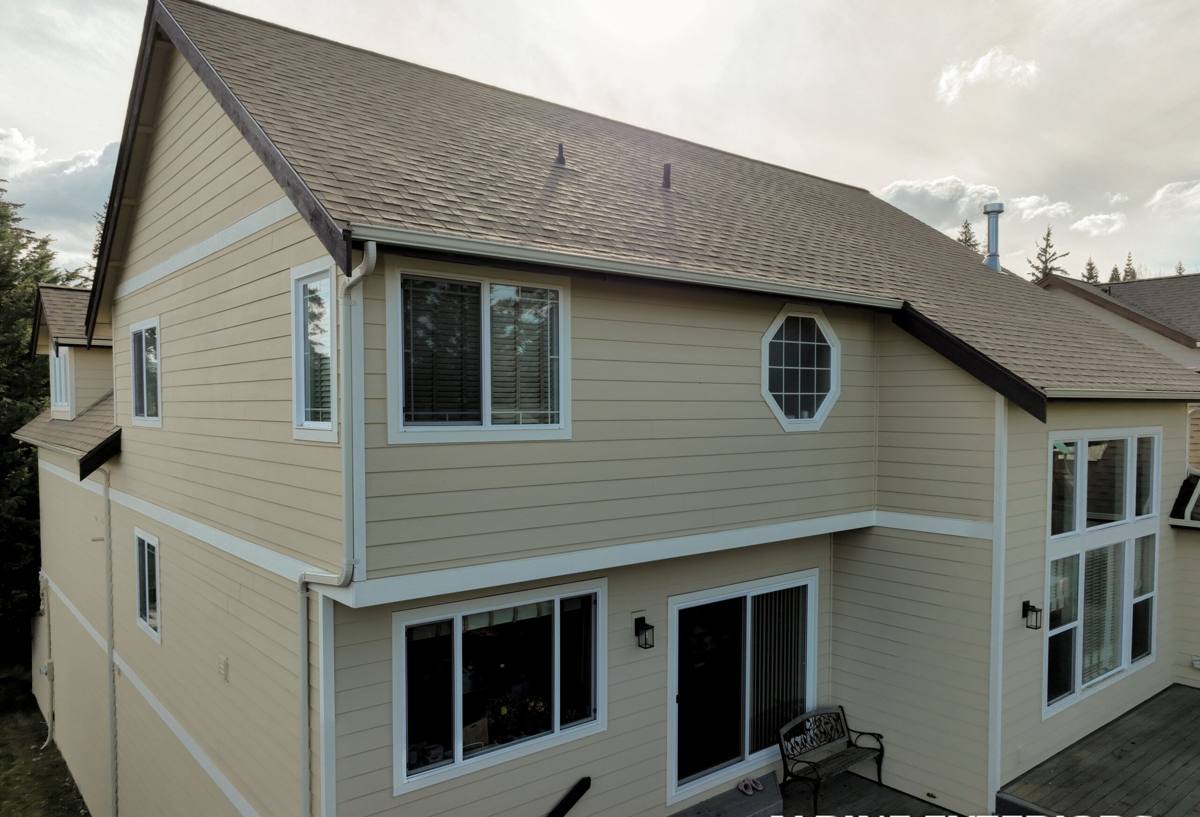
What Ferndale's Climate Actually Does to This Siding Style
Ferndale sits close enough to Semiahmoo Bay and the Strait of Georgia that salt-laden air is a real factor on exterior materials, not a theoretical one. Combine that with the long stretches of driving rain that come through Whatcom County most of the year, plus a moss season that can run from fall through spring on shaded or north-facing walls, and you've got three separate stressors working on the siding at once.
Salt Air
Salt exposure accelerates corrosion on fasteners, flashing, and any metal trim components. It also degrades cheaper paint and coating systems faster than an inland climate would, which is why the durability of the factory finish matters more here than it might in a drier region.
Driving Rain
Vertical board and batten has more seams per square foot than a standard lap profile, and every one of those seams is a place water can find its way behind the panel if it isn't lapped, flashed, or caulked correctly. Wind-driven rain off the water pushes moisture into places that gravity alone wouldn't reach, which is exactly the condition that exposes a sloppy install.
Moss and Sustained Dampness
Shaded elevations and tree-covered lots — common throughout Ferndale — stay damp for extended periods. Moss and algae need that sustained moisture to establish, and once they take hold on a porous or absorbent siding material, they hold even more water against the wall. That's a slow, compounding problem more than a sudden one, but it's a real one.
Why We Install This in James Hardie Fiber Cement — and Nothing Else
We only install James Hardie fiber cement siding. We don't install vinyl, LP SmartSide, primed spruce, cedar, or other fiber cement brands, and board and batten is actually one of the clearest examples of why that standard exists.
Wood board and batten looks great new, but it's an absorbent, organic material sitting in a climate that gives it near-constant moisture exposure. It needs regular refinishing to hold up, and any lapse in that maintenance shows up fast as cupping, checking, or rot at the panel edges and batten joints. Vinyl board and batten is low-maintenance but it's a thin, flexible material — it can distort in temperature swings, and its color is baked all the way through a plastic sheet that doesn't hold up the same way a factory-engineered finish does over decades. LP SmartSide is an engineered wood product, which means it performs well when the factory coating stays fully intact, but any breach at a cut edge or fastener hole exposes wood fiber that can swell if moisture gets in.
James Hardie fiber cement doesn't have that vulnerability. It's non-combustible, dimensionally stable in wet climates, and doesn't rely on an unbroken surface coating the way engineered wood does — the material itself resists moisture-driven swelling and rot in a way organic siding can't. Hardie's HZ5 product line is specifically engineered for climates like ours, with a formulation built to handle sustained moisture exposure. The ColorPlus factory finish is baked on and warrantied against fading and flaking well beyond what field-applied paint or vinyl coloring can promise. When we put board and batten on a Ferndale home, we're using vertical Hardie panel with Hardie trim battens — a system designed to be installed as one assembly rather than trim pieced together from mismatched materials.
What a Correct Board & Batten Installation Actually Involves
The style is simple to describe but not simple to install correctly. Every one of the following steps matters for how the wall performs in five, ten, or twenty years — skipping any of them is how a good-looking install turns into a callback.
- Weather-resistive barrier: a continuous, properly lapped house wrap behind the panels, with all penetrations sealed before a single panel goes up.
- Rainscreen or drainage gap: a small air gap behind the siding lets any moisture that does get past the panel drain and dry out instead of sitting against the wall sheathing.
- Panel layout and seams: vertical Hardie panels installed plumb, with seams landing over solid backing and properly gapped per manufacturer spec — not tight-butted, which doesn't allow for expansion.
- Batten placement and fastening: battens fastened through the panel into structural framing, not just into the panel face, with consistent spacing that also carries the wind and moisture load correctly.
- Flashing at every transition: windows, doors, roof lines, and any horizontal trim need step flashing or kick-out flashing so water is directed out and away from the wall assembly, never behind it.
- Fastener selection: corrosion-resistant fasteners rated for the coastal exposure this region gets, driven to the correct depth so they don't crack the panel or sit loose.
- Cut-edge treatment: every field cut sealed per Hardie's specifications, since a factory finish only protects the surfaces it was applied to.
- Caulking and sealant: a quality, flexible sealant at the joints that will move with the building without failing prematurely in our temperature and humidity swings.
Any one of these steps done wrong is invisible on install day and obvious three to five years later — usually as a moisture stain, a soft spot at a butt joint, or moss establishing at a seam that never dried out.
How Our Process Works
1. On-Site Assessment
We walk the home, check the condition of the existing siding and sheathing, and look specifically at drainage, sun exposure, and which elevations get the most wind-driven rain or shade — the details that decide how we detail the installation, not just how it looks.
2. Product and Layout Plan
We confirm panel width, batten spacing, and trim details with the homeowner before ordering material, and we plan seam locations around windows, corners, and transitions so the finished wall reads clean.
3. Tear-Off and Prep
Old siding comes off, sheathing is inspected and repaired where needed, and the weather-resistive barrier and drainage gap go in before any Hardie product touches the wall.
4. Installation
Panels and battens go up to Hardie's fastening and clearance specifications, with flashing integrated at every window, door, and roofline as we go — not added afterward.
5. Final Detailing and Walkthrough
We seal cut edges, caulk joints, clean up the site, and walk the finished job with the homeowner so everyone's looking at the same wall and agrees it's right.
Comparing Board & Batten Material Options
| Material | Moisture Performance in Wet, Salt-Air Climate | Maintenance | Finish Longevity |
|---|---|---|---|
| James Hardie Fiber Cement | Strong — engineered for coastal, high-moisture regions (HZ5 line) | Low — occasional wash | ColorPlus factory finish, long warranty |
| Cedar / Wood | Moderate — absorbs moisture, prone to rot without upkeep | High — refinishing on a regular cycle | Field-applied stain/paint fades faster |
| Vinyl | Fair — doesn't rot but can warp or distort with temperature swings | Low | Color can fade; not repaintable in the same way |
| LP SmartSide (engineered wood) | Fair — vulnerable at cut edges or coating breaches | Moderate | Factory coating, but wood core beneath |
Maintenance Checklist for Ferndale Homeowners
Board and batten in James Hardie fiber cement is genuinely low-maintenance, but "low" isn't "none," especially in a climate that grows moss on anything that stays damp long enough.
- Rinse the siding, especially shaded and north-facing walls, once or twice a year to keep moss and algae from establishing.
- Keep gutters clear so overflow isn't running down the wall face or pooling at the base of the siding.
- Trim back trees and shrubs that keep an elevation shaded and damp longer than the rest of the house.
- Inspect caulking at seams, trim, and penetrations every couple of years and re-seal if it's cracking or pulling away.
- Check fastener heads and battens periodically for any sign of corrosion staining, particularly on elevations facing the water.
- Repaint is optional with ColorPlus finish, but if you ever do change color, use a Hardie-approved product and process to protect the warranty.
What Real Cost Factors Look Like
Board and batten typically costs somewhat more than standard lap siding per square foot, mostly due to the extra material (battens) and the added labor of getting seams and fastening right. Beyond that baseline, a few things move the number on any given Ferndale home:
| Factor | Why It Matters |
|---|---|
| Tear-off scope | Removing multiple old layers or repairing rotted sheathing adds labor before installation even starts |
| Wall height and access | Two-story gables and steep sites need more scaffolding and time |
| Trim and batten spacing | Tighter batten spacing uses more material and more fastening labor |
| Number of penetrations | Windows, vents, and fixtures each need individual flashing and detailing |
| Full house vs. accent use | Board and batten as a gable or accent feature costs less than a full-elevation install |
We'll always give you a real number after seeing the house, not a guess based on square footage alone — the condition of what's underneath the existing siding affects the price as much as the new material does.
Why Hiring a Crew That Already Works Ferndale Matters
A lot of siding problems in this region trace back to a crew that installed the product correctly for a drier climate but not for ours. Ferndale's exposure to salt air off the bay, the volume of driving rain we get through fall and winter, and the shaded, moss-prone lots that are common here all change what "correct installation" means in practice — flashing details, drainage gap decisions, and fastener choices that would be optional elsewhere aren't optional here. A crew that's already worked houses in this specific area has already seen which walls take the worst of the weather and details accordingly, instead of learning that lesson on your house.
If you're weighing board and batten for a Ferndale home, we're happy to walk the property, talk through where it makes sense, and give you a straightforward, no-pressure estimate using the form below.