 Semiahmoo
 Why Decks Near Drayton Harbor Wear Out Faster
A deck built for Drayton Harbor and the surrounding Semiahmoo waterfront is doing a different job than a deck in a dry inland yard. The marine air coming off the harbor and Semiahmoo Bay carries salt that settles into wood grain, metal fasteners, and any gap in a finish. Add the driving rain that blows in sideways during Whatcom County's wet months, and a long moss season that starts early and doesn't let up until late spring, and you have three separate forces working on the same structure at the same time. None of them is dramatic on its own. Together, over several winters, they're what turns a solid deck into a soft, spongy, or rusted-out one.
We're not describing a worst-case scenario — this is the normal life cycle of an untreated or poorly maintained deck this close to the water. The good news is that almost all of the damage this climate causes is preventable with the right materials, the right fasteners, and repairs done correctly the first time.
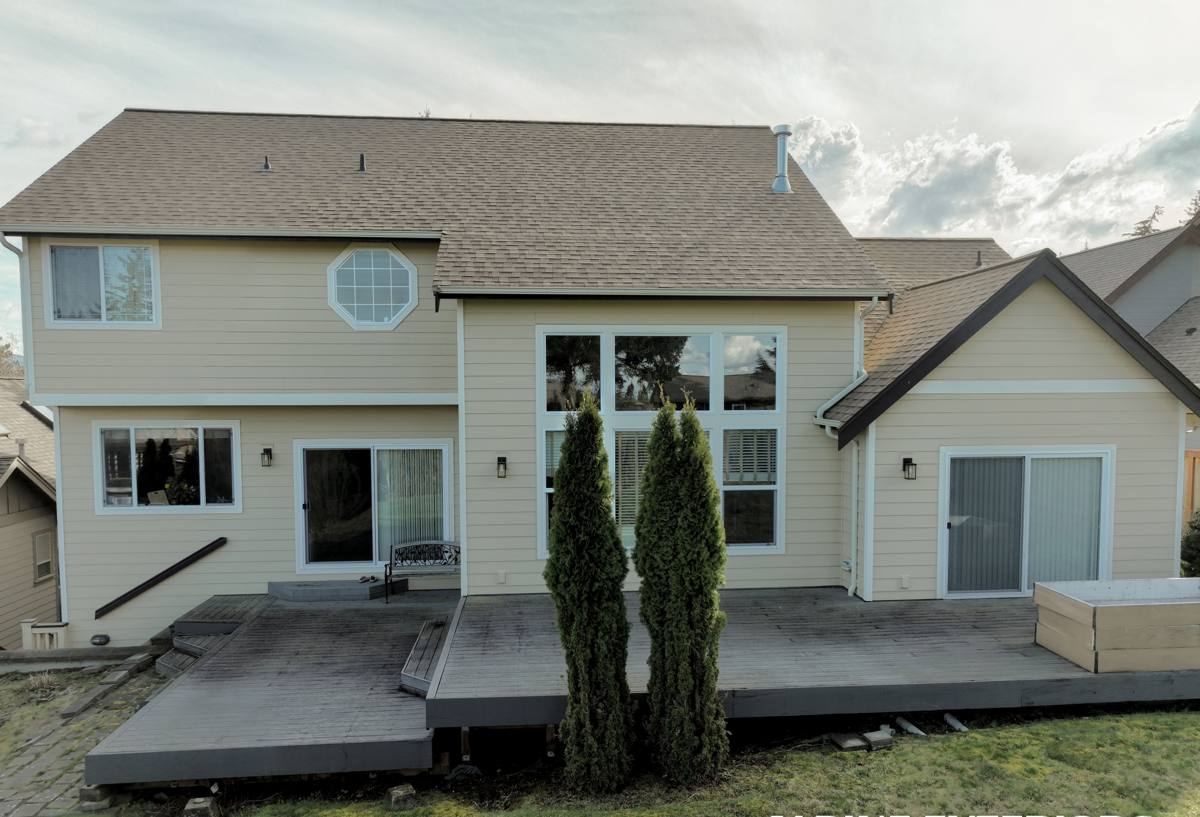
The First Signs of Trouble
Deck problems near the water rarely show up as one big failure. They start small and get ignored because the deck still looks fine from a few feet away. Here's what we tell homeowners to check twice a year, especially after the wet season:
- Boards that feel spongy, springy, or noticeably softer underfoot in one spot
- Rust streaks running down from screw heads or bolt connections
- Gaps opening up between boards, or boards that have started to cup or crown
- Green or black film building up faster in shaded corners or under railings
- Any wobble in the railing posts when you push on them
- Visible daylight or gaps where the ledger board meets the house
- A musty smell coming from underneath the deck
Any one of these on its own might just need a repair. Several at once, especially rust plus soft boards, usually means water has been getting into the structure for a while.
Repair or Replace? How We Make That Call
Most decks don't need to be torn out — they need targeted repair to the parts that actually failed. We check the framing underneath first, because that's the part that determines everything else. If the joists, beams, and posts are solid and just the surface decking has weathered, that's a straightforward repair. If the framing itself has soft spots, especially near the ledger connection to the house, that's a structural issue that needs to be fixed properly, not patched over with a new board on top.
We'll never talk you into a full rebuild when a repair will genuinely hold up, and we won't recommend a surface patch over a structural problem just to keep the job small. We tell you what we find and what it means, and you decide from there.
What a Correct Deck Repair Actually Involves
Framing and Structure
Any joist, beam, or post showing rot or significant softness gets sistered, reinforced, or replaced — not just covered. Framing repairs are load-bearing work, and cutting corners here is the single most common reason a "repaired" deck fails again within a year or two.
Fasteners and Hardware
This is where salt air does the most damage and where a lot of repairs go wrong. Standard galvanized screws and nails corrode faster this close to Drayton Harbor and Semiahmoo Bay than they would even a few miles inland. A correct repair uses fasteners and structural hardware rated for coastal or marine exposure, not whatever is cheapest at the hardware store.
Ledger Board and Flashing
The ledger board — where the deck attaches to the house — is the single most common point of hidden rot on any deck, and it's almost always caused by missing or failed flashing letting water track behind the board over time. A repair that doesn't address flashing at this connection is a repair that will need to be done again.
Decking Surface
Individual boards get replaced to match the existing material as closely as possible, with proper gapping left between boards for drainage and seasonal movement. Tight, gapless board replacement is a common DIY mistake that traps water and speeds up rot in exactly the spot you just fixed.
Choosing Materials That Hold Up in This Climate
When boards need replacing, homeowners near the harbor usually choose between matching the existing wood, upgrading to a more rot-resistant wood species, or switching sections to composite decking. Each has real trade-offs — there's no universally "best" answer, only what fits your deck, your budget, and how much upkeep you want going forward.
| Material | How It Handles Salt Air & Rain | Maintenance | Trade-offs |
|---|---|---|---|
| Pressure-treated fir/hem | Good if fasteners and sealant are right; treatment resists rot | Needs re-sealing every 1-2 years near the water | Lowest cost, shortest interval between refinishing |
| Cedar | Naturally rot- and insect-resistant; still needs a sealed finish | Re-sealing every 1-2 years, more if it's shaded and stays damp | Better looks and feel underfoot; softer, so dents and wear show more |
| Composite decking | Doesn't absorb moisture or rot; some boards can fade or chalk from UV and salt exposure over many years | Periodic washing, no sealing or staining | Higher upfront cost, mixing composite repairs into an existing wood deck needs planning to match height and trim |
For a repair — as opposed to a full rebuild — we usually recommend matching the existing decking material unless it's failed across most of the deck, in which case switching materials during the repair can make sense. We'll walk through what that means for your specific deck rather than pushing one material as the default answer.
Our Process for Drayton Harbor Deck Repairs
- Full inspection from underneath. We check framing, the ledger connection, and fastener condition before touching the surface — surface problems and structural problems don't always show up in the same place.
- Written scope, no guesswork. You get a clear list of what's being repaired, what materials and fasteners we're using, and why, before any work starts.
- Structural work first. Framing, ledger, and flashing issues get corrected before we touch decking or railings, since those are what the rest of the repair depends on.
- Surface and railing repair. Boards, railings, and stairs get repaired or replaced with material and fasteners suited to this climate.
- Walkthrough. We show you what was done and what to watch for going forward, especially around moss and drainage.
Cost Factors
Deck repair pricing depends on how much of the deck is affected and whether the problem is structural or cosmetic. Rather than quote a flat number that won't mean much without seeing your deck, here's what actually moves the price:
| Factor | Why It Matters |
|---|---|
| Framing vs. surface-only damage | Structural repairs to joists, beams, or ledger boards take more labor and material than swapping surface boards |
| Fastener and hardware upgrades | Coastal-rated fasteners cost more than standard galvanized, but they're what keeps a repair from rusting out again in a few years |
| Deck size and board count | More linear feet of decking to remove and replace means more labor and material |
| Access and height | Elevated decks or decks with limited underneath access take longer to inspect and repair properly |
| Material choice | Composite costs more upfront than wood but reduces future maintenance |
We give exact numbers only after we've actually looked at the deck — anything else is a guess, and guesses aren't useful to you.
Keeping Your Deck Ahead of Moss and Salt
A properly repaired deck still needs regular attention in this climate. A little consistent maintenance is far cheaper than letting problems build up again over a few wet seasons.
- Sweep debris and standing leaves off the deck regularly, especially in shaded corners where moss takes hold first
- Rinse salt film off the surface periodically, particularly after storms with wind off the water
- Check the ledger flashing and any spots where the deck meets the house once a year
- Re-seal or re-stain wood decking on the schedule appropriate to the material — don't wait until it looks obviously weathered
- Keep gutters and downspouts near the deck clear so runoff isn't draining directly onto or under it
- Address soft boards or rust spots as soon as you notice them, before the next wet season sets in
Why a Crew That Already Works Semiahmoo and Drayton Harbor Matters
Deck repair done right in this climate isn't the same job as deck repair fifty miles inland, and it isn't a job you want a crew learning on your house. We already know which fasteners hold up against this air, how flashing needs to be detailed at the ledger to keep water out during a driving rain, and how fast moss builds back if it isn't addressed properly the first time. That's not a sales pitch — it's the difference between a repair that lasts and one you're paying for again in three years.
If you're seeing soft boards, rust streaks, or a deck that just doesn't feel as solid as it used to, we're happy to take a look and give you an honest read on what it needs. Reach out for a free, no-pressure estimate using the form below — we'll tell you plainly what we find, whether that's a small repair or something bigger.