 Semiahmoo
 Why Laurel Decks Wear Differently Than Decks Inland
Laurel sits close enough to Semiahmoo Bay and the broader Puget Sound shoreline that homes here deal with a combination most inland Whatcom County properties don't: salt-laden air, long stretches of driving rain off the water, and a moss season that can run from October through April in a wet year. None of these things is dramatic on its own. Together, over ten or fifteen years, they're exactly what breaks down a poorly built deck.
Salt air accelerates corrosion on anything metal — fasteners, brackets, railing hardware — long before most people notice it. Driving rain doesn't just fall straight down here; wind off the water pushes it sideways and up under rail caps, fascia boards, and stair stringers where a lot of decks never get properly flashed or sealed. And moss doesn't need much: shade, moisture, and a surface it can grip onto. A deck built without airflow underneath, or with boards packed too tight, gives moss and algae exactly the environment they want.
Composite decking handles this climate better than most alternatives when it's specified and installed correctly. The material itself resists rot and doesn't need to be refinished, but "composite" isn't a single product — board quality, fastening method, and substructure work vary enormously, and the install is where most long-term problems start or get avoided.
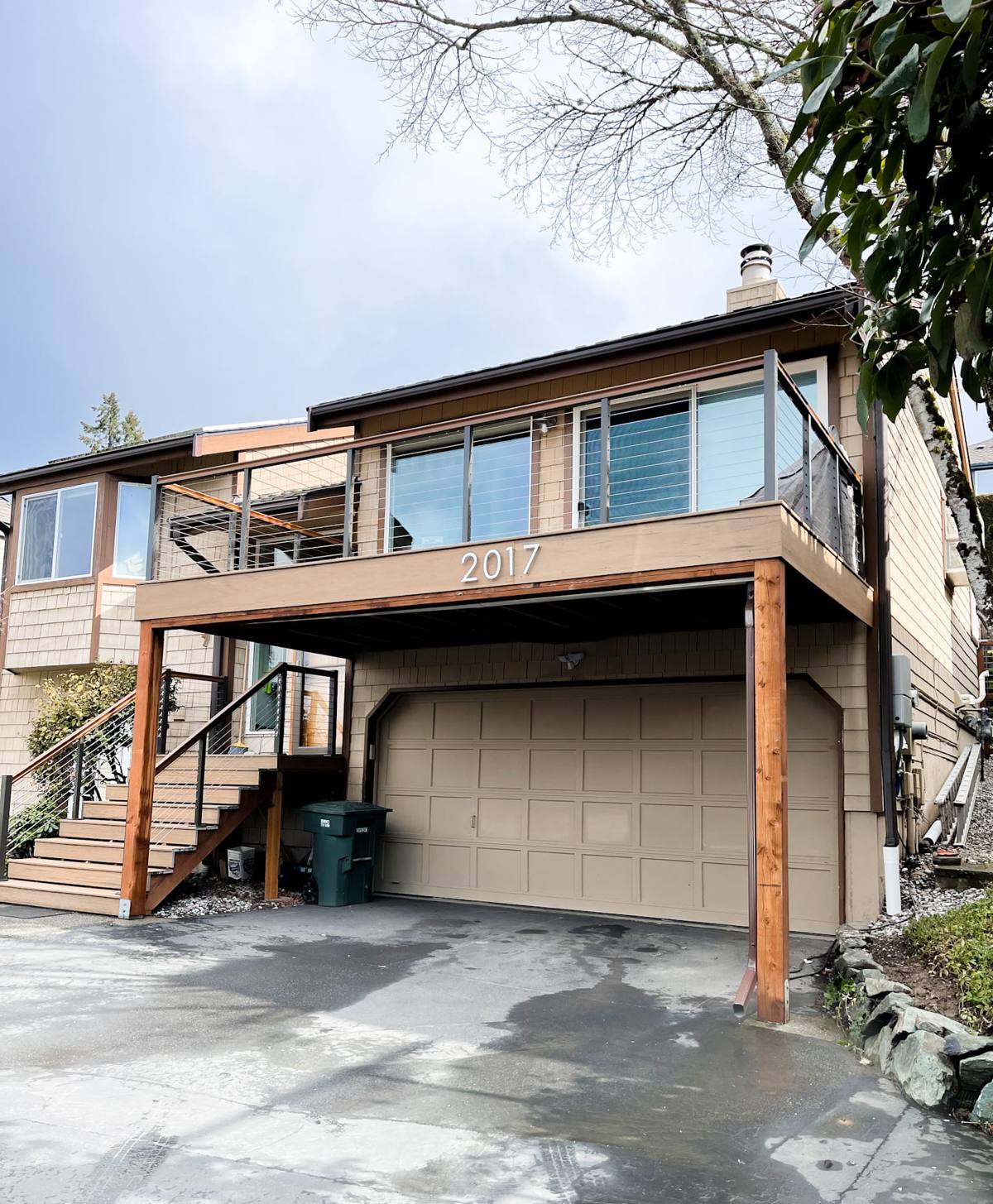
What a Correct Composite Deck Build Looks Like Here
Framing and Moisture Management
The framing underneath a composite deck matters as much as the boards on top, maybe more, in a wet coastal climate. Joists should be protected with a proper joist tape or flashing membrane, not just left as bare treated lumber — treated wood still absorbs water at the cut ends and fastener holes, and that moisture sits against the underside of composite boards if there's nowhere for it to go. Adequate air gap and slope away from the house keep water moving instead of pooling.
Fastening and Board Spacing
Board spacing needs to account for both composite's thermal expansion and this area's rainfall volume. Too tight, and water and debris get trapped between boards, which is exactly where moss and algae take hold first. Too loose, and you get an uneven, sloppy-looking deck that collects grit in the gaps. Hidden fastener clip systems are worth the extra labor time in most cases — they avoid face screws that can loosen, back out slightly, and create a spot where water sits and staining starts.
Railings, Fascia, and Flashing at the House
The ledger board connection at the house is the single most common failure point on any deck, composite or wood. It needs proper flashing so wind-driven rain doesn't track behind it and into the rim joist or siding. Railing posts need solid, corrosion-resistant hardware given the salt air — standard zinc-coated fasteners aren't enough this close to the water, and it shows up as rust streaks and loosening hardware within a few years if the wrong hardware gets used.
Composite vs. Other Decking Materials for This Climate
| Factor | Composite (capped) | Pressure-treated wood | PVC |
|---|---|---|---|
| Moisture/rot resistance | High — capped boards shed water and don't absorb like wood | Moderate — needs regular sealing to hold up near the water | Very high — fully synthetic, no organic material |
| Moss/algae resistance | Good, especially capped boards with a textured but non-porous surface | Poor — porous surface holds moisture and grip for growth | Good, similar to capped composite |
| Maintenance | Occasional washing; no staining or sealing | Annual or biennial staining/sealing to keep performing | Occasional washing; no staining or sealing |
| Upfront cost | Mid to upper-mid range | Lowest upfront cost | Highest upfront cost |
| Look/feel underfoot | Wood-like texture, wide color range | Natural wood grain, ages and grays over time | Can look slightly more plastic in some lines |
| Typical warranty | 25–50 years on capped boards (fade/stain coverage varies) | No material warranty; performance depends on maintenance | 25–50 years, similar structure to composite |
We install composite most often in this area because it's the best balance of upfront cost, low maintenance, and performance against salt air and moss for homeowners who don't want to be out there staining a deck every other summer. That said, it's not automatically the right call for every project — some homeowners genuinely prefer real wood's look and are willing to keep up the maintenance, and that's a legitimate choice too. We'll give you a straight answer on trade-offs rather than push one material because it's what we happen to have on the truck.
What Drives Cost on a Composite Deck
| Cost factor | Why it matters |
|---|---|
| Board tier (base vs. premium capped) | Higher-tier boards typically have better fade and stain resistance, which matters more here given rain and organic debris |
| Substructure condition | Reusing sound existing framing costs less than a full tear-out and rebuild |
| Height and stairs | Elevated decks and multi-level stairs add framing, railing, and code complexity |
| Railing system | Composite or metal railing systems cost more than basic wood but hold up better in salt air |
| Fastening method | Hidden fastener systems add labor time but reduce long-term maintenance issues |
| Site access | Decks over slopes or with limited equipment access take longer to build |
How We Approach a Composite Decking Project in Laurel
We start with a site visit, not a phone quote. A deck's exposure — how much direct rain and wind it takes off the water, how much shade it sits in, what the existing framing looks like underneath if there's a deck to replace — changes what we recommend. We're not guessing at your specific lot from a satellite photo.
- On-site assessment of the existing structure (if replacing) or the build site, including drainage and sun/shade exposure
- Written scope covering board tier, fastening method, railing system, and any framing or flashing work needed
- Permit pull where required by Whatcom County — deck height, guardrail requirements, and footing depth all factor in
- Tear-out and disposal of the old deck, if applicable, with attention to what's happening at the ledger connection
- Framing and moisture management work before a single composite board goes down
- Board installation with correct spacing and fastening for this climate
- Railing, stairs, and trim installed with corrosion-resistant hardware
- Final walkthrough so you know what maintenance (if any) the specific product you chose actually needs
Living With a Composite Deck Through a Whatcom County Winter
Even a well-built composite deck benefits from a little seasonal attention here, mostly because of what falls on it, not because the material itself is failing. A checklist we'd give any homeowner in this area:
- Sweep leaves and needles off regularly in fall — trapped organic debris is the main food source for moss and algae on any deck surface
- Rinse the deck a couple of times during the wet season, especially shaded areas that don't get direct sun to dry out
- Check railing hardware annually for corrosion, particularly on decks with direct bay exposure
- Keep gutters and downspouts near the deck clear so runoff isn't dumping extra water onto or under the deck surface
- Confirm drainage under the deck isn't blocked by stored items, planters, or debris buildup over time
- Address any soft spots, movement, or gaps at the ledger connection promptly rather than waiting
That's genuinely most of it. Composite doesn't need staining, sealing, or sanding, which is the main reason it's become the default choice for homeowners in wetter, shadier parts of the county who are tired of a maintenance cycle that never quite keeps up.
Signs an Existing Deck in This Area Needs Replacing, Not Patching
- Soft, spongy, or discolored framing at the ledger board or joists — often the first place moisture damage shows up
- Persistent moss or dark staining that comes back within weeks of cleaning
- Loose or rusted fasteners and railing hardware that keep working themselves loose
- Visible gaps or separation where the deck meets the house
- Boards that are cupping, splintering, or have gone soft underfoot
- A deck that was never properly flashed at the house — often invisible until damage is already underway behind the siding
If you're only seeing surface wear — fading, minor staining, cosmetic scratches — that's often a cleaning or refinishing issue rather than a rebuild. We'll tell you honestly which category your deck falls into rather than sell you a full replacement you don't need.
Why a Crew That Already Works This Area Matters
A lot of what separates a deck that holds up for twenty-five years from one that needs rework in five isn't the brand of board — it's whether the crew building it actually accounts for local conditions. A crew used to building in a dry inland climate might not think twice about standard fastener coatings, minimal ledger flashing, or tight board spacing, because none of that causes visible problems where they usually work. Here, those same shortcuts show up as rust streaks, trapped moisture, and moss within a few seasons.
Working regularly in and around Semiahmoo and Laurel also means we're familiar with Whatcom County permitting requirements for decks — height thresholds that trigger guardrail and footing requirements, inspection scheduling, and how local building department reviews typically go. That familiarity keeps a project moving instead of stalling on paperwork or a failed inspection over something a locally experienced crew would have caught the first time.
Get a Straight Answer for Your Property
Every deck on the water side of Whatcom County deals with a slightly different mix of sun, wind, shade, and rain exposure, and that mix should shape the actual build, not just the sales pitch. If you're planning a new composite deck in Laurel or considering whether your current deck is worth repairing versus replacing, we're happy to come take a look and give you a straightforward assessment — no pressure, no upsell, just what we'd actually recommend for your specific property. Request a free estimate using the form below and we'll get back to you to schedule a visit.