 Semiahmoo
 Why Cherry Point Puts Ordinary Siding to the Test
Cherry Point sits right on the Strait of Georgia in Whatcom County, close enough to Semiahmoo and Blaine that homes here get the same weather pattern we see all along this stretch of coastline: salt-laden air blowing off the water, long stretches of driving rain, and short, low-angle winter sun that never quite dries things out. Add in the tree cover common to rural Whatcom County lots, and you get a fourth factor that's just as damaging as the first three — moss and algae that colonize any siding surface that stays damp and shaded for weeks at a time.
None of this is unique to any one house. It's the baseline environment every exterior surface in this area has to survive, year after year, without a break. Siding that's rated for a dry inland climate — or installed with inland assumptions about drainage and fastening — tends to show its age here faster than the homeowner expects. That's the gap we're closing when we talk about a "Cherry Point job" instead of a generic siding job.
Salt Air Attacks the Details, Not Just the Surface
Airborne salt doesn't just dull paint. It accelerates corrosion on anything metal — fasteners, flashing, trim caps — and it's abrasive on finishes that aren't engineered to shed it. A siding product can look fine in a showroom and still struggle within a few years once it's facing onshore wind day after day.
Driving Rain Finds the Weak Points
Wind-driven rain doesn't fall straight down — it gets pushed sideways into laps, seams, and butt joints. Any siding system with poor drainage detailing, or any installation that skipped proper flashing and gapping, eventually lets water behind the cladding. Once moisture gets behind siding on a house this close to the water, it has a much harder time drying out than it would inland.
Moss Season Is Longer Here Than Most Homeowners Realize
Shaded, north-facing walls and anything near mature trees stay damp for a large part of the year in this part of Whatcom County. That's exactly the condition moss and algae need to take hold. On some siding materials, that growth also traps moisture against the surface, which compounds the water-exposure problem rather than just being a cosmetic issue.
Why We Install Only James Hardie Fiber Cement
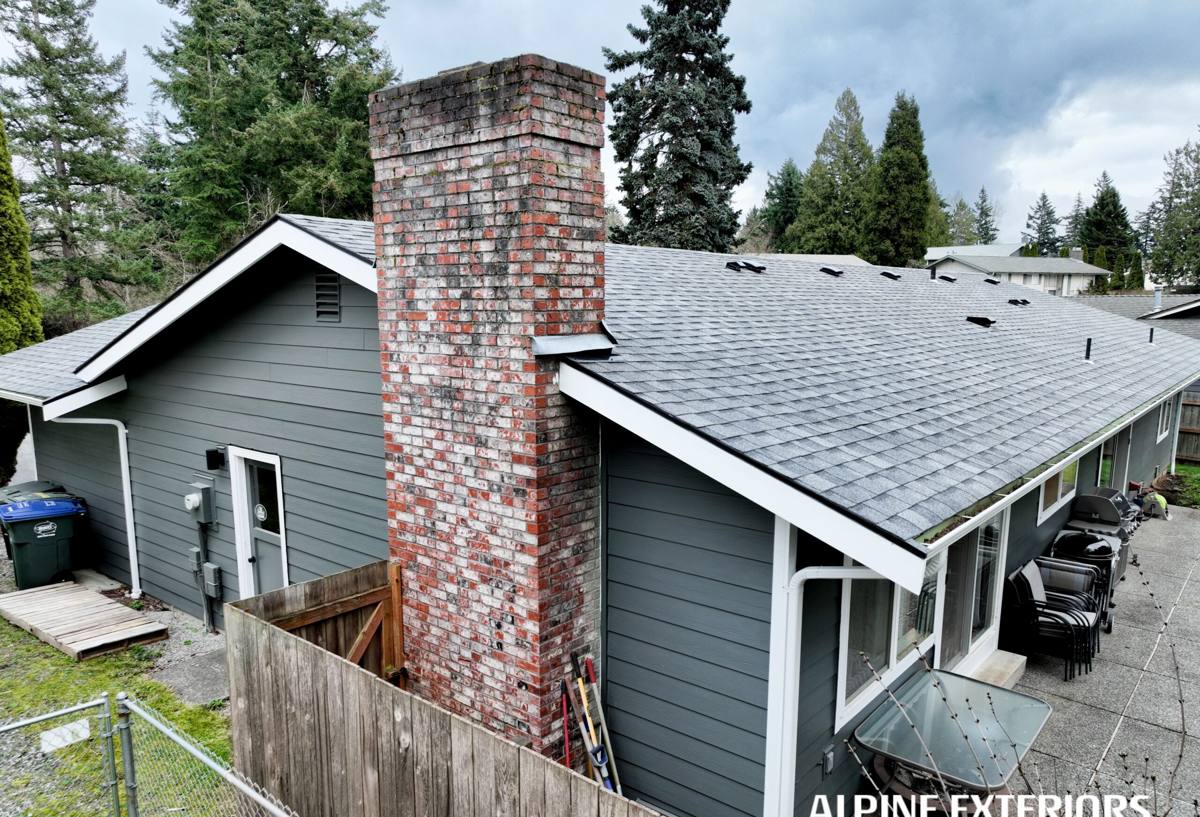
We've standardized on James Hardie siding for every home we work on, including in Cherry Point, because it's a fiber cement product engineered specifically for this kind of exposure. It's non-combustible, it doesn't swell, rot, or delaminate the way wood-based products can when they take on moisture, and the ColorPlus factory finish is baked on under controlled conditions rather than field-sprayed — which gives it better resistance to fading and to the kind of salt-and-UV combination this coastline delivers.
James Hardie also makes climate-engineered HZ product lines, and for a location like Cherry Point we spec the HZ5 formulation built for wetter, harsher climate zones. That's not a marketing detail — it affects how the board is formulated to handle moisture cycling over decades, not just how it looks on day one.
We don't install vinyl, LP SmartSide, Cemplank, Allura, primed spruce, or cedar. Every one of those products has legitimate uses somewhere. But each comes with a trade-off — vinyl's seams and heat sensitivity, engineered wood's dependence on unbroken paint film to stay dry, cedar's ongoing maintenance and fire rating — that we don't think holds up well against the specific combination of salt air, driving rain, and moss exposure this area sees. James Hardie is the one product line where we're comfortable standing behind the long-term result on a Cherry Point exterior.
What a Correct Installation Actually Involves
The material is only half of the equation. James Hardie's own installation guidelines are detailed for a reason — most siding failures we get called out to inspect trace back to installation shortcuts, not the product itself. On a coastal, high-rain job like Cherry Point, a few details matter more than usual:
- Correct clearance and gapping at every butt joint, corner, and penetration, sealed with a flexible sealant rated for the exposure — not caulked tight with no room to move
- Proper flashing above windows, doors, and any horizontal trim so water is directed out and away from the wall assembly, not just relying on caulk
- A weather-resistive barrier installed and lapped correctly underneath the siding, with rainscreen furring where the wall assembly calls for it, so any moisture that does get behind the cladding has a path to drain and dry
- Fastener placement and spacing that matches Hardie's published specs for the specific plank or panel profile, using fasteners rated to resist corrosion in a salt-air environment
- A starter strip and finish details set correctly at the foundation line, since that's the joint most exposed to splash-back and standing moisture
None of this is exotic. It's just the difference between an installation that meets spec and one that looks fine at completion but starts showing problems in year three or four — cracked caulk lines, staining at the joints, or moisture damage that isn't visible until the siding is pulled back.
Cost Factors on a Cherry Point Job
Every home is different, so we don't quote off square footage alone. The factors below are the ones that actually move a Cherry Point estimate up or down:
| Factor | Why It Matters Here |
|---|---|
| Tear-off vs. overlay | Removing old siding lets us inspect and repair sheathing that may have taken on moisture — common on older coastal homes |
| Existing moisture damage | Rot or soft sheathing found during tear-off has to be replaced before new siding goes on, which affects both cost and schedule |
| Wall complexity and trim | More corners, dormers, and window trim means more flashing and cut work, which is where installation quality matters most |
| Exposure side | Walls facing the water or prevailing wind often get upgraded flashing and sealant details, which is time well spent given the exposure |
| HZ5 vs. standard HZ product | The climate-engineered line costs a bit more than a standard-zone product but is what we spec for this location |
| Number of stories and access | Staging and scaffolding needs go up with height, which affects labor time more than material cost |
How Our Process Works
1. On-Site Walkthrough
We look at the whole exterior, not just the siding — trim, flashing, gutters, and anywhere we can see or suspect moisture has been getting in. On a home this close to the water, we pay particular attention to the wall facing the prevailing weather and any shaded areas already showing moss or algae growth.
2. Honest Scope and Estimate
We tell you what we find, including anything that looks like it needs more than a siding swap — soft sheathing, failed old flashing, trim that's already past saving. No pressure, no upsell games. You get a clear scope before anything is torn off.
3. Tear-Off and Inspection
Once the old siding is off, we can actually see the wall assembly. Any damaged sheathing or framing gets addressed before a single new board goes up — installing new siding over a compromised wall just locks the problem in.
4. Installation to Spec
Weather-resistive barrier, flashing, fastening, and gapping all done to James Hardie's published requirements for the HZ5 product and the specific climate exposure of the wall. This is the stage where the details from the section above actually get executed.
5. Final Walkthrough
We walk the finished job with you, check the trim and caulk lines, and make sure everything matches what was scoped.
Maintaining Hardie Siding in a Salt Air, High-Moss Environment
James Hardie siding is genuinely low-maintenance compared to wood or engineered wood products, but "low-maintenance" doesn't mean "no maintenance," especially in this climate. A simple annual routine keeps it performing the way it's designed to:
- Rinse the siding once a year, focusing on shaded and north-facing walls where moss and algae take hold first
- Keep gutters clear so overflow isn't running down the wall face during heavy rain events
- Trim back vegetation and tree cover that keeps a wall shaded and damp longer than the rest of the house
- Check caulk lines at trim and penetrations every couple of years and have any cracked or shrunk sealant redone before it becomes a water path
- Watch for any staining at the bottom courses near grade, which usually means splash-back or a drainage issue worth addressing early
Why a Crew That Already Works Cherry Point Matters
Siding installation in this part of Whatcom County isn't the same job as siding installation forty miles inland. A crew that's used to milder, drier conditions can install a technically correct-looking job that still isn't detailed for the amount of wind-driven rain and salt exposure a Cherry Point wall actually sees. Working this area regularly means we already know which walls need the extra flashing detail, which fastener spacing holds up to the wind load out here, and what moss and algae growth on an existing house usually tells us about drainage before we even get on a ladder.
It also means straightforward logistics — material lead times, scheduling around this area's weather windows, and a crew that isn't learning the region on your project.
Is James Hardie Right for Your Cherry Point Home?
If your current siding is showing chronic moss staining, cracked caulk joints, soft spots, or paint that won't hold, those are signs the material or the installation — sometimes both — isn't keeping up with this environment. James Hardie fiber cement, installed to spec with the flashing and drainage details this location calls for, is built to handle exactly that combination of salt air, driving rain, and shade-driven moss growth for the long haul.
If you'd like a straightforward look at your home's siding — no pressure, no sales script — we're glad to come take a look and give you a free estimate.