 Semiahmoo
 Building a Deck That Actually Holds Up in Cherry Point
Cherry Point sits close enough to the water that every deck built here is fighting a slightly different battle than a deck built twenty miles inland. Salt-laden air moves through the area regularly, wind-driven rain gets under things that would stay dry elsewhere, and the wet season runs long enough that moss and algae get a real head start on any surface that doesn't drain and dry quickly. None of that means a deck can't last decades here — it means the material choices, the framing details, and the fastener hardware all need to be picked with that exposure in mind from day one, not treated as an afterthought.
A lot of the deck problems we get called out to look at in this part of Whatcom County aren't design failures — they're moisture and corrosion failures that started small and were never visible until the damage was already structural. That's the gap this page is meant to close: what a Cherry Point deck actually needs, what a correctly built one looks like, and what our process does differently because we work this specific stretch of coastline regularly.
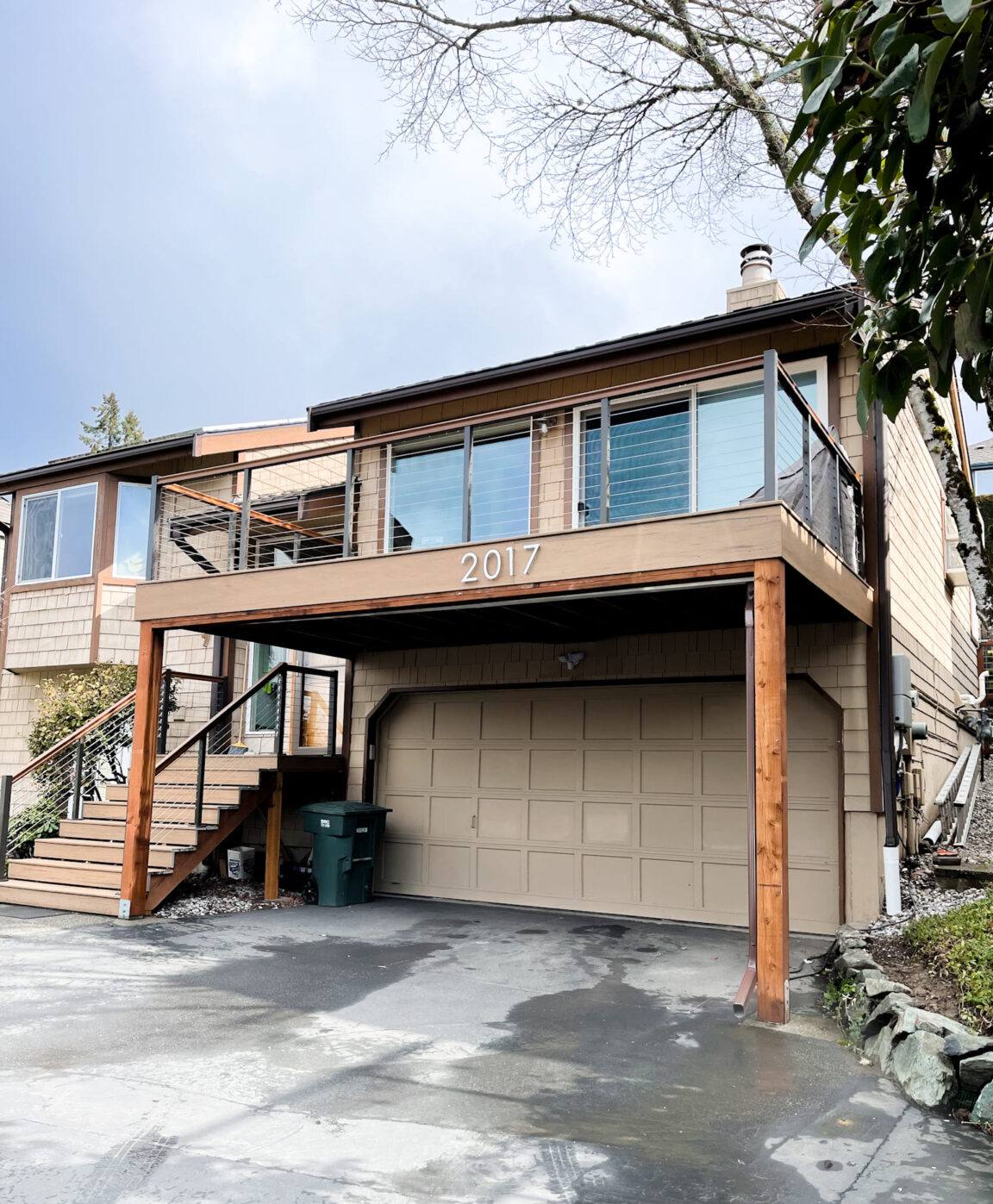
What Salt Air, Driving Rain, and Moss Actually Do to a Deck
Each of these three factors attacks a deck differently, and understanding the difference matters when you're deciding what to build with and how to build it.
Salt Air and Corrosion
Airborne salt doesn't need direct ocean spray to cause problems — it travels on wind and settles on any exposed metal. Standard zinc-coated deck screws and joist hangers that are rated fine for an inland build can start showing rust streaks and pitting years earlier near Semiahmoo. Once a fastener starts to corrode, it loses holding strength quietly, often long before there's any visible sign at the deck surface.
Driving Rain and Water Intrusion
Rain that comes in sideways, which is common in this part of Washington, gets pushed into joints, under ledger boards, and behind fascia in ways that vertical rain never would. A deck built with the flashing and gap details meant for a calmer climate will let water track into places it was never supposed to reach — usually the ledger-to-house connection, which is also the single most safety-critical joint on the whole structure.
Moss, Algae, and the Long Wet Season
Whatcom County's wet season stretches long enough that any decking surface with poor drainage, minimal airflow underneath, or a rough/porous surface texture will grow moss and algae well before it would in a drier climate. Beyond looking bad, wet moss on a walking surface is a real slip hazard, and moss roots hold moisture against the board itself, which accelerates rot in wood decking and can stain composite surfaces if left unaddressed.
Choosing Decking Material for This Exposure
There's no single "best" decking material for every project — it depends on budget, maintenance appetite, and how much direct salt exposure a given lot actually gets. Here's how the common options actually perform under Cherry Point conditions.
| Material | Moisture / Salt Performance | Moss Resistance | Maintenance |
|---|---|---|---|
| Pressure-treated wood | Good if properly sealed and re-sealed on schedule; fasteners must be stainless or hot-dip galvanized rated for treated lumber | Low — needs regular cleaning and re-sealing to resist moss buildup | Annual inspection, re-seal every 1-3 years |
| Cedar | Naturally rot-resistant but softer; still needs sealing near salt air to prevent graying and surface breakdown | Moderate — better natural drainage but still needs cleaning | Re-seal every 1-2 years, more frequent cleaning |
| Capped composite | Excellent — the cap layer resists moisture absorption and salt staining much better than uncapped composite or wood | High — smooth, low-porosity surface sheds moss more easily | Periodic washing, no sealing required |
| PVC decking | Excellent — fully synthetic, doesn't absorb moisture at all | High, though can still grow surface algae without cleaning | Periodic washing, no sealing required |
For homes with direct water exposure or heavy wind, we generally steer clients toward capped composite or PVC for the walking surface specifically because they don't rely on an owner keeping up a sealing schedule to stay protected. That's not a knock on wood — a well-maintained cedar or treated deck can look great for a long time — it's just an honest trade-off: wood decking in this climate is lower upfront cost but higher ongoing maintenance burden, and if that maintenance slips, the material shows it fast.
What Doesn't Change With Material: The Framing
Whatever decking surface you choose, the substructure underneath is where corrosion-resistant hardware matters most, because it's the part you can't see and can't easily inspect once the boards are down.
Framing and Fastener Details That Actually Matter Here
The visible decking gets all the attention, but the framing underneath is what determines whether a deck is still safe in fifteen years. In a salt-air, high-rain environment, we treat these details as non-negotiable rather than upgrades:
- Stainless steel or hot-dip galvanized joist hangers, screws, and structural hardware rated for coastal exposure — not standard electro-galvanized fasteners
- Proper ledger board flashing with a drainage gap, so any water that reaches the house connection sheds away from the wall rather than pooling against it
- Post bases set above grade and away from standing water, with concrete footings sized and set to current code depth for this frost and soil condition
- Joist spacing and blocking that account for the actual decking material's span rating — composite and PVC often require tighter joist spacing than wood
- Airflow underneath the deck — adequate clearance and, where the design allows, gaps or venting so the underside can dry out between rain events instead of staying damp
Skipping any one of these doesn't show up as a problem in year one. It shows up in year eight or ten, as a soft ledger connection, rust-streaked hangers, or a deck that "just needs a little give" when you walk near the rail — which is usually a sign the framing has already started to fail.
Our Deck Building Process
Every Cherry Point deck project follows the same core sequence, adjusted for the specific footprint, elevation, and exposure of the site.
1. Site Walk and Design
We look at sun and wind exposure, drainage slope, how close the site is to prevailing weather, and how the deck ties into the house. This is also when we talk through material trade-offs honestly, based on what we're actually seeing on that lot.
2. Permitting
Most deck projects in Whatcom County require a permit, especially anything attached to the house or built above a certain height. We handle that process as part of the job rather than leaving it to the homeowner to sort out.
3. Demolition or Site Prep
For a rebuild, this includes checking what's actually happening under the old deck — it's common to find moisture damage at the ledger or posts that wasn't visible from the surface, which we'll flag before moving forward.
4. Footings and Framing
Footings are set to code depth, posts and beams go in plumb and level, and all structural hardware is the corrosion-resistant grade discussed above — this is the step that determines the deck's actual lifespan more than any other.
5. Decking, Rail, and Stairs
Surface material goes down with proper spacing for drainage and material expansion, followed by railing and stair systems built to current code for guard height and baluster spacing.
6. Final Walkthrough
We walk the finished deck with the homeowner, cover basic maintenance expectations for whatever material was chosen, and make sure everything's sound before calling the job done.
Maintenance: What Actually Keeps a Cherry Point Deck Healthy
The build quality sets the ceiling, but ongoing care determines whether a deck reaches it. Here's a realistic maintenance checklist for this climate specifically:
- Sweep debris off the surface regularly — trapped leaves and needles hold moisture and feed moss growth
- Wash the deck surface at least once or twice a year to remove early moss and algae before it takes hold
- Check fastener heads and visible hardware annually for rust streaking, especially near rail posts and stair stringers
- Re-seal wood decking on the schedule appropriate to the product — don't wait until graying is severe
- Keep gutters and downspouts near the deck clear so roof runoff isn't dumping extra water onto or under the structure
- Confirm underdeck drainage or venting hasn't been blocked by stored items or plant growth
Signs an Existing Deck Needs Attention
If you've got an existing deck in the Cherry Point area, a few warning signs are worth checking for before they become bigger problems: soft or spongy spots in the decking, rust streaking below hardware, visible gaps or dark staining at the ledger board connection, and moss that keeps coming back within weeks of cleaning. Any of those is worth a professional look before the next wet season, not after.
Cost Factors to Expect
Deck project cost depends heavily on size, material, elevation, and site access, but the biggest cost drivers on any Cherry Point job tend to be the same handful of factors:
| Factor | Why It Moves the Price |
|---|---|
| Decking material | Composite and PVC cost more upfront than wood but reduce long-term maintenance cost |
| Height and stairs | Elevated decks require more structural framing, railing, and code-compliant stair work |
| Ledger and flashing complexity | Difficult house connections or siding types can add labor to do the flashing correctly |
| Footing and soil conditions | Poor drainage or difficult access can increase excavation and footing costs |
| Corrosion-resistant hardware | Stainless or coastal-rated fasteners cost more than standard hardware but are worth it here |
We'll walk through these specifics for your actual site during the estimate rather than quoting a number without seeing the lot — deck pricing that doesn't account for site conditions usually ends up being wrong in one direction or the other.
Why Hire a Crew That Already Works Cherry Point
A crew that builds decks all over the region, without regular exposure to this specific coastal condition, can still build a structurally sound deck — but they're more likely to default to standard hardware and standard details that work fine inland and fall short here. Working Cherry Point regularly means we've already seen how salt air and driving rain affect decks built without those upgrades, and we build with that knowledge baked in rather than learning it on your project. It also means we know the local permitting process, the typical soil and drainage conditions in the area, and how to sequence a build around the wetter stretches of the year without cutting corners to hit a deadline.
If you're planning a new deck or need an honest look at an existing one, we're glad to walk the site and put together a straightforward, no-pressure estimate — just fill out the form below.