 Semiahmoo
 Storm Damage Roof Repair for Blaine Homes
Blaine sits at the northern tip of Whatcom County, wrapped by Semiahmoo Bay and Drayton Harbor and open to whatever the Pacific throws at it before it makes landfall. Storms here don't need to be dramatic to do real damage — a steady winter system with sustained wind and hours of driving rain can lift shingles, work flashing loose, and push water into places it was never supposed to reach. We work on roofs across Blaine and out toward Semiahmoo regularly enough to know that storm damage in this area rarely looks like the textbook version. It's often quieter: a few missing shingles, a soft spot near a chimney, a slow stain on a ceiling that shows up weeks after the wind event that actually caused it.
This page is about one job: repairing a roof after a storm has damaged it, correctly, for a house in this specific climate. Not a general roofing pitch, and not a checklist copied from a drier part of the country. What follows is what we actually look for, what a proper repair involves, and how we decide between a repair and a full replacement when a Blaine roof has taken a hit.
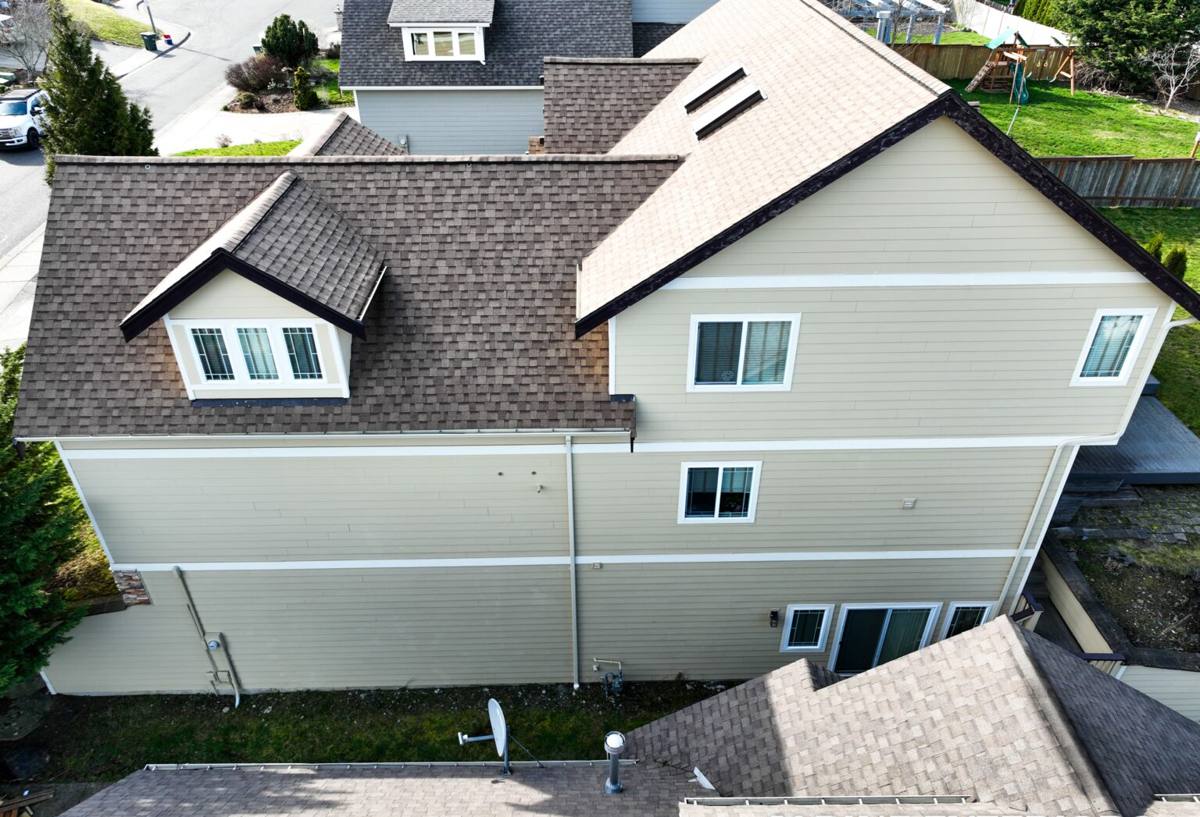
What Blaine's Weather Does to a Roof
Wind Off the Water
Blaine's position on the bay means very little breaks the wind before it hits a roofline. Gusts here can get up under shingle tabs and edges, especially on roofs where the seal strip never bonded fully or where age has already weakened the adhesive. Once wind gets a starting point, it works a shingle loose progressively, storm by storm, until a piece finally tears free or lets water underneath it.
Driving Rain and Wind-Driven Moisture
Rain off Semiahmoo Bay rarely falls straight down during a real storm. Wind pushes it sideways and up under laps, at valleys, and around any roof penetration — vent pipes, chimneys, skylights — that isn't flashed tightly. That sideways force finds weak points a calm-weather inspection would miss, which is exactly why storm damage often shows up as a leak somewhere other than where the visible damage is.
Salt Air and Metal Fatigue
Close to the water, salt-laden air accelerates corrosion on every exposed metal component of a roof — flashing, vent caps, gutter fasteners, nail heads. A storm doesn't cause that corrosion, but it exploits it: a flashing joint that's already rusting through fails faster under wind and rain load than one that's still sound. That's part of why the same storm can damage one Blaine roof and leave a similar one next door untouched.
Moss on Top of Everything Else
Whatcom County's moss season runs long, and a roof that's been holding moisture under a moss mat is already softer and more vulnerable before a storm ever arrives. Moss holds water against shingles and roof decking far longer than a clean surface would, and that constant dampness weakens the material a storm then finishes off. We see this combination — moss damage plus storm damage — often enough on Blaine roofs that we check for both at the same time, not one after the other.
Common Storm Damage We Find on Blaine Roofs
- Lifted, torn, or missing shingles — usually starting at ridges, edges, and any spot where the wind gets the most direct hit
- Granule loss from wind and hail impact, which shows up as bare patches or granules collecting in gutters
- Flashing failures at chimneys, skylights, and roof-to-wall transitions, often already weakened by salt-air corrosion before the storm
- Soft or damaged decking underneath shingles that have been letting moisture through for longer than the homeowner realized
- Damaged or clogged gutters and downspouts that then push water back up under the roof edge during the next storm
- Debris impact damage from branches or wind-carried material, which can puncture or crack shingles without always being visible from the ground
What a Proper Storm Damage Repair Involves
A storm damage repair that actually holds up in this climate goes past just replacing the shingles that are obviously missing. A repair that only addresses what's visible from the driveway tends to fail again in the next storm, sometimes in the exact same spot.
- A full roof inspection, not just a look at the damaged section, since wind and rain damage often extends past the obvious spot
- Checking the decking underneath removed shingles for soft spots, staining, or rot before anything new goes back on
- Replacing or resealing flashing at every penetration near the damaged area, not just patching around it
- Matching shingle type and, where possible, color and lot so the repair blends and performs the same as the surrounding roof
- Confirming proper nailing pattern and fastener type, since under-driven or corroded fasteners are a common reason repairs fail early in a coastal climate
- Checking attic ventilation and insulation near the repair, since trapped moisture from a storm can cause problems that show up long after the roof itself is fixed
Repair vs. Replacement: How We Make the Call
Not every storm-damaged roof needs to come off entirely, and not every roof is worth patching. The decision comes down to the roof's age, how much of it is affected, and what condition the rest of it is in once we're actually up there.
| Factor | Favors Repair | Favors Replacement |
|---|---|---|
| Roof age | Roof is within its expected service life | Roof is already near or past the end of its expected life |
| Extent of damage | Damage is localized to one section or slope | Damage is spread across multiple sections or the whole roof |
| Decking condition | Decking underneath is sound once exposed | Decking shows widespread soft spots, rot, or water staining |
| Prior moss or moisture history | Isolated moss with no underlying material breakdown | Long-term moss growth has already compromised shingle or decking material broadly |
| Matching materials | Matching shingles are available for a clean, blended repair | Original shingle line is discontinued or too weathered to match |
We walk the roof and make this call in person rather than off a photo or a phone description. Two roofs that look similar from the ground can be in very different condition once we're actually checking decking and flashing up close, and that's not something we're willing to guess at.
Our Process for Storm Damage Calls in Blaine
- Inspection. We get up on the roof, not just around it, and document damage to shingles, flashing, decking, and any related areas like gutters or attic ventilation.
- Honest assessment. We tell you plainly whether this is a repair, and why, or whether the damage and the roof's condition point toward replacement instead.
- Documentation. If you're filing an insurance claim, we provide clear photos and a written scope of the damage that your adjuster can work from.
- The repair or replacement itself. Work is done to manufacturer installation specs, with attention to the flashing, fastening, and ventilation details that matter most in this climate, not just the visible shingle layer.
- Final walkthrough. We check the completed work with you before we consider the job done, not just leave an invoice.
Storm Damage and Insurance Claims
Most homeowner policies cover sudden storm damage — wind, hail, falling debris — though coverage details and deductibles vary by policy, and we're not the ones who can tell you what your specific policy covers. What we can do is document the damage clearly and give you an honest, specific scope of repair that reflects what we actually find, not an inflated estimate built to match what a claim might pay out. That distinction matters: a scope that's accurate holds up better with an adjuster than one that looks padded, and it's the right way to handle the job regardless of how the claim goes.
Not every storm-related repair rises to the level of filing a claim, especially with smaller, localized damage below a policy's deductible. We'll give you a straight answer on the scope and cost either way so you can decide how to handle it.
Why It Matters That the Crew Already Works Blaine
A crew that works this stretch of Whatcom County regularly knows what a storm out of the northwest typically does to a roofline here versus what it does further inland, and that shapes where we look first and what we check twice. We've seen how salt air quietly weakens flashing and fasteners years before a storm actually exploits that weakness, and how a moss mat can hide decking problems that a quick glance would miss entirely. That background means fewer surprises mid-repair and a better read on whether a roof genuinely needs to come off or can be brought back with a solid, correctly executed repair.
Signs a Blaine Roof Needs a Storm Damage Inspection
- Missing, torn, or curling shingles after a windstorm
- Granules collecting in gutters or downspouts following heavy wind or rain
- New or worsening water stains on ceilings or interior walls
- Visible sagging or soft spots when walking near the roofline from a ladder
- Daylight visible through the attic roof deck
- Rust streaks near flashing, vents, or gutter fasteners
- Debris, branches, or noticeable granule loss on the roof surface after a storm
If you're seeing any of these after a recent storm, it's worth having the roof looked at before the next system off the water finds the same weak point. We offer free, no-pressure estimates for storm damage roof repair in Blaine and the surrounding Semiahmoo area — reach out using the form below and we'll take a straightforward look and tell you exactly where things stand.