 Semiahmoo
 Why Blaine Roofs Wear Differently Than Homes Inland
A roof in Blaine doesn't age the same way a roof twenty miles inland does. Sitting right up against the water near Semiahmoo, homes here take a steady dose of salt-laden air, wind-driven rain that gets pushed sideways under eaves and flashing, and a moss season that can run most of the year in the shade of tall firs and cedars. None of this is dramatic on its own, but it compounds. Fasteners corrode faster near the coast. Underlayment and decking that stay damp longer than they should start to break down from the inside, long before the shingles on top look obviously bad. By the time a homeowner notices staining on a ceiling or granules piling up in the gutters, the roof has often been struggling quietly for a couple of years.
That's the core argument for treating a Blaine roof replacement as a Whatcom County job, not a generic one. The materials, the fastening schedule, the ventilation design, and the flashing details all need to account for salt exposure and near-constant moisture, not just wind speed and snow load on a spec sheet.
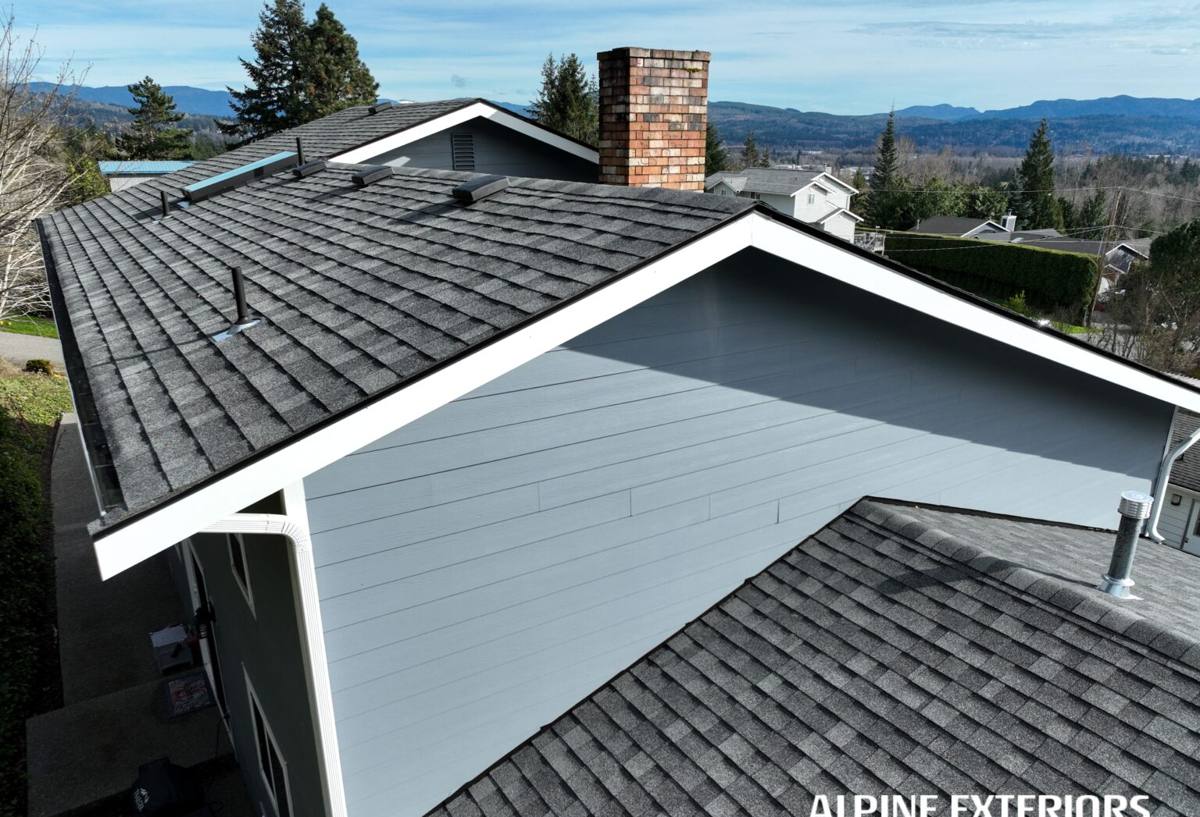
Signs Your Blaine Roof Needs Replacement, Not Another Repair
Repairs make sense when a roof has isolated damage and years of usable life left. Replacement makes sense when the underlying materials are failing across the board, even if the visible symptoms look small. Here's what tends to separate the two in this area:
- Granule loss heavy enough that you can see bare, shiny patches on multiple slopes, not just one storm-damaged spot
- Shingles that are cupping, curling at the edges, or cracking when you walk the roof
- Moss growth that keeps coming back within a season or two of cleaning, especially on north-facing slopes
- Soft or spongy decking felt underfoot during inspection, a sign moisture has reached the plywood or OSB
- Rusted or lifting flashing around chimneys, skylights, and roof-to-wall transitions
- Daylight visible through the attic sheathing, or damp insulation below the roof deck
- A roof already past 20-25 years old for asphalt shingle, regardless of how it looks from the ground
- Repair costs that keep recurring in the same areas year after year
If two or three of these apply, a full replacement is usually the more honest recommendation than another round of patching.
Choosing the Right Roofing Material for Semiahmoo's Coastal Climate
There's no single "best" roofing material everywhere, but some hold up better than others in salt air and constant wet-dry cycling. We walk every material's trade-offs with the homeowner rather than pushing one default option.
| Material | How it handles coastal conditions | Maintenance | Typical lifespan here |
|---|---|---|---|
| Architectural asphalt shingle | Good performance when properly ventilated; needs corrosion-resistant fasteners near the water | Periodic moss removal, gutter checks | 20-25 years |
| Standing seam metal | Excellent shedding of driving rain; needs a marine-grade or coated finish to resist salt corrosion | Low; occasional fastener and seam checks | 40-50+ years |
| Cedar shake | Traditional look but holds moisture longer, which accelerates moss and rot in shaded, damp yards | High; regular treatment and moss control | 20-30 years with upkeep |
| Synthetic/composite shingle | Resists moisture absorption well; good option where cedar look is wanted without the upkeep | Low to moderate | 30-40 years |
We don't install cedar shake as a default recommendation for shaded, moisture-heavy Blaine lots — not because it's a bad product, but because its maintenance burden and moisture behavior are a poor match for a north-facing roof under trees. That's a judgment about the site, not a knock on the material itself.
Underlayment matters as much as the surface layer
In this climate, we treat underlayment as a primary defense, not a formality. A synthetic underlayment with good tear resistance, backed by self-adhered ice-and-water membrane at eaves, valleys, and penetrations, buys real protection against the wind-driven rain that gets under shingle tabs during winter storms off the strait.
What a Correct Roof Replacement Involves
A roof replacement is more than swapping old shingles for new ones. Done right, it's a full system rebuild:
- Complete tear-off to bare decking, so we can actually inspect the plywood or OSB underneath rather than layering over hidden rot
- Decking repair or replacement anywhere the sheathing has softened from long-term moisture intrusion
- New underlayment matched to the material and the exposure level of that particular roof
- Ice-and-water membrane at eaves, valleys, and around chimneys and skylights, where wind-driven rain concentrates
- Corrosion-resistant fasteners and flashing throughout, given the salt content in the air this close to the water
- Proper attic ventilation — balanced intake and exhaust so moisture from inside the house doesn't condense against the underside of the new deck
- Final inspection of every penetration, seam, and transition before we consider the job finished
Skipping any one of these steps is usually where a "new roof" ends up leaking within a few years.
Our Roof Replacement Process, Step by Step
- On-site inspection. We walk the roof, check the attic, and look at decking condition, ventilation, and flashing before recommending anything.
- Written estimate. Material options, scope of work, and a clear price — no vague allowances that turn into surprise add-ons later.
- Scheduling around weather windows. We plan tear-offs for stretches of manageable weather and keep the house protected if conditions shift mid-project.
- Tear-off and deck inspection. Old roofing comes off down to the sheathing, and any soft or damaged decking gets flagged and replaced.
- Underlayment and flashing installation. This is where most of the long-term waterproofing performance actually comes from.
- New roofing material installed to manufacturer specs, with fastening patterns and detailing suited to coastal wind and rain exposure.
- Site cleanup and magnetic nail sweep, then a final walkthrough with the homeowner.
Cost Factors for a Blaine Roof Replacement
Every roof is different, so we don't quote prices sight unseen, but the main variables that move the number are consistent:
| Factor | Why it affects cost |
|---|---|
| Roof size and pitch | More square footage and steeper slopes mean more material and more labor time/safety setup |
| Number of layers to remove | Tear-off of multiple existing layers takes longer and adds disposal cost |
| Decking condition | Rotted or soft sheathing found during tear-off requires replacement before new roofing goes on |
| Material choice | Asphalt, metal, and composite options carry different material and installation costs |
| Roof complexity | Valleys, dormers, skylights, and chimneys all add flashing detail and labor |
| Ventilation upgrades | Adding or correcting intake/exhaust venting is worth doing during a replacement, not after |
As a general range, most straightforward asphalt shingle replacements on a typical Blaine home fall somewhere in the mid five figures, with metal and more complex rooflines running higher. An on-site walk-through is the only way to get a number you can actually rely on.
Moss, Algae, and Long-Term Roof Maintenance in Whatcom County
Even a well-installed roof needs some upkeep in this climate. Moss thrives in the shade and moisture that's normal for much of the year around Semiahmoo, and left unchecked it lifts shingle edges and holds water against the surface. A few habits go a long way:
- Keep gutters clear so water isn't backing up under the roof edge
- Trim back overhanging branches to cut down shade and debris buildup
- Have moss removed gently, not power-washed, which can strip granules
- Consider zinc or copper strips near the ridge on shingle roofs prone to repeat moss growth
- Schedule a roof check every couple of years, especially after major winter storms
Why Hire a Crew That Already Works in Blaine
A crew that's replaced roofs elsewhere in the Pacific Northwest but hasn't worked this specific stretch of coastline can still do competent work — but there's a real advantage to hiring one that already knows how Blaine's salt air, exposure to wind off the water, and shaded, moss-prone lots behave over time. That familiarity shows up in small decisions: which fastener grade to use without being asked, where ice-and-water membrane earns its keep beyond the code minimum, and which slopes on a given lot need extra attention because of tree cover or wind direction. It also means a crew that understands Whatcom County permitting and can plan around this region's rainy stretches instead of getting caught mid-tear-off by a system rolling in off the strait.
If your roof is showing its age, or you just want an honest read on how much life it has left, we're happy to take a look. The estimate is free, there's no pressure attached to it, and you'll get a straight answer either way — use the form below to get started.