 Semiahmoo
 Why Bellingham Homes Need Siding That's Built for This Coastline
Bellingham sits close enough to the water that homes take on a steady diet of salt-laden air, wind-driven rain, and long stretches of overcast, damp weather that can run from October well into spring. Add in the tree cover common around Whatcom County neighborhoods, and you get a fourth factor working against your siding: moss and algae that thrive wherever moisture lingers on a wall. Siding here isn't just a cosmetic layer. It's the thing standing between that climate and your sheathing, framing, and insulation, day after day, year after year.
Not every siding product handles that combination well. Materials that perform fine in a dry inland climate can start showing problems within a few years on a Bellingham exterior — swelling at seams, paint failure, soft spots at the bottom courses, or a green cast that keeps coming back no matter how often it's washed. That's the backdrop for why we install fiber cement, specifically James Hardie products, and why we think through every detail of a Bellingham job differently than we would somewhere drier.
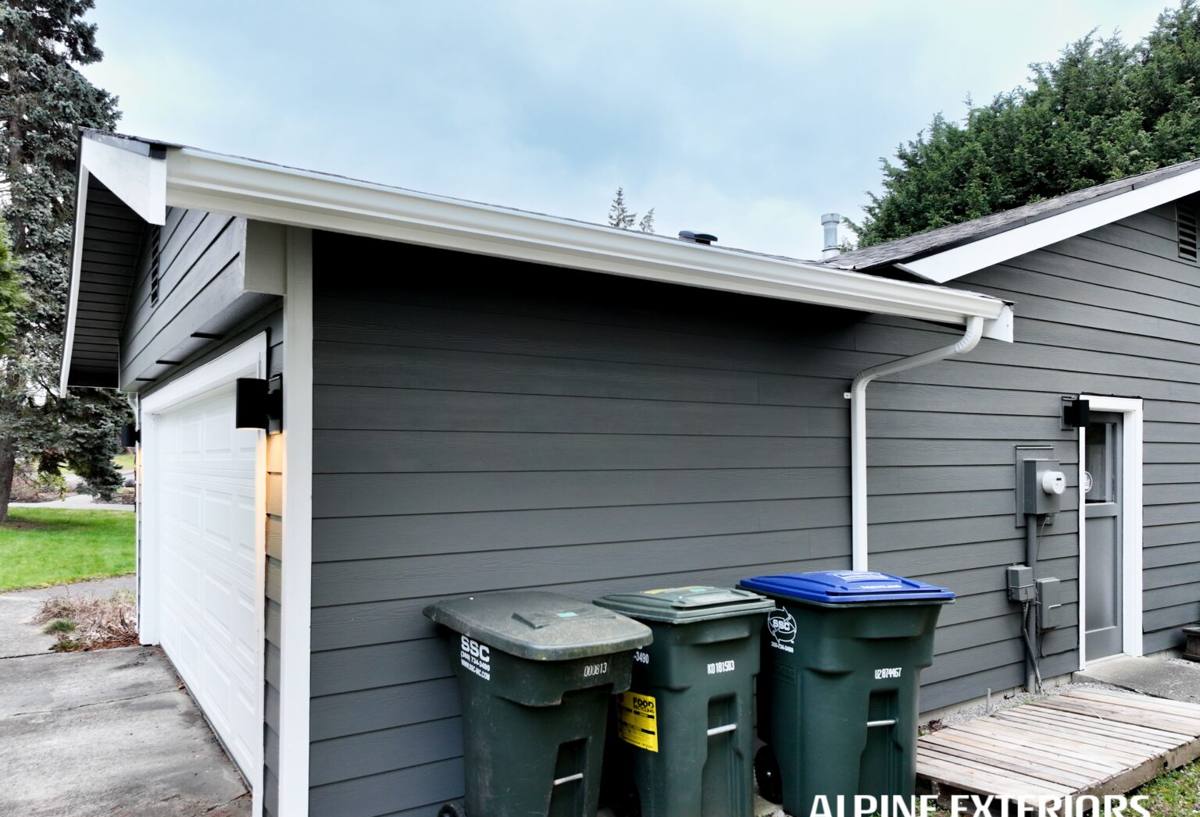
What Bellingham's Climate Actually Does to Siding
Salt Air
Proximity to Puget Sound and the Strait of Georgia means airborne salt is a real factor here, not a theoretical one. Salt accelerates corrosion of metal fasteners and trim, and it can degrade certain paint and coating systems faster than manufacturers' general climate ratings assume. Siding and the fasteners holding it need to be chosen with that in mind, not just picked off a generic spec sheet.
Driving Rain
Storms off the water frequently come in sideways rather than straight down, which means rain gets driven into laps, seams, and butt joints that would stay dry in a calmer climate. A siding system's weather-resistive barrier, flashing details, and joint treatment matter more here than they would inland — the water is actively being pushed at every gap in the installation, not just falling on the face of the wall.
Long Moss and Algae Season
Whatcom County's damp, mild, tree-shaded conditions are close to ideal for moss and algae growth. Any siding material that stays damp for extended periods — because it absorbs moisture, or because it's installed too close to grade or landscaping — will grow something green on it eventually. The fix isn't constant power-washing; it's a material and installation approach that sheds water and dries out between rain events instead of holding it.
Why We Install Only James Hardie Fiber Cement
Fiber cement is cement, sand, and cellulose fiber, engineered to be dimensionally stable and non-combustible. It doesn't swell and rot the way wood-based products can when they take on repeated moisture, and it doesn't have the seam and expansion issues that some other siding materials develop over time in a wet climate. James Hardie specifically offers HZ5 formulations engineered for the Pacific Northwest's moisture and freeze-thaw cycle, along with a factory-applied ColorPlus finish that's baked on under controlled conditions rather than field-painted — which matters a lot in a region where field painting has to compete with rain, humidity, and a short dry-weather installation window.
We don't install vinyl, LP SmartSide, Cemplank, Allura, or primed wood siding. That's not a knock on every homeowner who has one of those products already on their house — plenty of them perform fine for years under the right conditions. It's a standard we hold for what we put on a home ourselves, because we've seen how each of those alternatives handles long-term exposure to salt air, driving rain, and a wet climate compared to Hardie, and we'd rather stand behind one system we know inside and out than install several we have reservations about.
What a Correct Fiber Cement Job Requires in This Climate
- A weather-resistive barrier installed and lapped correctly, with all penetrations properly flashed before a single piece of siding goes up
- Proper clearance from grade, decks, and roof lines so the bottom of the siding isn't sitting in a moisture trap
- Correctly fastened panels — right nail type, right spacing, right depth — since over-driven or corrosion-prone fasteners are one of the most common failure points on coastal jobs
- Caulked and sealed joints at trim, corners, and penetrations, using sealants rated for the movement and moisture cycling this climate produces
- Rainscreen or drainage detailing where the wall assembly calls for it, so any water that does get behind the cladding has somewhere to go
- Field-touched cut edges sealed with manufacturer-approved product, since a raw cut edge is the one place ColorPlus's factory protection doesn't reach on its own
Our Process for a Bellingham Fiber Cement Project
1. Assessment
We start by walking the exterior and looking specifically at the conditions this climate creates: siding-to-grade clearance, existing moisture damage, roofline and gutter interaction, and how much moss or algae buildup is already present. That assessment shapes the scope — sometimes it's straightforward re-siding, and sometimes it uncovers sheathing or trim damage that needs to be addressed before new siding goes on.
2. Product and Color Selection
We walk homeowners through Hardie's plank, panel, and shingle-style options along with the ColorPlus palette, factoring in how each finish and texture tends to perform and weather in a marine climate like Bellingham's.
3. Tear-Off and Sheathing Check
Old siding comes off and we inspect the sheathing underneath. This is often where hidden moisture damage from years of driving rain shows up, and it's far cheaper to address at this stage than to find out later.
4. Weather Barrier and Flashing
This is the step that determines how the wall performs for the next 30-plus years, and it's the step that's easiest to rush. We don't rush it.
5. Installation
Panels, fasteners, and joint treatment are done to Hardie's specifications, adjusted for the exposure level of each elevation — a wall that takes the brunt of prevailing storms gets the same rigor as one that's more sheltered, not less.
6. Final Detailing and Walkthrough
Trim, caulking, and touch-up paint on cut edges are finished, and we walk the job with the homeowner before calling it done.
Comparing How Common Siding Materials Handle This Climate
| Material | Moisture Behavior | Salt Air Exposure | Moss/Algae Resistance | Long-Term Maintenance |
|---|---|---|---|---|
| James Hardie Fiber Cement | Dimensionally stable, doesn't swell or rot | HZ5 formulation and factory finish suited to marine exposure | Non-organic surface resists sustained growth better than wood-based products | Occasional wash and periodic caulk check |
| Vinyl | Doesn't absorb water but can warp and gap at seams over time | Can become brittle faster under UV and salt exposure | Seams and laps can trap moisture and organic debris | Low upfront, but seam and fade issues emerge over years |
| LP SmartSide / Engineered Wood | Wood-based core is more vulnerable to prolonged moisture | Edge and seam sealing critical near salt air | More prone to moss/algae if moisture management fails | Requires vigilant edge sealing and maintenance |
| Primed Cedar/Spruce | Natural wood movement and moisture absorption | Needs frequent refinishing in salt-exposed areas | Organic material, most susceptible to moss and rot | Highest ongoing maintenance of the group |
Why Hiring a Crew That Already Works Bellingham Matters
A siding crew that mostly works in a different climate zone will still know how to hang panels straight and cut a clean corner. What they're less likely to have dialed in is the judgment calls specific to a place like this: how much clearance to leave near a shaded, moss-prone side of the house, which flashing details actually matter when storms come off the water sideways, and how to sequence a job around a wet-weather window instead of a dry one. Those judgment calls come from doing the work here repeatedly, not from a general contracting background.
There's also a practical warranty angle. James Hardie's product warranty depends on installation being done to spec, and an installer familiar with regional detailing — drainage planes, fastener selection for salt exposure, joint sealing appropriate to this rainfall pattern — is less likely to create the kind of installation gaps that cause problems down the road, whether or not they'd technically void coverage.
Signs Your Current Siding Isn't Holding Up
- Soft, spongy spots when you press on the siding, especially near the bottom courses or around windows
- Paint that's peeling, bubbling, or chalking faster than it should
- Persistent green or black staining that returns quickly after cleaning
- Visible gaps, warping, or separation at seams and corners
- Rising energy bills that may point to moisture-compromised insulation behind the siding
- Musty odors or visible staining on interior walls near exterior corners
What Fiber Cement Siding Typically Costs
Cost depends on the size and complexity of the home, the amount of trim and detail work, tear-off requirements, and product selection within the Hardie lineup. Rather than quote a number that doesn't reflect your specific house, we'd rather walk your exterior, look at what's actually driving cost on your project, and give you a real figure. Broadly speaking, fiber cement sits above vinyl and below premium natural materials in upfront cost, with a longer service life and lower long-term maintenance burden than most of the cheaper alternatives.
If your Bellingham home's siding is showing wear, or you're planning ahead for a replacement before the next wet season sets in, we're glad to come take a look. The estimate is free, there's no pressure, and you'll get a straight answer about what your home actually needs — just fill out the form below.