 Semiahmoo
 Wiser Lake Siding Takes a Different Kind of Beating
Wiser Lake sits inland enough to feel like it should be sheltered, but Whatcom County weather doesn't work that way. Homes here still catch the salt-laden air that drifts off the Semiahmoo waterfront and Drayton Harbor on windy days, and they sit under the same low gray sky that dumps driving, sideways rain for months at a stretch. Add in a moss season that can run from early fall through late spring, and you've got siding that's under near-constant moisture pressure even when it never floods or freezes.
That combination is why siding failures out here rarely look dramatic. There's no single storm that wrecks a wall. Instead it's slow: a compromised caulk joint that lets water track behind a board for two winters, a shaded north wall that never fully dries between rains, moss roots working into a seam. By the time a homeowner notices a soft spot or a stain, the damage has usually been building for a while. Repair work in this area has to account for that pattern, not just patch what's visible.
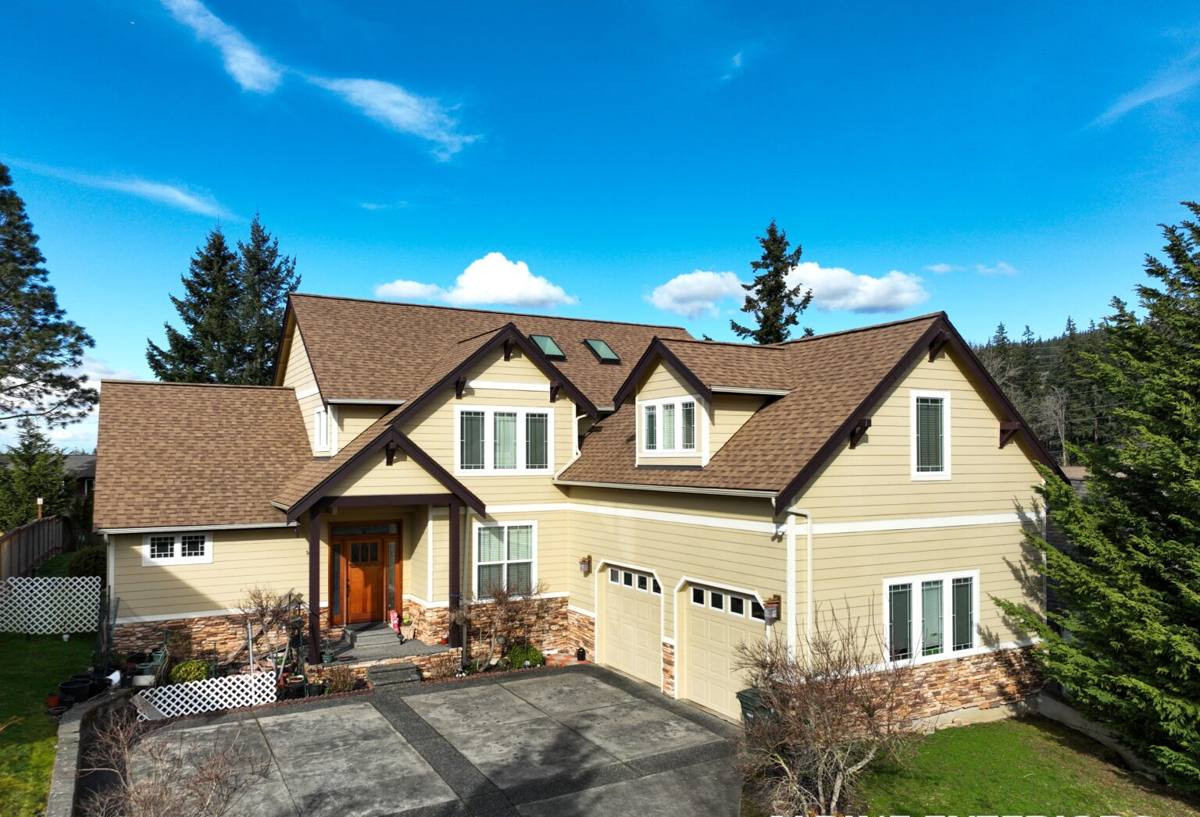
Signs Your Wiser Lake Home Needs Siding Repair
Moisture and Rot Damage
Soft or spongy siding, dark staining that spreads rather than sits still, and boards that flex when pressed are all signs water has gotten behind the surface. On wood-based products this often means active rot underneath, even if the face still looks mostly intact.
Moss, Algae, and Persistent Staining
Green or black streaking, especially on north- and west-facing walls, isn't just cosmetic. Moss holds moisture against the siding surface and, over time, can work into seams and butt joints, which accelerates whatever damage is already starting underneath.
Cracked, Warped, or Loose Boards
Cracking from impact or age, warping where a board has absorbed and released moisture repeatedly, and boards that have pulled away from fasteners all create entry points for water. A single loose board can undermine the drainage plane for the whole section around it.
Failed Caulk and Trim Joints
Caulk is the first line of defense at seams, corners, and penetrations, and it's also the first thing to fail. Cracked or missing caulk lines are one of the most common early warning signs on homes in this climate, and one of the cheapest problems to fix before it becomes an expensive one.
What a Correct Siding Repair Actually Involves
A repair that just covers a stain or swaps a cracked board without asking why it happened is a temporary fix. Doing it right means tracing the water first.
- Find the actual water path — not just the visible damage, but where moisture is getting in and where it's draining (or not draining) once it's behind the wall
- Check the weather-resistive barrier and flashing underneath the damaged section, since siding is the last layer, not the only layer, of protection
- Match the replacement material correctly so the new section performs the same as the surrounding siding, not just looks similar on day one
- Re-fasten and re-flash to spec, including proper nail placement, clearances at the bottom edge, and sealed penetrations
- Re-finish or color-match the repair so it doesn't stand out as an obvious patch
Skip any of those steps and you've bought yourself a repeat visit in a year or two — often to a bigger area than the first time, since the underlying moisture problem was never actually solved.
Why We Repair With James Hardie — Not Vinyl, Not Wood, Not LP
We install and repair with James Hardie fiber cement exclusively. That's a deliberate standard, not a limitation, and it matters directly for repair work.
Fiber cement doesn't absorb water the way wood-based siding does, so a properly executed Hardie repair isn't fighting the same swell-and-shrink cycle that causes repeat rot in products like LP SmartSide or old-growth cedar. It's also non-combustible, which is a real consideration anywhere wildfire smoke and ember exposure have become a normal part of a Pacific Northwest summer. And because Hardie's ColorPlus finish is factory-baked rather than field-painted, a color-matched replacement board holds its finish the same way the original does — it doesn't fade at a different rate than the rest of the wall the way a hand-painted patch on wood or vinyl often does.
We'll be straight about the trade-off: fiber cement repair work asks for more precision during installation than vinyl, and it isn't the cheapest material on a shelf. But for a climate that puts constant moisture pressure on a home, we've found it's the material that actually holds up to a real repair, not just a cosmetic one — which is why it's the only thing we put back on a wall.
Our Wiser Lake Repair Process
- On-site inspection. We look at the damaged area and the sections around it, not just the spot you called about — moisture problems rarely stay contained to one board.
- Moisture and cause diagnosis. We check for the actual water path: failed caulk, missing flashing, grade issues, gutter overflow, or a shaded wall that never dries out.
- Written repair plan. You get a clear explanation of what's damaged, why, and what it takes to fix it correctly — including if a small patch isn't actually the right call.
- Material match and prep. We source Hardie boards and trim in a matching profile and ColorPlus color, or plan a full-section replacement where a spot patch won't hold.
- Repair and re-seal. Damaged material comes out, the barrier and flashing underneath get corrected, and the new siding goes in fastened and sealed to spec.
- Cleanup and walkthrough. We walk the finished repair with you so you know exactly what was done and why.
Repair vs. Replace: How to Think About It
Not every siding problem in Wiser Lake needs a full re-side, and not every problem should be treated as a spot repair. The honest answer usually comes down to how far the moisture has traveled and how old the existing siding is.
| Factor | Leans Toward Repair | Leans Toward Replacement |
|---|---|---|
| Extent of damage | Isolated to one or two boards/areas | Spread across multiple walls or elevations |
| Age of existing siding | Under roughly 10-15 years, otherwise sound | Original siding nearing or past its expected service life |
| Moisture behind the wall | Surface-level, caught early | Signs of rot in sheathing or framing |
| Material match | Discontinued or mismatched product not a major concern | Original siding no longer made or fading unevenly next to new material |
| Typical cost range | Several hundred to a few thousand dollars depending on scope | A larger project-scale investment, priced per job after inspection |
That last row is intentionally broad — every home's scope is different, and we don't give real numbers until we've actually looked at the damage. What we won't do is talk you into a full replacement when a correctly done repair will hold, or talk you into a repair when the underlying siding is already past the point of being worth patching.
Managing Moss and Moisture Between Repairs
Whatcom County's wet season is long, and Wiser Lake's tree cover and lake-adjacent humidity don't help. A few habits go a long way toward stretching the life of a repair, or avoiding needing one in the first place.
- Keep gutters clear so overflow isn't running down the siding face during heavy rain
- Trim back vegetation and tree canopy that keeps a wall shaded and damp longer than the rest of the house
- Rinse visible moss and algae growth before it has a chance to work into seams — a garden hose on a low-pressure spray is usually enough
- Re-caulk seams and trim joints proactively every few years rather than waiting for a visible gap
- Walk the exterior once a season and look specifically at north- and west-facing walls, where moisture lingers longest
None of this eliminates the need for repair over a home's lifetime — it just keeps small problems from turning into structural ones.
Why It Matters to Hire a Crew That Already Works Wiser Lake
Siding repair diagnosis is mostly about reading water, and reading water correctly takes familiarity with how a specific area behaves. A crew that regularly works this part of Whatcom County already knows which wall orientations take the worst of the driving rain, how aggressively moss builds up in a given season, and what salt exposure actually does to fasteners and finishes near the water versus further inland. That local pattern recognition is the difference between a repair that addresses the real cause and one that just covers the symptom until it resurfaces.
It also means someone is available to actually come back — for the walkthrough, for a follow-up question, or years later if a related issue shows up nearby. Repair work benefits from a contractor who isn't just passing through the area on a single job.
If you're seeing staining, soft spots, cracked boards, or failing caulk on your Wiser Lake home, we're glad to take a look and give you a straight assessment — no pressure, no obligation. Reach out for a free estimate and we'll tell you honestly what your siding needs.