 Semiahmoo
 Decks in Semiahmoo Resort Face a Different Set of Problems
Semiahmoo Resort sits right out on the spit, with Drayton Harbor on one side and open water on the other. That location is exactly why it's a beautiful place to build a deck — and exactly why a deck built to "average" specs won't hold up. Salt-laden air moves through this area constantly, driving rain comes in sideways more often than straight down, and the marine layer keeps everything damp for long stretches of the year. Add in a genuinely long moss season, and you've got a combination that will find every weak point in a deck within a few winters.
We're not describing anything exotic here — it's the normal climate for waterfront and near-waterfront property in Whatcom County. But it does mean the standard deck detailing that works fine forty minutes inland doesn't hold up the same way on the spit. The fasteners corrode faster. The end grain on boards absorbs more moisture. Anything with a flat horizontal surface grows moss if it can't shed water and get airflow. None of this is a mystery to a crew that works this specific stretch of coastline regularly — it's just something you have to design and build around from the first footing.
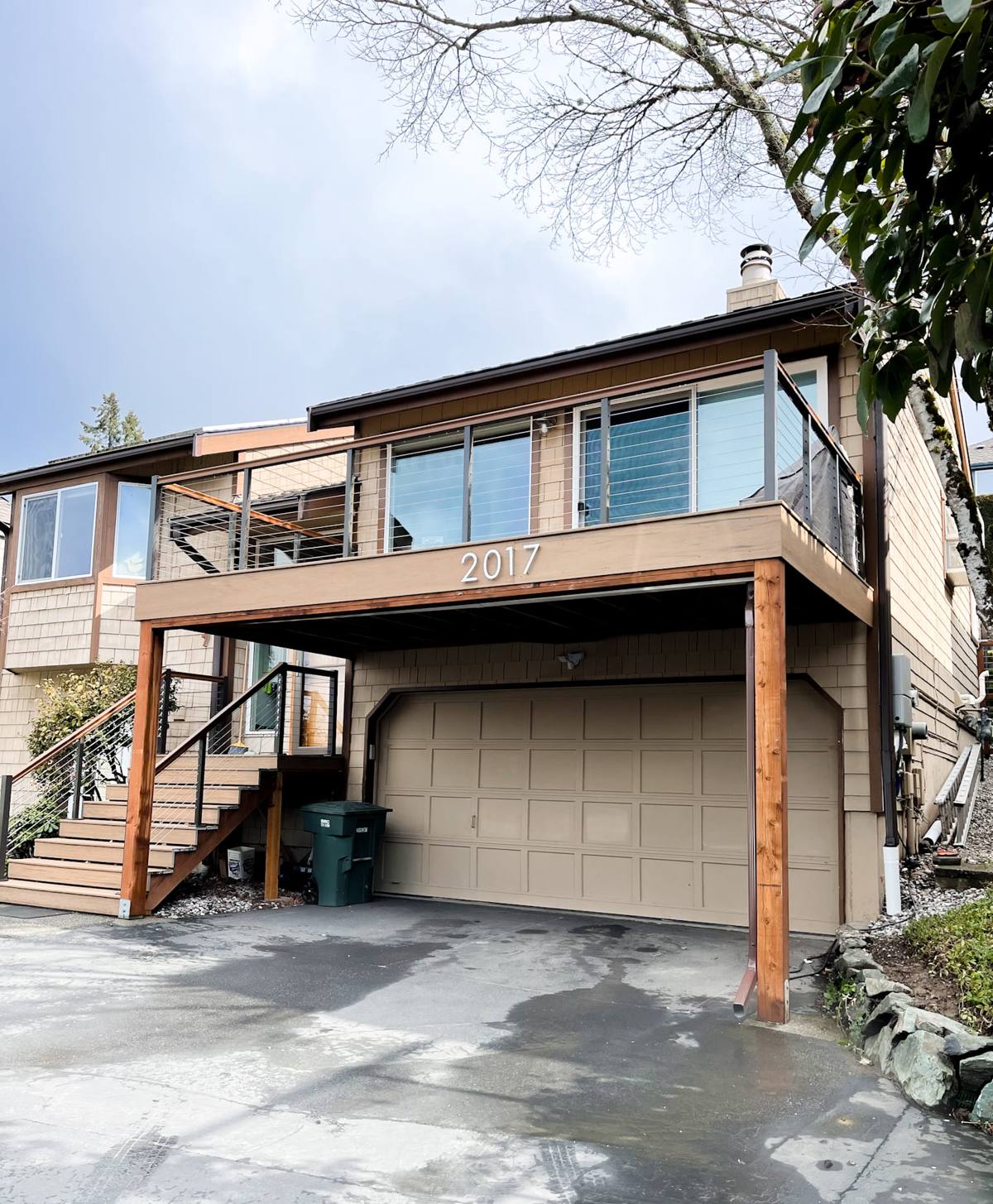
What a Correctly Built Deck Requires Here
Framing and Footings
Everything starts below the decking boards. Footings need to be sized and set to the actual soil conditions on the lot, not just poured to a generic minimum — spit and near-shore soils vary, and a footing that's marginal will show up as a bouncy or settling deck within a few years. Ledger attachment to the house is one of the most common failure points we see on older decks anywhere on the coast: flashing that wasn't installed, or was installed but not lapped correctly with the house's water-resistive barrier, lets water track behind the ledger board and rot the framing from the inside where nobody sees it until the deck starts to sag.
Fasteners and Hardware
This is the detail that separates a deck that lasts from one that doesn't in a salt-air environment. Standard galvanized fasteners and joist hangers are rated for general exterior use, but they weren't designed with constant salt exposure in mind, and over time you'll see rust bleed, weakening, and eventually hardware failure at connection points. On any deck we build near Semiahmoo's shoreline, we spec stainless steel or hot-dip galvanized fasteners and structural hardware rated for coastal exposure, and we match the decking fasteners to the decking material so you're not getting galvanic corrosion between two incompatible metals.
Choosing the Right Decking Material for This Climate
There's no single "best" decking material — there's a best material for your budget, your maintenance tolerance, and how exposed your specific lot is to wind and salt spray. Here's how the common options actually perform in a Semiahmoo-type environment:
| Material | Moisture/Salt Behavior | Maintenance | Typical Lifespan Here |
|---|---|---|---|
| Pressure-treated pine | Absorbs moisture at cut ends and fastener holes; needs sealing to resist salt-driven weathering | Annual cleaning, re-sealing every 1-2 years | 10-15 years before major boards need replacing |
| Cedar | Naturally moisture- and rot-resistant; still needs UV/moisture protection near salt air | Cleaning and oiling every 1-2 years to hold color and grain | 15-20 years with upkeep |
| Capped composite | Sealed shell resists moisture intrusion and salt staining well; solid-core boards handle heat/cold cycling better than uncapped composite | Periodic washing; no sealing or staining | 25+ years, manufacturer-warrantied |
| PVC decking | Fully synthetic, doesn't absorb moisture at all; performs consistently in salt air | Occasional washing | 25-30+ years |
We install all of these depending on what the homeowner wants, but we'll tell you honestly: on lots with direct wind and salt exposure off the water, we steer people toward capped composite or PVC for the decking surface, and reserve wood for structural framing (which is protected under the decking, out of direct weathering) or for homeowners who specifically want the look and are committed to the maintenance schedule. It's not that wood decking is a bad product — it's that it asks for more attention in this specific climate than a lot of owners realize going in.
Moss, Drainage, and the Long Wet Season
Moss doesn't grow because a deck is dirty — it grows because water and shade linger on a surface longer than they should. In a climate with as many wet, overcast months as Whatcom County gets, moss control is really a drainage and airflow problem, not a cleaning problem. A few things matter more here than in drier climates:
- Board spacing has to be correct for the material — too tight and water sits between boards; too loose and it looks and feels wrong underfoot
- The substructure needs enough clearance for air to move underneath the deck, not just water to drain away
- Any solid-surface area (steps, low decks near grade, transitions) needs a real drainage plan, not just a slight pitch
- North-facing and heavily shaded sections need extra attention since they simply dry out slower
A deck that's built with correct spacing, pitch, and clearance from day one will still need occasional washing during moss season, but it won't be fighting a losing battle against standing moisture the way an under-built deck will.
Railings, Stairs, and Code-Compliant Safety
Any deck above a certain height, or any deck attached to the house, is going to fall under Whatcom County's permitting and inspection process, which follows the state building code. That covers railing height, baluster spacing, guard strength, stair rise and run, and footing depth — and it exists because those are the details that cause injuries when they're skipped. We pull permits and build to pass inspection the first time, which also matters for resale: an unpermitted deck is a real headache when a home eventually goes on the market.
On resort and waterfront properties specifically, it's also worth checking whether your property is subject to design guidelines through an HOA or resort association — many communities in resort settings like this have their own review process for exterior changes on top of the county permit. We're happy to help homeowners figure out what applies to their specific property before we finalize a design.
Our Process for a Semiahmoo Resort Deck Project
We keep the process straightforward because most homeowners are doing this once and want to understand what's happening at each stage:
- Site visit and assessment — we look at sun/wind exposure, existing structure if it's a rebuild, soil and access conditions, and talk through how you actually want to use the space
- Design and material selection — layout, decking and railing material, and hardware spec, with honest tradeoffs explained for each option
- Permitting — we handle the Whatcom County permit submission and any HOA/resort design review your property may require
- Build — footings and framing first, inspected before decking goes down, then decking, railings, and stairs
- Final walkthrough — we go over the finished deck with you, including what maintenance it actually needs and when
Cost Factors to Expect
Deck pricing depends on size, framing complexity, height above grade, material choice, and railing style — anyone quoting a flat per-square-foot number without seeing your site is guessing. That said, homeowners planning a budget should expect these general drivers:
| Factor | Why It Moves the Price |
|---|---|
| Decking material | Pressure-treated is the lowest upfront cost; cedar sits in the middle; capped composite and PVC cost more upfront but less over the deck's life since there's no repeated sealing or staining |
| Height above grade | Taller decks need deeper footings, more substantial framing, and code-required guardrails, which adds material and labor |
| Hardware spec | Coastal-grade stainless fasteners and connectors cost more than standard galvanized, but they're the difference in how long connections last in salt air |
| Access and site conditions | Waterfront and spit lots sometimes have limited equipment access, which affects labor time |
| Railing style | Cable, glass, and custom-milled railings cost more than standard baluster railing |
Maintenance Checklist for Long-Term Performance
Whatever material you choose, a little regular attention goes a long way in this climate. We tell every deck customer the same thing:
- Rinse or wash the deck surface a few times a year to clear salt residue, pollen, and organic buildup before it turns into moss
- Check fastener heads and connector hardware annually for early rust bleed, especially at the ledger and stair connections
- Keep gutters and downspouts near the deck clear so runoff isn't dumping extra water onto the structure
- Re-seal or re-stain wood decking on the schedule the product actually needs — skipping a cycle in this climate costs more later than doing it on time
- Clear debris from between boards and off the substructure so airflow underneath isn't blocked
- Have the structure checked every few years, particularly ledger flashing and any framing near grade, since that's where hidden moisture damage shows up first
Why Local Experience in Semiahmoo Resort Actually Matters
A deck built by a crew that hasn't worked this specific stretch of coastline will often build to a generic spec — one that's fine in a drier or more sheltered part of the county but under-built for the wind and salt exposure right on the spit. We work in Semiahmoo Resort and the surrounding waterfront communities regularly, so we already know which fastener grades hold up, how much clearance a substructure needs to dry out between rain events, and what the county and any resort design review will expect before we ever submit a permit. That familiarity saves you rework, saves you a rejected permit, and means the deck we hand you is built for the exact conditions it's going to live in — not the conditions forty minutes inland.
If you're planning a new deck or need to replace one that's showing its age, we're happy to come take a look and give you a straightforward, no-pressure estimate. Fill out the form below and we'll set up a time to walk the site with you.