 Semiahmoo
 Wiser Lake Roofs Take a Different Kind of Beating
Wiser Lake sits inland from Semiahmoo and Blaine, but it doesn't escape the weather pattern that defines roofing work across Whatcom County. The combination of onshore wind gusts, long stretches of driving rain off the Strait of Georgia, and heavy tree cover around the lake means roofs here take damage in ways that don't always show up as a single dramatic event. A windstorm might lift a run of shingles along a ridge. A week of sideways rain might find a weak spot in flashing that's been marginal for years. And the shade and moisture around the lake keep moss and moisture-loving growth active nearly year-round, which quietly undermines a roof's ability to shed water even when nothing looks obviously "storm damaged."
That's the pattern we see repeatedly on Wiser Lake homes: storm damage isn't always a hole or missing shingles you can spot from the driveway. It's often a combination of wind stress, standing moisture, and moss intrusion that adds up over one wet season and shows up as a leak the following winter. Repairing it correctly means treating the roof as a system, not patching the one spot where water finally got in.
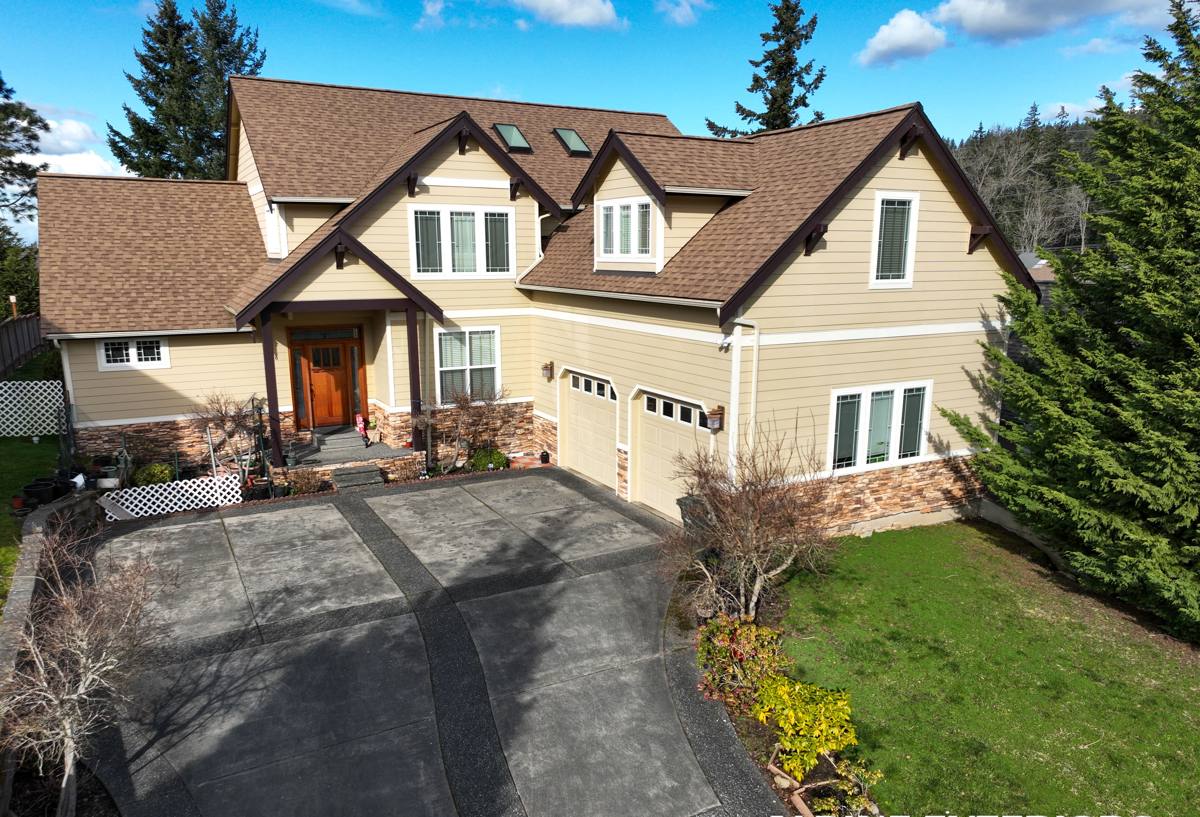
What Actually Counts as Storm Damage
Homeowners often assume storm damage means a tree limb through the roof or shingles scattered across the yard. Sometimes it's that obvious. More often, it's subtler, and it's worth knowing what to look for after a wind or rain event so a small problem doesn't turn into a ceiling stain by spring.
- Lifted or creased shingles — wind can lift a shingle's tab without tearing it off completely, breaking the seal underneath even though the shingle looks "still there."
- Displaced or bent flashing — around chimneys, skylights, and roof-to-wall transitions, flashing can shift just enough to open a gap.
- Granule loss — driving rain and wind-blown debris wear away the protective granules on asphalt shingles, which accelerates aging even without visible tearing.
- Debris impact — branches, cones, and blown debris from the trees around the lake can bruise or puncture shingles without leaving an obvious hole.
- Gutter and downspout separation — wind and ice can pull gutters loose from fascia, which redirects water back up under the roof edge instead of away from the house.
- Ridge cap damage — the ridge takes the most direct wind load on most roofs and is one of the first places to show cracking or lifting.
Any one of these on its own might not cause an active leak right away. Left alone through a Whatcom County winter, most of them will.
The Moss Factor: Storm Damage That Happens Slowly
Around Wiser Lake, moss isn't just a cosmetic nuisance — it's a mechanical problem. Moss holds moisture against the shingle surface far longer than open air and sun would allow, and as it grows it can work its way under shingle edges and tabs, lifting them slightly and breaking their seal. That's functionally the same failure mode as wind damage, just slower and less obvious. A roof that's been carrying a moss mat through several wet seasons is often more vulnerable to storm damage than a cleaner roof of the same age, because the moss has already loosened the shingles' grip on each other.
When we assess storm damage on a Wiser Lake roof, we're always looking at moss coverage alongside the storm's direct effects. Repairing wind-lifted shingles without addressing an established moss mat nearby just sets up the same failure again next season.
Signs Moss Has Already Compromised a Roof
- Visible green or dark buildup concentrated on the shaded, north-facing, or tree-covered sections of the roof
- Shingle tabs that feel spongy or lift more easily than the surrounding field
- Granules collecting in gutters even without a recent storm
- Dark streaking below moss patches, which usually means water is already tracking under the shingle line
Our Storm Damage Assessment Process
We start every storm damage call with a full-roof inspection, not just a look at the spot the homeowner is worried about. A single visible issue — a curled shingle, a stain on the ceiling — is often a symptom of damage spread across a wider section of roof, especially after a windstorm that hit the whole exposure at once.
What We Check
- Exterior roof surface — shingle condition, lifting, cracking, granule loss, and impact marks across every slope, not just the reported problem area.
- Flashing and penetrations — chimneys, vents, skylights, and any roof-to-wall transitions, which are the most common source of storm-related leaks even when the shingles themselves look fine.
- Ridge and edge details — ridge caps, drip edge, and rake edges take the brunt of wind uplift and are frequently damaged even when the field of the roof looks intact.
- Gutters and drainage — separated or sagging gutters that could be redirecting water back toward the roof edge or siding.
- Attic and interior — where accessible, we check for moisture staining, damp insulation, or daylight at the deck, which tells us whether water has already gotten past the roof covering.
- Moss and organic growth — extent and location, since it changes both the repair scope and how urgently the roof needs attention.
We give homeowners a straight answer about what we find — what's storm-related, what's pre-existing wear, and what can reasonably wait. Not everything needs to become a bigger job than it is.
Repair vs. Replace: How We Make That Call
Most storm damage on a Wiser Lake roof is repairable, especially when it's caught within a season or two of the roof's overall condition being sound. The decision to repair rather than replace comes down to how much of the roof is affected, how old the existing roofing is, and whether the underlying deck is still solid.
| Factor | Favors Repair | Favors Replacement |
|---|---|---|
| Extent of damage | Localized to one slope or section | Spread across most of the roof |
| Roof age | Under roughly 12–15 years, in otherwise good shape | Nearing or past typical service life for the material |
| Deck condition | Solid, dry sheathing under the damaged area | Soft spots, rot, or repeated past leaks in the same area |
| Moss/moisture history | Recently developed, limited coverage | Long-established moss mat with widespread lifting |
| Shingle availability | Matching shingles still obtainable | Discontinued product, visible patchwork if repaired |
We'll always recommend the repair when the roof supports it. A full replacement is a bigger investment, and we're not going to push one on a roof that a proper repair will carry for years.
What a Correct Storm Repair Actually Involves
A storm repair done right goes beyond swapping out the shingles that are obviously torn. Given how the wind and rain move through this area, we treat the repair area — and the transitions around it — as the actual scope of work.
- Removing and replacing damaged shingles with matching material, tied properly into the surrounding courses so the repair sheds water the way the original roof was designed to
- Inspecting and re-securing or replacing flashing at any penetration within the repair area
- Checking the underlayment beneath damaged shingles for moisture intrusion before closing the repair back up
- Re-nailing or resetting ridge caps and edge details that took direct wind load
- Clearing moss from the repair area and treating it as needed so the fix isn't undermined by the same growth that contributed to the damage
- Reattaching or resetting any gutters or downspouts that separated in the storm
Skipping any of these steps is how a "repaired" roof ends up leaking again in the next storm — the visible damage gets fixed, but the underlying cause doesn't.
Insurance Claims: What Wiser Lake Homeowners Should Know
Storm damage is one of the more common reasons homeowners in Whatcom County file a roofing insurance claim, and having clear documentation matters. We provide a written assessment of what we find — including photos of the damage and our read on whether it's storm-related versus pre-existing wear — that homeowners can use when talking to their insurance adjuster. We're not an adjuster and don't represent the insurance company; our job is to give an honest, accurate picture of the roof so the homeowner has good information going into that conversation.
One thing worth knowing: insurers generally distinguish between sudden storm damage and gradual deterioration like long-term moss growth. That's part of why we document both separately — a roof can have genuine storm damage that's covered, moss-related wear that isn't, or some combination of both.
Why a Local Crew Matters for Storm Repairs
After a significant windstorm, roofing crews from outside the area sometimes come through Whatcom County offering fast repairs. The trouble is that a crew unfamiliar with how this climate treats a roof over time — the moss cycle, the salt-tinged wind off the water, the amount of standing moisture a shaded roof around a lake holds onto — can miss the underlying causes and leave a homeowner with a repair that looks fine for a season and fails again.
We work Wiser Lake and the surrounding Semiahmoo area regularly, which means we're not guessing at how a roof here typically fails. We know what a wind-damaged ridge looks like six months later if it isn't properly resecured, and we know which flashing details tend to be the actual source of a "mystery leak" that shows up nowhere near where the water is entering. That local pattern recognition is a big part of getting a storm repair right the first time.
After a Storm: A Homeowner's Checklist
If you've just been through a wind or rain event and are checking your own roof before calling anyone, here's what's worth doing safely from the ground.
- Walk the perimeter of the house and look for shingle pieces, granules, or flashing debris in the yard or gutters
- Check gutters and downspouts for separation from the fascia or visible sagging
- Look up at the roofline from several angles for shingles that appear lifted, curled, or missing
- Check ceilings and attic spaces (if safely accessible) for new staining, dampness, or a musty smell
- Note the date and general weather conditions of the storm for your own records
- Avoid getting on the roof yourself, especially after rain — wet shingles and moss-covered surfaces are genuinely dangerous underfoot
If anything on that list raises a question, it's worth having it looked at before the next round of weather moves through. Small storm damage is inexpensive to fix. The same damage after another few months of rain finding its way in usually isn't.
If you're dealing with storm damage on a Wiser Lake roof — or just want an honest second look after a rough stretch of weather — we're happy to come take a look. The estimate is free, there's no pressure, and you'll get a straight answer about what actually needs fixing.