 Semiahmoo
 Why Decks Fail Faster in Point Roberts
Point Roberts sits on its own point of land surrounded almost entirely by water, which means every deck out here takes a harder hit than a deck built twenty miles inland. Salt-laden air off the Strait of Georgia and Boundary Bay works on fasteners, flashing, and any exposed metal around the clock. Add in Whatcom County's driving rain, which comes in sideways more often than straight down, and you've got water finding its way into joints and ledger connections that a calmer climate would never test. Then there's moss season, which in this part of Washington isn't really a season at all — it's most of the year. Moss holds moisture against wood and composite decking alike, and once it gets a foothold on a north-facing deck or one shaded by evergreens, it doesn't let go on its own.
None of this means decks here are doomed. It means a deck built or replaced in Point Roberts needs to be built for these specific conditions, not just built to a general Pacific Northwest standard. That distinction is the difference between a deck that needs real work again in eight years and one that holds up for decades.
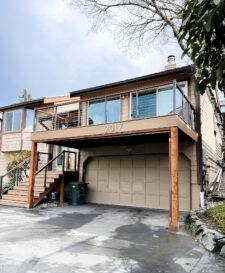
Signs a Deck Needs Replacement, Not Just Repair
Homeowners often call us thinking they need a few boards swapped out, and sometimes that's true. But there are signs that point to a full replacement being the more honest recommendation:
- Soft or spongy decking boards in more than one area, not just a single isolated spot
- Rot or soft wood at the ledger board where the deck attaches to the house
- Rust streaking or crumbling around joist hangers and structural fasteners
- Persistent moss or black staining that returns within weeks of cleaning
- Visible sagging, bounce, or movement in the frame when you walk across it
- Railings that wiggle at the post base, which usually means the post itself is compromised
One or two of these on an otherwise sound deck can often be repaired. Several at once, especially anything involving the ledger board or the framing underneath, usually means the structure has been absorbing moisture for years and patch repairs will only buy a short amount of time.
Why the Frame Matters More Than the Surface
It's easy to judge a deck by its decking boards, but the framing underneath is what actually keeps people safe. A deck with new composite boards laid over a rotting or rusted frame looks fine and isn't. Any honest replacement estimate starts with an assessment of the ledger board, the joists, and the posts and footings — not just the visible surface.
What a Correct Deck Replacement Involves
A deck replacement done right in this climate has a few non-negotiables:
Ledger Board Flashing
The ledger board — where the deck bolts into the house — is the single most common failure point on decks in wet climates. Water that gets behind an improperly flashed ledger board rots the rim joist and can damage the house framing itself, not just the deck. We flash this connection so water sheds away from the house rather than tracking behind the board.
Joist Protection
Untreated joist tops absorb rainwater that sits between the decking boards and the frame, which is exactly the kind of slow, hidden rot that shows up as a soft spot years later. We protect joist tops so water runs off instead of soaking in.
Fasteners and Hardware
Given the salt air along this stretch of coastline, standard galvanized fasteners corrode faster than they would inland. We use fasteners and structural connectors rated for coastal exposure, which costs a bit more up front and saves the headache of rust stains and failing hardware a few years down the road.
Drainage and Airflow Underneath
A deck built low to the ground or over poorly graded soil traps moisture underneath, which feeds both rot and moss. Where the site allows it, we build in enough clearance and slope for water to actually get away from the structure instead of sitting under it.
Choosing Decking Material for This Climate
There's no single "best" decking material — there's a best material for what you want to maintain and how you use the space. Here's how the common options hold up specifically against salt air, rain, and moss:
| Material | Moss & Moisture Resistance | Maintenance | Typical Lifespan |
|---|---|---|---|
| Pressure-treated wood | Fair — needs regular sealing to resist moisture and moss growth | Annual cleaning and re-sealing recommended | 10-15 years |
| Cedar | Good natural resistance, but still needs care in constant damp shade | Periodic cleaning and oiling to maintain appearance | 15-20 years |
| Capped composite | Very good — the cap layer resists moisture absorption and staining | Occasional washing, no sealing or staining | 25-30 years |
| PVC decking | Excellent — non-porous, doesn't absorb water at all | Occasional washing only | 25-30+ years |
In shaded, north-facing, or heavily treed lots — common around Point Roberts — we usually steer homeowners toward capped composite or PVC simply because untreated or lightly sealed wood in constant shade fights an uphill battle against moss all year. That's not a knock on wood decking; it's an honest tradeoff between upfront cost and how much upkeep you want to sign up for.
Our Deck Replacement Process
- On-site assessment — We inspect the existing deck's framing, ledger connection, posts, and footings, not just the surface boards, and give you a straight answer on repair versus replacement.
- Material and layout discussion — We walk through decking material, railing style, and layout based on how you actually use the space and how much maintenance you want going forward.
- Demolition and disposal — The old deck comes out, and we haul away the debris rather than leaving it for you to deal with.
- Framing and flashing — New or reinforced framing goes in first, with proper ledger flashing and joist protection before a single decking board is installed.
- Decking, railing, and finish work — Boards, railings, and any stairs are installed to a level, secure standard, with fasteners rated for the coastal exposure this area gets.
- Final walkthrough — We go over the finished deck with you, including what maintenance it does and doesn't need going forward.
Working in an Exclave: Why Logistics Actually Matter Here
Point Roberts is a bit of a logistical outlier — it's only reachable by road through Canada, or by water or air. That's not a small detail when it comes to construction. A crew that doesn't regularly work this area can run into real trouble if they forget a part of the order or need a same-day material run, because there's no quick trip back to a Whatcom County lumberyard. We plan material lists and border crossings for Point Roberts jobs the same way we'd plan for any remote job site: order complete, stage what we need, and avoid the kind of mid-project scramble that turns a one-week deck replacement into a three-week one.
Railings and Hardware That Hold Up in Salt Air
Railings take a lot of abuse from salt air because they're the most exposed, highest-touch part of the deck. Aluminum and vinyl railing systems generally outperform bare metal railings here, since they resist the pitting and rust streaking that untreated steel or lower-grade aluminum develops within a few seasons this close to the water. Wood railings can still look great, but they need the same sealing discipline as wood decking — skip a year of maintenance in a moss-prone yard and you'll see it. Whatever railing material you choose, the post connections and any embedded hardware matter as much as the railing itself; a good-looking railing on an under-built post is a safety problem waiting to happen.
What Affects Deck Replacement Cost
| Cost Factor | Why It Matters |
|---|---|
| Deck size and footprint | More square footage means more framing, decking, and labor hours |
| Height and stairs | Elevated decks and stairs require additional framing, footings, and railing code compliance |
| Decking material | Composite and PVC cost more upfront than wood but need far less long-term maintenance |
| Condition of existing framing | Rotted joists, posts, or footings add cost if they need full replacement rather than reinforcement |
| Railing style | Cable, glass, and custom railing systems cost more than standard baluster railing |
| Site access | Tight lots, water-adjacent sites, or limited equipment access can add labor time |
We don't quote a number until we've actually seen the site — anyone offering a firm price over the phone for a deck replacement is guessing. What we can say is that the framing and flashing details described above aren't optional add-ons; they're part of what a correct replacement costs, whether or not a lower bid includes them.
Maintaining Your New Deck
Whatever material you choose, a little seasonal attention goes a long way in this climate:
- Sweep debris and standing leaves off the deck regularly, especially in fall
- Rinse or wash the surface a few times a year to interrupt moss growth before it takes hold
- Check railing posts and stair connections annually for any looseness
- For wood decking, reseal or re-stain on the schedule the product calls for — don't wait until it looks faded
- Keep gutters and downspouts near the deck clear so runoff isn't dumping extra water onto the structure
- Trim back overhanging branches that keep the deck shaded and damp longer than it needs to be
Why Local Experience in Point Roberts Matters
A deck replacement isn't just a materials question — it's a question of who's actually done this work in this specific spot before. A crew that regularly works Point Roberts and the broader Semiahmoo area already knows how salt exposure, rain patterns, and moss behave on decks here, has already worked out the material logistics of building in an exclave, and isn't learning these lessons on your project. That experience shows up in the details — the flashing, the fastener choice, the drainage under the frame — that you won't see once the deck is finished, but that determine whether it's still solid in fifteen years.
If your deck is showing its age or you're planning a full replacement, we're happy to take a look and give you a straightforward assessment — no pressure, no upsell, just an honest read on what your deck actually needs. Reach out using the form below to schedule a free estimate.