 Semiahmoo
 Peace Arch Roofs Take a Different Kind of Beating
Homes around Peace Arch sit close to open water, which means roofs here deal with a combination most inland properties never see: salt-laden air off Semiahmoo Bay and Drayton Harbor, wind-driven rain that comes in sideways during winter storms, and long stretches of damp, shaded weather that keep moss and moisture sitting on the roof deck for months at a time. Whatcom County's marine climate is generally mild, but "mild" doesn't mean gentle on a roof. It means slow, steady wear punctuated by sharp storm events that expose whatever weaknesses were already building underneath.
We work on roofs in this specific stretch often enough to know the pattern: a windstorm doesn't usually destroy a roof outright. It finds the spot that was already marginal — a flashing seam that had started to lift, a shingle tab weakened by months of moss growth, a valley where debris had been collecting — and turns a slow problem into a leak overnight. Storm damage repair here isn't just about patching what broke. It's about understanding why that spot broke first.
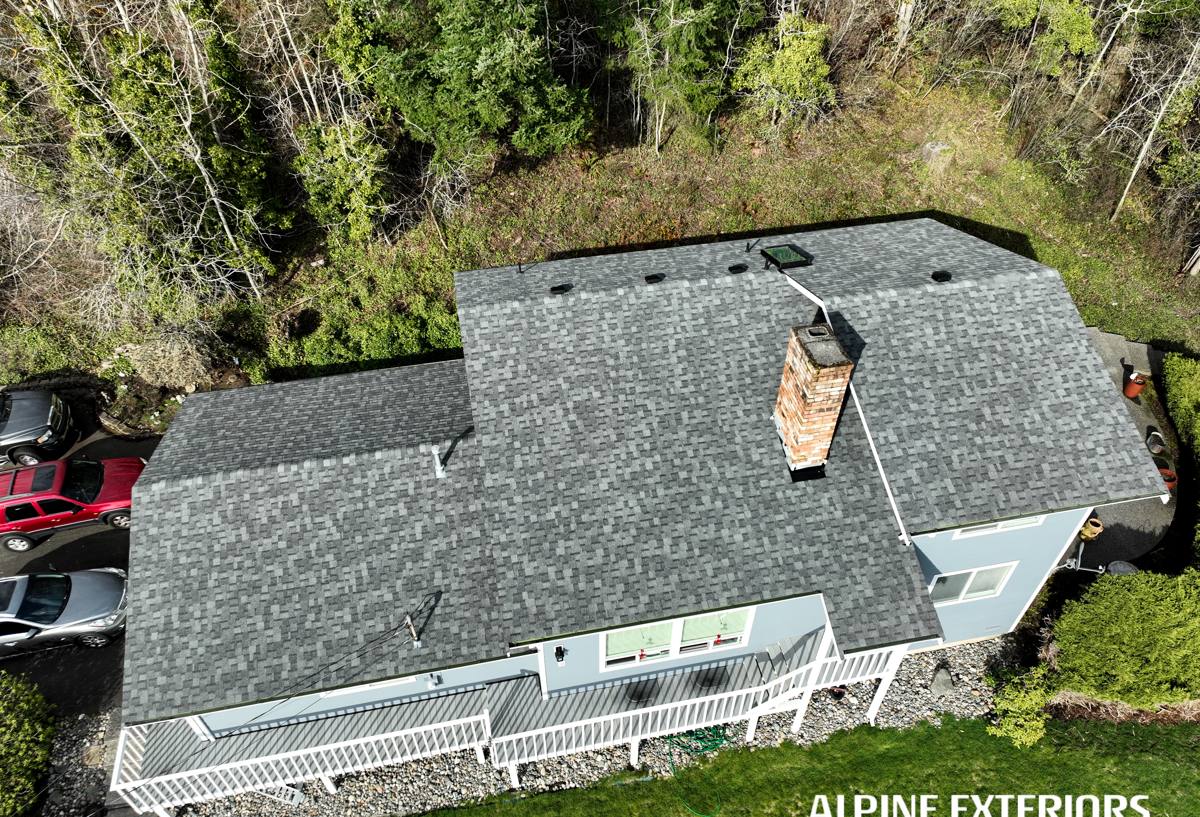
What Actually Counts as Storm Damage
Not every roof problem that shows up after a storm was caused by the storm. Some damage is genuinely storm-related and often covered by insurance; some is pre-existing wear that a storm simply revealed. Knowing the difference matters for both the repair plan and any insurance claim.
Wind-Lifted or Missing Shingles
Sustained wind or a hard gust can lift shingle tabs, break the sealant bond, or tear shingles off entirely. On roofs that already had moss or granule loss weakening the shingle surface, wind damage tends to spread faster and wider than it would on a healthy roof.
Flashing and Seal Failures
Flashing around chimneys, vents, skylights, and roof-to-wall transitions is usually the first thing to fail in a storm, because it relies on sealant and mechanical fasteners rather than the shingle system itself. Once flashing lifts or a seal cracks, water finds its way in even on days with no visible storm damage on the shingles themselves.
Debris and Impact Damage
Branches, cones, and windblown debris can crack shingles, dent metal flashing, or puncture underlayment where shingles are already missing. On treed lots, this is one of the more common calls we get after a wind event.
Pre-Existing Wear Mistaken for Storm Damage
Moss-related shingle degradation, worn-out sealant strips, and deteriorated underlayment from years of moisture exposure often get blamed on "the storm" simply because that's when the leak became obvious. An honest inspection separates what the storm caused from what the storm exposed.
Why Speed and Correctness Both Matter Here
Two things happen when storm damage on a Peace Arch roof sits unaddressed. First, the humid, shaded conditions common near the water mean exposed decking and underlayment don't dry out quickly between rain events — moisture gets a chance to work into the roof deck, fascia, and sometimes attic insulation before anyone notices a stain on the ceiling. Second, temporary fixes (a tarp, a bead of roofing cement, a few replacement shingles without checking the flashing underneath) tend to fail again at the next storm, because they treat the symptom without addressing the entry point.
A correct repair identifies the actual water path — which is not always directly above the interior stain — and rebuilds that section properly: matching underlayment, correctly lapped flashing, and shingles fastened and sealed to spec. That's the difference between a repair that lasts and one that becomes an annual callback.
What a Correct Storm Repair Involves
Full Inspection, Not Just the Obvious Spot
We check the reported damage area first, then walk the rest of the roof plane, valleys, and penetrations. Storms rarely damage just one spot, and a repair quote based on a single visible shingle often misses a second weak point that fails a few months later.
Matching Materials and Fastening Correctly
Replacement shingles should match the existing roof's type, profile, and where possible, color batch closely enough that the repair doesn't stand out as a patch. Fasteners and nailing patterns follow manufacturer specs for wind exposure, which matters more here than in sheltered inland areas.
Flashing and Underlayment First, Shingles Second
Any repair that touches a leak path gets the flashing and underlayment checked and replaced where needed before new shingles go down. Covering damaged underlayment with new shingles just hides the problem for another season.
Sealing for Wind, Not Just Water
Given the wind exposure around the bay, we pay attention to sealant strip activation and supplemental fastening in high-exposure areas — ridge lines, eaves, and roof edges facing open water — rather than assuming standard nailing alone will hold through the next storm season.
Our Process for a Storm Damage Call
- Initial assessment — we look at the damage in person, check the broader roof condition, and give you a straight answer on whether it's a targeted repair or something larger.
- Temporary protection if needed — if there's active leaking or exposed decking, we get it covered properly so it doesn't get worse while a full repair is scheduled.
- Written scope and estimate — what's being repaired, what materials are used, and what it costs, before any work starts.
- Repair — flashing, underlayment, and shingle work done to match the existing roof system, not a generic patch.
- Final check — we confirm the repair area, surrounding sections, and any related flashing are sound before calling the job done.
What Affects the Cost of Storm Repair
Every storm repair is different, but the same handful of factors drive most of the cost variation we see on jobs in this area.
| Factor | Why It Matters |
|---|---|
| Extent of damage | A few displaced shingles is a different job than a section with compromised decking or underlayment. |
| Roof pitch and access | Steeper roofs and difficult access (tight lots, tall trees, water-adjacent setbacks) take longer and require more safety setup. |
| Material match | Matching an older or discontinued shingle style can cost more in sourcing time than the labor itself. |
| Underlying moisture damage | If water has been getting in for a while, decking replacement adds to the scope beyond the visible shingle damage. |
| Flashing complexity | Chimneys, skylights, and multiple roof-wall intersections each add their own flashing detail work. |
Storm Damage and Insurance: A Few Honest Points
Many storm repairs are eligible for insurance coverage, but coverage depends on your policy and the cause of damage — wind and impact events are typically treated differently than damage attributed to long-term wear like moss or age. It's worth having a contractor document the damage with clear photos and a written scope before you file, since adjusters respond better to a specific, itemized description than a vague "roof leak" claim. We're happy to provide that documentation; we don't handle the claim itself, but a clear scope makes your conversation with your insurer more straightforward.
Reducing Repeat Storm Damage
You can't storm-proof a roof completely, but you can reduce how much any single storm is able to exploit. A few maintenance habits make a real difference for homes in this climate:
- Clear moss buildup before it lifts shingle edges or holds moisture against the roof surface
- Keep gutters and valleys clear so wind-driven rain has somewhere to go instead of backing up under shingles
- Trim back branches that overhang the roof, since falling debris is one of the most common storm-damage triggers here
- Have flashing around chimneys, vents, and skylights checked periodically, since these fail quietly before they fail visibly
- Address minor shingle damage promptly rather than waiting for the next storm to make it worse
Why Local Experience Around Peace Arch Matters
A roof repair crew that mostly works inland doesn't always account for how much harder salt air and near-constant coastal moisture are on fasteners, flashing sealant, and shingle granules. Working regularly on homes around Peace Arch and the broader Semiahmoo area means we've seen how storms actually behave here — which directions the worst wind comes from, which roof details fail first, and which repairs hold up through a full winter versus which ones come back as callbacks. That's the kind of judgment that doesn't come from a general storm-damage checklist; it comes from repeatedly working this specific stretch of Whatcom County.
If you've got storm damage on your roof — or you're not sure whether what you're seeing is storm-related or just wear that's finally showing — we're glad to take a look and give you a straight, no-pressure assessment. Use the form below to request a free estimate.