 Semiahmoo
 Why Peace Arch Homes Take a Different Kind of Beating
Homes near the Peace Arch border crossing sit in one of the more punishing microclimates in Whatcom County. The Semiahmoo Bay shoreline puts salt-laden air on siding year-round, onshore storms drive rain sideways into wall assemblies rather than straight down, and the long, wet Pacific Northwest winter gives moss and algae months at a time to take hold on shaded and north-facing walls. None of that is exotic weather by regional standards, but it is a combination that ordinary siding materials handle poorly over a 15-20 year span. Salt accelerates corrosion of fasteners and trim. Driving rain finds every gap in flashing and caulk. Moss holds moisture against the wall surface long after a storm has passed.
We install James Hardie fiber cement exclusively, and on Peace Arch homes specifically, that choice is less about brand preference and more about matching a wall system to what this stretch of Whatcom County actually does to a house. This page covers what that means in practice for this one service, in this one area.
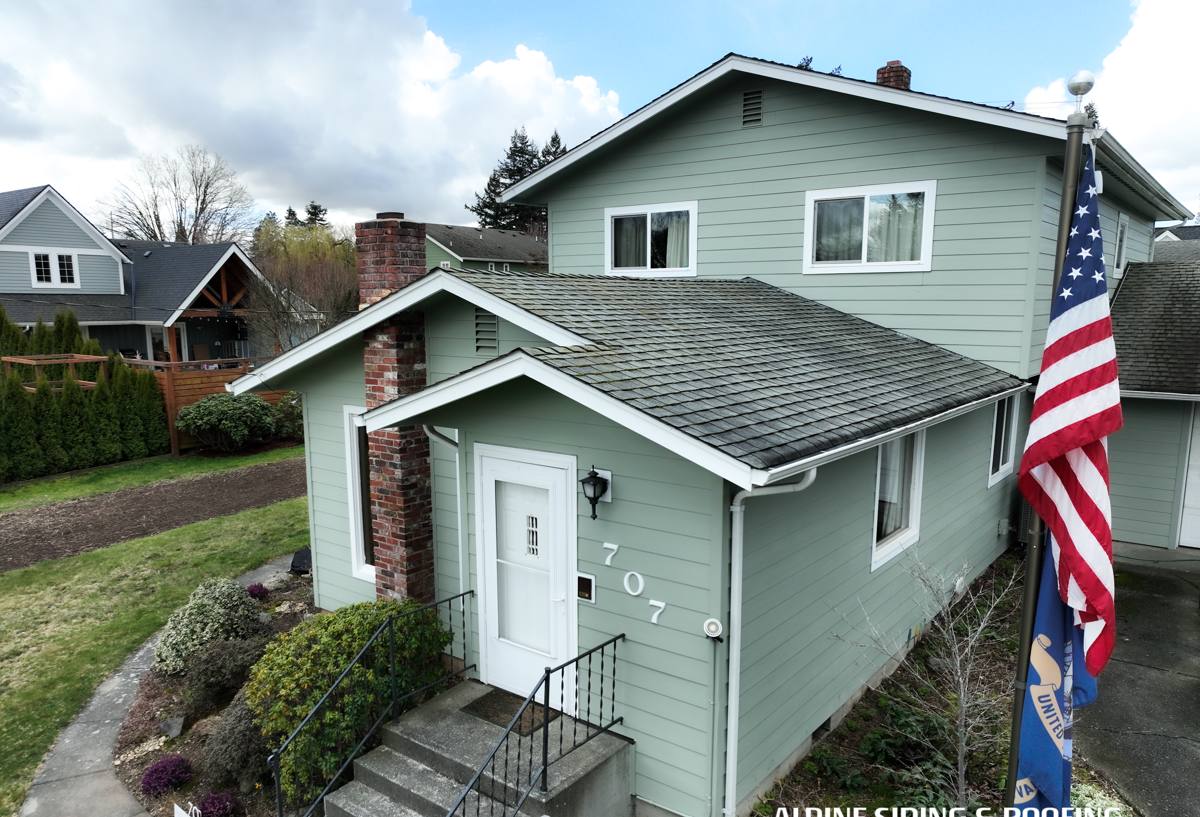
What Salt Air, Driving Rain, and Moss Actually Do to Siding
Salt Air
Airborne salt from Semiahmoo Bay settles on exterior surfaces and accelerates oxidation of exposed metal — nail heads, trim flashing, hose bib penetrations, and any fastener that isn't properly set or sealed. On wood and wood-composite sidings, salt exposure also draws moisture into the material, which speeds up swelling, checking, and paint failure at the surface.
Driving Rain
Wind off the water doesn't let rain run straight down a wall — it pushes water sideways and upward into laps, seams, and butt joints. Siding systems that rely on face-sealed caulk joints instead of proper lap geometry and flashing tend to leak first at these pressure points, often years before any visible damage shows up on the surface.
Moss and Algae
Shaded walls, north exposures, and anywhere tree cover blocks afternoon sun stay damp longer here than in drier parts of the state. Moss and algae growth on siding isn't just cosmetic — sustained moisture contact softens paint film, and on materials with any wood content, it can accelerate rot at the surface over time.
| Climate Stress | What It Attacks | Why It Matters Long-Term |
|---|---|---|
| Salt air | Fasteners, trim, exposed metal, paint film | Corrosion and finish breakdown start earlier near open water |
| Driving rain | Laps, butt joints, penetrations, flashing details | Water intrusion at poorly detailed joints causes hidden sheathing damage |
| Extended moss season | Shaded and north-facing wall sections | Prolonged surface moisture degrades paint and promotes staining |
Why James Hardie's HZ5 System Fits This Climate
James Hardie engineers its siding by climate zone, and the Pacific Northwest falls under the HZ5 specification — a formulation and testing standard built around the region's wet, moderate-temperature weather rather than a generic national product. Fiber cement itself is non-combustible and dimensionally stable, meaning it doesn't swell, warp, or delaminate the way wood-based sidings can when they take on repeated moisture exposure. That stability matters more here than in a dry inland climate, because Peace Arch siding is rarely given a long stretch of dry weather to fully recover between rain events.
Fiber cement also doesn't feed moss and algae the way wood fiber can. It won't stop biological growth from landing on the surface — nothing does — but it doesn't break down or invite rot underneath that growth the way untreated or lightly primed wood products can over time.
What a Correct Installation Involves in This Environment
The material is only half the equation. Most siding failures we get called out to investigate in this area trace back to installation shortcuts, not product defects. On a Peace Arch home, a correct James Hardie install means paying close attention to the details that driving rain and salt air punish first.
Water Management Behind the Siding
A weather-resistive barrier and rain screen or properly detailed drainage plane behind the siding gives any water that does get past the surface a way out, instead of trapping it against the sheathing. This matters more on a wind-exposed elevation than on a sheltered one.
Flashing at Every Penetration
Windows, doors, hose bibs, light fixtures, and vents all need step flashing or properly lapped flashing tape — not caulk alone. Caulk is a maintenance item; flashing is the actual water barrier.
Fastener Choice and Placement
Corrosion-resistant fasteners, driven at the manufacturer's specified location and depth, matter more within a mile or two of salt water than they do further inland. Overdriven or underdriven nails are one of the most common causes of premature board failure we see on re-inspections.
Clearances and Gaps
James Hardie specifies minimum clearances from grade, roofing, decks, and other siding terminations. Cutting those clearances short traps moisture at the bottom edge of the wall — exactly where driving rain off the bay tends to collect.
Joint Treatment and Caulking
Butt joints need to be treated per Hardie's published details, using a high-quality, paintable, elastomeric sealant rated for the exposure. In a high-wind-driven-rain environment, we don't treat this as an optional finishing step.
ColorPlus Factory Finish vs. Field Painting Near the Water
James Hardie's ColorPlus finish is baked on at the factory in multiple coats and backed by its own finish warranty, which is a meaningful advantage in a salt air environment where field-applied paint tends to chalk and fade faster on south- and west-facing elevations exposed to sun and salt together. We default to ColorPlus for Peace Arch projects for that reason. Primed Hardie board that gets field-painted after installation is still a sound product, but it puts the long-term finish performance in the hands of whatever paint and prep were used on site, and it shifts repainting timelines back onto the homeowner sooner than a factory finish typically requires.
Our Process, Start to Finish
- On-site assessment: We walk the home, check current siding and any moisture or rot damage, and evaluate wind exposure by elevation — the water-facing side of a Peace Arch home is rarely treated the same as the sheltered side.
- Product and color selection: We go over HardiePlank, HardieShingle, or HardiePanel options and ColorPlus color choices based on the home's exposure and style.
- Written estimate: A clear scope covering removal, water barrier and flashing work, material, and finish — no vague allowances.
- Tear-off and sheathing check: We inspect sheathing condition once old siding is off, since this is often the only point where hidden moisture damage becomes visible.
- Water barrier, flashing, and rain screen installation: Done to Hardie's specification before a single board goes up.
- Siding installation: Fastened, gapped, and jointed per manufacturer spec for the HZ5 zone.
- Final walkthrough: We review the finished work with the homeowner and go over basic care specific to a salt-air, high-moss location.
Cost Factors for Peace Arch Projects
Every home is different, but the factors that most often move a Peace Arch siding estimate up or down are consistent:
| Factor | Why It Affects Cost |
|---|---|
| Existing siding removal | Extra labor for tear-off, plus disposal, especially with layered or older material |
| Sheathing repair | Hidden moisture or rot damage found after tear-off adds material and labor |
| Home size and wall complexity | More corners, dormers, and penetrations mean more flashing and cut work |
| Product line | HardiePlank, HardieShingle, and HardiePanel carry different material and labor costs |
| Finish choice | Factory ColorPlus vs. field-painted primed board affects both upfront and long-term cost |
| Wind exposure of the site | Water-facing elevations near the bay may warrant additional rain screen detailing |
We give homeowners a real number after seeing the home, not a phone estimate — a wall facing open water needs different detailing than one sheltered by neighboring structures or tree lines, and that shows up in the price.
Choosing a Contractor Who Already Works This Area
A crew unfamiliar with marine-exposed installs in Whatcom County can put James Hardie siding on a home and still leave it vulnerable, simply by treating it like a standard inland job. What to check before hiring:
- Ask specifically how they detail rain screens and flashing on wind-exposed elevations, not just whether they "install Hardie."
- Confirm they use corrosion-resistant fasteners as standard practice, not only when asked.
- Ask how they handle butt joints and clearances at grade — these are the first places driving rain finds a shortcut.
- Check whether they default to factory ColorPlus finish or field painting, and ask them to explain the trade-off honestly.
- Ask if they've worked on homes near Semiahmoo Bay or similar water-exposed sites in the county, and what they watch for differently there.
- Get a written scope that names the water-resistive barrier and flashing approach, not just "siding installation."
The product matters, but the installer matters just as much in an environment where the weather is actively working against every joint and fastener on the wall.
Get a Free, No-Pressure Estimate
If you're weighing a siding replacement on a Peace Arch home, we're happy to take a look, walk you through what your home's exposure calls for, and give you a straightforward written estimate — no pressure, no vague allowances. Use the form below to get started.