 Semiahmoo
 Why Marietta Roofs Wear Differently Than Roofs Inland
Marietta sits close enough to the water that its roofs live a different life than a roof twenty miles inland. The combination of salt-laden air off the bay, wind-driven rain that doesn't just fall but gets pushed sideways under poorly sealed edges, and a moss season that can stretch from fall through spring means an asphalt shingle roof here is doing more work than the same roof would in a drier, warmer climate. None of that makes a good shingle roof a bad choice for this area. It means the installation details matter more here than they do somewhere with a milder, drier climate, and cutting corners on those details shows up faster on a Marietta roof than it would elsewhere in Whatcom County.
Salt air accelerates corrosion on exposed metal fasteners and flashing. Driving rain finds gaps in underlayment and flashing that a light inland shower never would. And moss doesn't just sit on the surface looking bad — its root structure works into shingle granules and butt joints, holding moisture against the roof deck long after the rain has stopped. A roofing job done for Marietta needs to account for all three from day one, not as an afterthought.
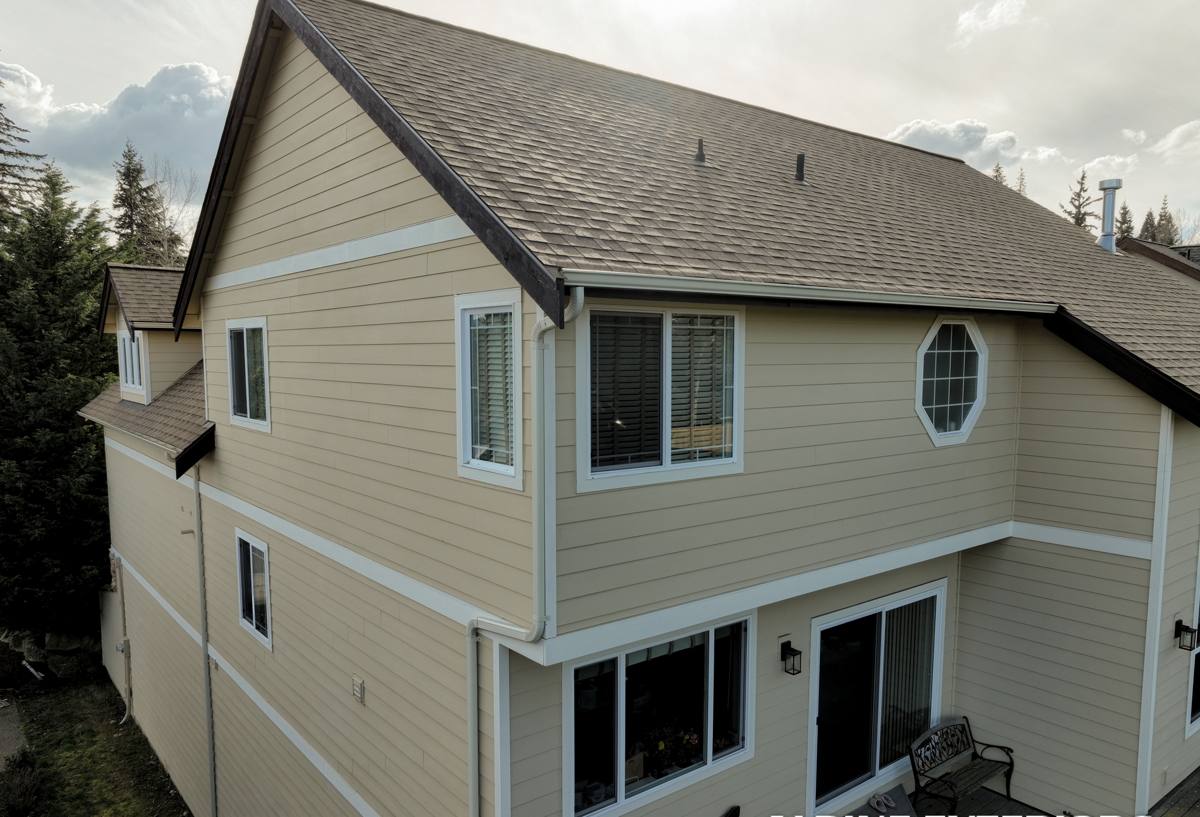
What a Correctly Installed Asphalt Shingle Roof Involves
Asphalt shingles are a proven, cost-effective roofing material, but the shingle itself is only part of the system. On a coastal Whatcom County home, the layers underneath and around the shingles are what actually determine whether the roof holds up through its expected lifespan.
Underlayment
A synthetic or self-adhering underlayment matters more here than in a drier climate because it's the backup layer that protects the deck if wind-driven rain gets past the shingles at all — which it eventually will, at some point, on every roof. In areas prone to ice damming or heavy wind-driven rain along eaves and valleys, a self-adhering ice-and-water membrane at those vulnerable points is worth the extra material cost.
Ventilation
A roof deck that can't breathe traps moisture, and trapped moisture is what accelerates deck rot and shortens shingle life from underneath — often before any problem is visible from the ground. Balanced intake and exhaust ventilation keeps the attic space closer to outdoor temperature and humidity, which also helps discourage the kind of persistent dampness that feeds moss and algae growth on the shingle surface itself.
Flashing
Flashing around chimneys, skylights, vent pipes, and roof-to-wall transitions is where most leaks actually start, not in the open field of shingles. On a home exposed to driving coastal rain, step flashing, counter-flashing, and properly lapped valley flashing aren't optional extras — they're the difference between a roof that sheds water correctly and one that slowly lets it in.
Fasteners
Salt air corrodes standard fasteners faster than it corrodes them inland. Corrosion-resistant nails, sized and placed according to the shingle manufacturer's nailing pattern, keep the roof's wind rating intact and avoid the premature fastener failure that shows up as lifted or missing shingles after a storm.
Signs a Marietta Roof Needs Attention
Most roofing problems don't announce themselves with a dramatic leak. They show up as small, easy-to-miss signs first. Homeowners in this area should keep an eye out for:
- Granules collecting in gutters or at downspout outlets, which signals shingle surface wear
- Dark streaking or green-black growth on north-facing or shaded slopes, an early sign of algae or moss colonization
- Moss visibly bridging shingle tabs, especially along ridges and in valleys where debris collects
- Curling, cupping, or lifted shingle edges, particularly on slopes that face prevailing wind and rain
- Rust staining around flashing, vent boots, or exposed fasteners
- Soft spots or sagging when walked, which points to deck moisture damage
- Daylight visible through the roof deck from inside an unfinished attic
- Interior ceiling stains, even faint ones, after a heavy rain event
Catching these early is almost always cheaper than waiting. A moss problem caught in year three is a cleaning and maintenance job. The same problem ignored until year seven is often a deck repair.
Choosing the Right Shingle for a Coastal Whatcom County Home
Not every asphalt shingle product is built the same, and for a Marietta home the right choice usually comes down to wind rating, algae resistance, and how the shingle handles repeated wet-dry cycles rather than just upfront price.
| Shingle Class | Typical Wind Rating | Algae Resistance | Best Fit For |
|---|---|---|---|
| Standard 3-tab | Lower | Varies by product | Budget-conscious projects on more sheltered lots |
| Architectural / laminate | Higher | Often includes algae-resistant granules | Most Marietta homes, especially exposed or waterfront-facing slopes |
| Impact-resistant architectural | Higher | Includes algae-resistant granules | Homes wanting extra durability against debris and hail |
Algae-resistant granules, usually copper- or zinc-infused, are a genuinely useful upgrade in a climate with this much sustained moisture and shade. We frame this as a practical trade-off, not a hard requirement: the upgraded granules cost a bit more upfront and reduce, but don't eliminate, the need for periodic roof cleaning. For most Marietta roofs, especially those with any tree cover or north-facing slope, that trade-off is worth discussing at the estimate stage.
Our Process, Start to Finish
- On-site inspection. We look at the existing roof, deck condition, ventilation, and flashing details before quoting anything — not just the shingle surface.
- Honest estimate. We walk through material options and their real trade-offs, with a written scope so there are no surprises once the tear-off starts.
- Tear-off and deck check. Old material comes off down to the deck, and we inspect the sheathing for soft or rotted sections before anything new goes down.
- Underlayment and flashing. Ice-and-water membrane at vulnerable points, synthetic underlayment across the field, and new flashing at every penetration and transition.
- Shingle installation. Installed to the manufacturer's nailing pattern and exposure specs, which is what keeps the wind rating and warranty valid.
- Ventilation check. Intake and exhaust balanced so the finished roof system, not just the shingle, performs the way it's supposed to.
- Cleanup and walkthrough. Job site cleared, magnetic sweep for stray fasteners, and a walkthrough of the finished roof with the homeowner.
Moss, Algae, and Salt Air: Maintenance That Actually Helps
A well-installed roof still needs some ongoing attention in this climate, and being upfront about that is part of doing honest work. Keeping gutters and valleys clear of debris reduces the organic material that moss needs to get established. Trimming back overhanging branches lets more light and airflow reach shaded slopes, which slows algae and moss growth. Where moss has already taken hold, gentle low-pressure cleaning methods protect the granule surface, while high-pressure washing can strip granules and shorten the shingle's remaining life — a mistake we see homeowners make when trying to handle moss themselves with the wrong equipment.
Zinc or copper strips installed near the ridge are a reasonable, low-maintenance option for slopes that see recurring moss growth, since rainwater carries trace metal ions down the roof surface and discourages regrowth over time. It's not an instant fix, but it's a sound long-term addition on a roof that's already showing a pattern of moss return.
Cost Factors for a Marietta Roofing Project
Every roof is different, so we don't quote from a generic price list, but the main factors that move a project's cost up or down are consistent:
| Factor | How It Affects Cost |
|---|---|
| Roof size and pitch | More surface area and steeper pitches increase labor time and safety requirements |
| Number of layers to remove | Tear-off of multiple existing layers adds labor and disposal cost |
| Deck condition | Rotted or soft sheathing found during tear-off requires repair before new roofing goes on |
| Shingle class chosen | Standard 3-tab costs less upfront than architectural or impact-resistant lines |
| Flashing and penetrations | Chimneys, skylights, and multiple vents each add material and installation time |
| Ventilation upgrades | Adding or correcting intake/exhaust venting is a smaller add-on when done during a full re-roof |
Broadly, homeowners in this area should expect standard 3-tab shingle re-roofs to sit at the lower end of the asphalt shingle price range, with architectural and impact-resistant lines running higher — the exact number depends entirely on the roof itself, which is why we inspect before we quote rather than pricing by square footage alone over the phone.
Why a Crew That Already Works in Marietta Matters
A roofing crew that works this stretch of Whatcom County regularly knows which slopes on a given lot tend to hold moisture longest, how local permitting and inspection expectations run, and which flashing details tend to fail first on homes exposed to bay winds versus more sheltered inland lots. That local knowledge shows up in small decisions throughout a project — where to add extra ice-and-water protection, which slopes benefit most from algae-resistant shingles, how to sequence a tear-off around a wet forecast — that a crew unfamiliar with the area's specific conditions might miss. It's the difference between a roof that's technically installed to code and one that's actually built for how weather behaves on this particular piece of coastline.
Ready to Talk About Your Roof?
If your Marietta home's roof is showing granule loss, moss, or you're just planning ahead for a replacement, we're happy to take a look and give you a straightforward assessment of where things stand. Reach out for a free, no-pressure estimate using the form below.