 Semiahmoo
 Why Decks in Sumas Wear Out Faster Than the Manuals Say
Most decking is rated and marketed using national averages that don't account for what a deck actually goes through in Sumas. Between the marine-influenced air moving in off the Semiahmoo area, driving rain that comes in sideways during fall and winter storms, and a moss season that can run six months or longer in shaded yards, a deck here is under constant low-grade attack. None of it looks dramatic day to day. It shows up later as soft spots near the ledger board, black staining in the grain, fasteners that have backed out, or a substructure that's gone spongy underneath boards that still look fine from the top.
That's the core problem with deck replacement in this climate: the damage that matters most is usually invisible until the deck is already failing structurally. A homeowner in Sumas calling about "a few soft boards" is often looking at a ledger connection or joists that have been wicking moisture for years. Understanding that is the first step to doing a replacement that actually lasts.
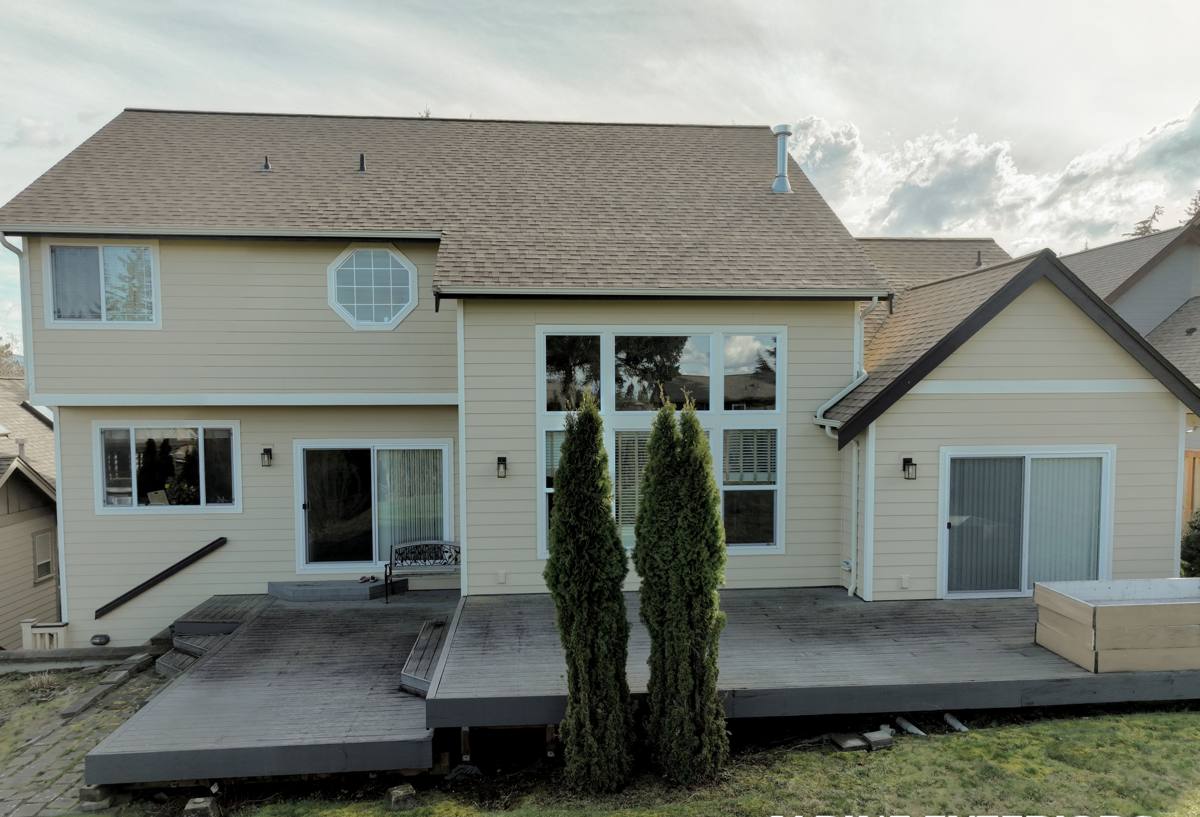
Signs You Need a Replacement, Not Another Repair
Not every tired deck needs to come out. But there's a point where patching individual boards is just delaying a bigger, more expensive problem. Here's how we tell the difference on a walkthrough:
- Soft or spongy decking in multiple areas, not just one or two boards near a downspout
- Visible rot, discoloration, or delamination where the deck attaches to the house (the ledger board)
- Joists or beams that flex noticeably when walked on, or show soft wood when probed with an awl
- Rust streaking from fasteners, or fasteners that have worked loose or popped up
- Persistent moss or algae growth that returns within weeks of cleaning, even in full sun areas
- Railings that wobble at the post base — often a sign the post-to-frame connection has rotted
- A deck older than 15-20 years that has never had the substructure inspected
If it's one or two of these, repair is usually the honest answer. If it's several at once, especially anything involving the ledger or the framing, replacement is almost always cheaper in the long run than chasing repairs on a structure that's already compromised.
What a Correct Deck Replacement Actually Involves
A deck replacement is not just pulling up old boards and screwing down new ones. In a climate that drives moisture into every gap and seam, the parts nobody sees are what determine whether the new deck lasts 10 years or 30.
The Ledger Connection
This is where most deck failures start, and it's the single most important detail on the job. The ledger board bolts the deck to the house, and if it isn't properly flashed to shed water away from the rim joist, moisture gets trapped behind it and rots the house framing from the inside — not just the deck. Correct flashing, proper fastener spacing, and a gap or flashing detail that lets water drain instead of pool is non-negotiable, especially with the amount of driving rain this region sees.
Footings and Framing
Footings need to be sized and set to current code depth for frost and load, not just matched to whatever was there before — older decks in this area were sometimes built on undersized or shallow footings. Joists and beams should be sized for the actual span and load, with joist tape or a comparable moisture barrier on top of the framing before decking goes down. That one detail alone dramatically cuts how much water the frame absorbs over the years.
Ventilation and Drainage
Decks that sit low to the ground or over enclosed space trap humidity underneath, which is exactly what moss and mildew want. Where possible, we build in airflow and grade the ground below to drain away from the house rather than pool under the deck.
Decking Material Options for This Climate
There's no single "best" decking material — there's a best fit for your budget, how much upkeep you want to do, and how much moss and moisture exposure your yard actually gets. Here's how the common options compare for a Whatcom County property:
| Material | Upfront Cost | Moss/Moisture Resistance | Maintenance | Realistic Lifespan Here |
|---|---|---|---|---|
| Pressure-treated wood | Lowest | Fair — needs sealing to perform | Annual cleaning and re-sealing | 10-15 years |
| Cedar | Moderate | Good natural resistance, but surface still needs care | Regular cleaning, periodic staining/sealing | 15-20 years |
| Composite | Higher | Very good — won't rot, but surface can still grow moss/mildew film | Periodic washing, no sealing needed | 25-30 years |
| PVC/capped polymer | Highest | Best — fully moisture-resistant board | Occasional washing | 30+ years |
Wood is a legitimate choice if budget matters most and you're willing to keep up with sealing on a schedule — skip a year or two here and the driving rain and shade will find every gap in the finish. Composite and PVC cost more upfront but hold up better against the moss and moisture cycle without annual maintenance, which is why we see more homeowners in this area moving that direction for decks that get significant shade or face the weather side of the house.
Our Deck Replacement Process
- On-site walkthrough — we assess the existing deck, probe the framing and ledger for hidden rot, and talk through what you actually use the deck for (entertaining, grilling, a quiet spot off the primary suite) so the layout makes sense.
- Written estimate — material options, structural scope, and a clear price, not a vague range.
- Permitting — we handle the Whatcom County permit process where required, including footing and railing inspections.
- Demolition and disposal — full removal of the old deck, including checking the house framing behind the ledger for water damage before anything new goes up.
- Framing and flashing — footings, posts, beams, joists, and ledger flashing built to current code, not just matched to what was there.
- Decking and railing installation — your chosen material installed with attention to fastener pattern, board spacing for drainage, and clean rail-post connections.
- Final walkthrough — we go over the finished deck with you and flag anything you should keep an eye on seasonally.
What Drives the Cost
| Factor | Why It Matters |
|---|---|
| Deck size and shape | Square footage plus complexity — multi-level decks or angled layouts take more labor and material than a simple rectangle |
| Decking material | The spread between treated wood and PVC can be substantial per square foot; it's the single biggest cost lever |
| Framing condition | If the ledger or joists behind existing decking are rotted, that framing repair is real added scope, not optional |
| Height and railing requirements | Decks above a certain height need code-compliant guardrails and sometimes stairs, which adds labor |
| Site access | Tight side yards or decks over sloped ground cost more to build and to remove the old structure from |
| Permit and inspection scope | Structural work typically requires permits and inspections, which is time and coordination, not just paperwork |
We'll always give you a firm number in writing before work starts — broad ranges before that point are only useful for budgeting, not for planning.
Keeping a New Deck in Good Shape Year-Round
- Sweep leaves and debris off the deck regularly in fall — trapped wet leaves are the fastest way to start moss and staining
- Rinse or gently wash the surface each spring before moss gets a foothold from the winter wet season
- Keep gutters and downspouts near the deck clear so runoff isn't dumping directly onto or under it
- Check railing posts and stair connections once a year for looseness
- For wood decks, re-seal on the schedule the finish manufacturer recommends — don't wait until it's visibly gray
- Trim back overhanging branches to cut down on shade and debris that feed moss growth
- Watch for any soft spots developing near the ledger board and call it in early rather than waiting
Why It Matters to Hire a Crew That Already Works in This Area
Deck-building fundamentals don't change from town to town, but the details that make a deck last do. A crew that regularly works decks in Sumas and across Whatcom County already knows how much drainage and ventilation to build in, which ledger flashing details actually hold up against this region's driving rain, and where moss tends to take over fastest based on sun exposure and tree cover. That's the kind of judgment that only comes from building and later revisiting decks in this specific climate — not from a generalized national spec sheet.
It also matters for permitting. Local building requirements around footing depth, guardrail height, and stair geometry get checked at inspection, and a crew that pulls permits in this county regularly knows what inspectors are looking for the first time through, which keeps the project moving instead of stalling on a failed inspection.
Getting Started
If your deck is showing soft spots, persistent moss, or is simply old enough that you're wondering whether it's still safe to stand on, it's worth having someone look at the framing before you decide between repair and replacement. We offer a free, no-pressure estimate for deck replacement in Sumas and the surrounding area — walk us through what's bothering you about the current deck, and we'll give you a straight assessment along with a written price. Use the form below to get started.