 Semiahmoo
 Why Lynden Roofs Take a Different Kind of Beating
Lynden sits inland from the Strait of Georgia and Drayton Harbor, but the same marine weather systems that push salt-tinged air across Whatcom County still reach the Nooksack Valley. What that means for a roof here isn't corrosion from ocean spray so much as near-constant moisture: long stretches of steady rain from fall through spring, heavy dew and fog off the river bottomland, and short, intense summer downpours that find every weak seam. Add a moss season that can run eight months out of the year in shaded, north-facing sections of a roof, and you have a climate that punishes small defects fast.
A roof that would coast along for years in a dry climate can develop a real leak here in a single wet winter if a flashing detail is off or granule loss has gone unnoticed. Roof repair in this area isn't just patching a hole — it's understanding how driving rain, standing moisture, and moss work together to find the path of least resistance into your attic and walls.
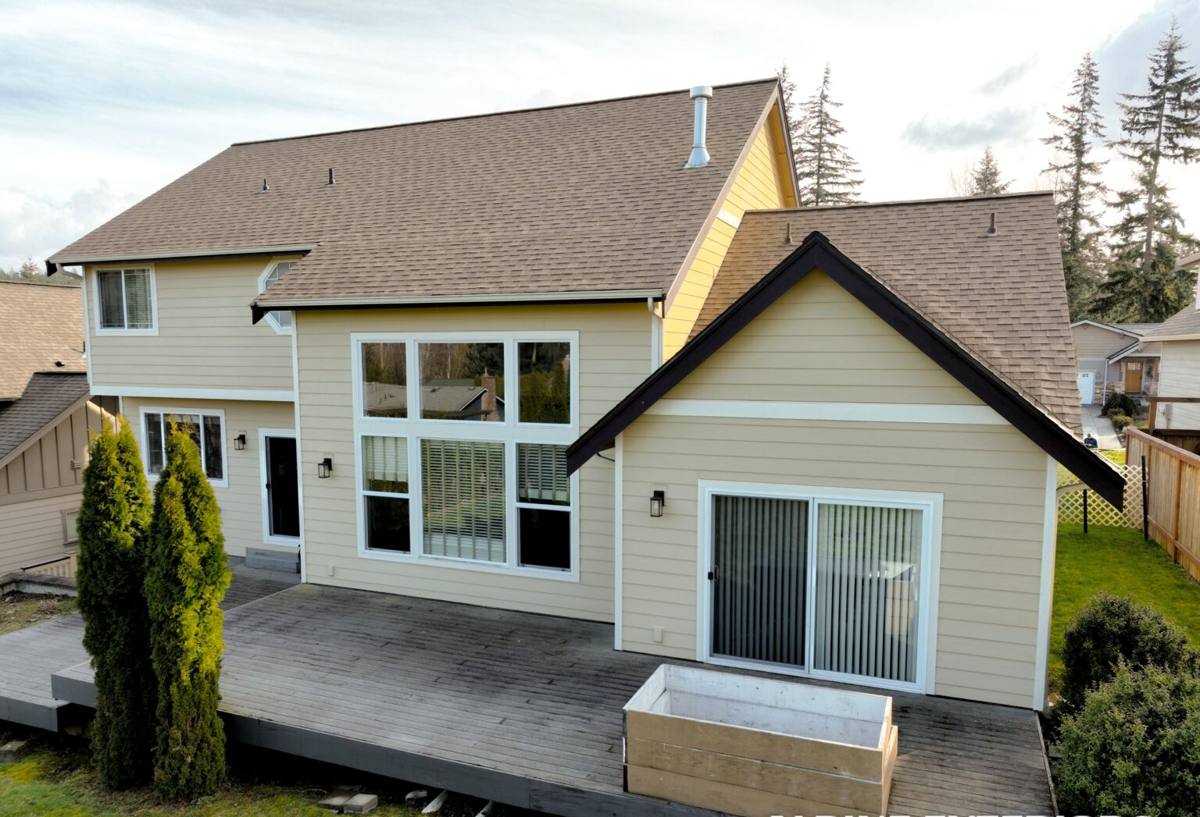
How the Climate Actually Damages a Roof
Driving Rain and Wind-Driven Moisture
Storms coming through Whatcom County often carry enough wind to push rain sideways under shingle tabs, around chimney flashing, and into any gap where two roof planes meet. Repairs that only address the visible symptom — a stain on the ceiling, a curling shingle — without checking the flashing and underlayment nearby tend to fail again in the next big storm.
Moss and Trapped Moisture
Moss doesn't just look bad. Once it establishes on a roof, it holds water against the shingle surface far longer than the shingle was designed to tolerate, and its root structure works into granule beds and seams. Over a few seasons that trapped moisture accelerates granule loss, softens decking, and opens tiny channels for water to travel sideways under the shingle instead of running off the roof.
Temperature Swings and Freeze-Thaw
Whatcom County doesn't get extreme cold often, but it gets enough freeze-thaw cycling in winter that any water already trapped under a shingle or in a compromised seam can expand, lift materials, and widen existing damage. A repair done in summer without accounting for how that same spot will behave in a January freeze is a repair that gets redone.
Signs a Lynden Roof Needs Repair — Not Full Replacement
Most roofs don't fail all at once. They show localized warning signs first, and catching those early is what keeps a repair a repair instead of turning it into a replacement.
- Dark streaking or thick moss growth concentrated on shaded or north-facing slopes
- Granules collecting in gutters or at downspout outlets after rain
- Curling, cupping, or cracked shingles in isolated areas rather than across the whole roof
- Soft or spongy decking felt when walking the roof (a sign moisture has already reached the wood)
- Water stains on interior ceilings or in the attic, especially near chimneys, skylights, or roof valleys
- Rusted, lifted, or missing flashing around penetrations — chimneys, vents, and wall-to-roof transitions
- Daylight visible through the roof deck from inside the attic
If damage is contained to a section — one valley, one chimney, one slope — a proper repair addressing both the visible damage and its underlying cause is usually the right call. Widespread granule loss, multiple leak points, or soft decking across large areas usually mean the roof is past the point where patching makes financial sense.
What a Correct Roof Repair Actually Involves
A repair that lasts through another Whatcom County winter has to do more than cover the hole. Our approach on every roof repair job includes:
1. A Full Inspection, Not Just a Spot Check
Water travels. A stain on the ceiling in one room often traces back to a flashing failure or shingle gap several feet away, sometimes upslope from where the leak shows up inside. We check the whole roof plane around the damage — flashing, valleys, penetrations, and the surrounding shingle field — before deciding what needs fixing.
2. Matching Materials, Not Guessing
Mismatched shingle color, profile, or exposure is the most obvious sign of a poor repair, but the bigger issue is compatibility — using an underlayment or flashing detail that doesn't integrate cleanly with what's already there. We match materials as closely as possible and use compatible flashing and sealants so the repair performs as one system with the existing roof, not as a patch fighting it.
3. Addressing the Cause, Not Just the Symptom
If moss caused the granule loss, we remove it properly and address the moisture and shading conditions that let it establish, rather than just replacing the damaged shingles and leaving the same conditions in place. If a flashing detail was undersized or installed wrong originally, we correct the detail, not just reseal it.
4. Checking Ventilation While We're Up There
Poor attic ventilation traps moisture against the underside of the deck and shortens the life of any roof, repaired or not. A repair visit is a good time to check that soffit and ridge ventilation are actually working, especially on older Lynden homes where insulation upgrades over the years sometimes blocked original vent paths.
Common Roof Repair Types We Handle in Lynden
| Issue | Typical Cause | What the Repair Involves |
|---|---|---|
| Chimney or skylight leak | Failed or undersized flashing, cracked sealant | Remove and replace flashing, re-integrate with surrounding shingles and underlayment |
| Valley leak | Worn valley material, debris damming water flow | Clear debris, replace valley lining, restore proper water path |
| Moss-related granule loss | Extended moisture retention from moss growth | Safe moss removal, spot shingle replacement, address shading/moisture conditions |
| Wind-lifted or missing shingles | Storm wind uplift, aged adhesive strips | Replace missing shingles, reseal tabs, check surrounding field for hidden lift |
| Soft decking / localized rot | Long-term hidden leak | Cut out and replace affected decking before reroofing the section |
| Gutter-line or fascia damage | Overflow from clogged or undersized gutters | Repair fascia/edge, correct drainage so water sheds properly |
Our Roof Repair Process in Lynden
- Initial contact and scheduling. We talk through what you're seeing — stains, missing shingles, moss — and get a repair visit on the calendar, working around weather windows since inspecting a wet or icy roof safely isn't always possible the same week a storm comes through.
- On-site inspection. We walk the roof (weather permitting) and check the attic from inside where accessible, tracing any leak back to its actual source rather than just the point it shows up.
- Written scope and estimate. You get a clear explanation of what's damaged, what caused it, and what the repair involves — no vague line items.
- The repair itself. We remove damaged material down to sound decking, correct any underlying flashing or ventilation issue, and install matched materials properly integrated with the existing roof.
- Cleanup and walkthrough. We clear debris, remove replaced materials, and walk you through what was done and what to watch for going forward.
Materials and Our Repair Standards
We use materials that are compatible with what's already on your roof and rated for sustained wet exposure — standard practice for anywhere in western Washington, but especially important given how long Lynden roofs stay damp between dry stretches. We won't patch a flashing detail with sealant alone if the underlying metal or membrane has failed; sealant-only fixes look fine for a season and then fail again once the material underneath keeps moving or corroding. Where a full metal flashing replacement is the honest fix, that's what we scope, because a callback repair costs more than doing it right the first time.
We're also careful about moss treatment. Pressure washing a mossy roof can strip granules and shorten shingle life faster than the moss itself — we use methods that remove growth without damaging the shingle surface, and we're upfront if a roof's moss damage has already gone past the point where treatment alone will help.
Cost Factors for Roof Repair
Every repair is different, but the same handful of factors drive most of the cost difference between a simple fix and a bigger job:
| Factor | Why It Matters |
|---|---|
| Size and location of damage | A single flashing repair costs far less than multiple leak points or a hard-to-access valley |
| Decking condition | If water has reached and softened the plywood or planking underneath, that has to be replaced before new shingles go on |
| Material match availability | Older or discontinued shingle lines can be harder to match closely, sometimes affecting material cost |
| Roof pitch and access | Steep or high roofs take longer and require more safety setup than a simple single-story slope |
| Extent of moss damage | Light growth is a cleaning job; long-established moss with granule loss may mean more shingle replacement |
As a very rough guide, a contained flashing or shingle repair is typically a few hundred dollars, while a job involving deck replacement or multiple problem areas can run into the low thousands. We give you a real number after seeing the actual damage — not a phone-quote guess.
Why Local Experience in Lynden Matters
A roof repair crew that works Whatcom County regularly knows how to schedule around this area's weather — getting a tarp or emergency patch on a damaged roof before the next front rolls in, and timing full repairs for the drier windows that actually exist even in a wet climate. We also know what moss cycles and moisture patterns look like on roofs in this part of the county, so we're not guessing at cause and effect on your roof for the first time.
Local experience also means straightforward logistics: no long mobilization delays, and a crew that can come back quickly if something needs a second look after the next hard rain actually tests the repair.
Maintenance Between Repairs
A repaired roof still needs upkeep to get its full life out of the fix. Between service visits:
- Keep gutters and downspouts clear so water doesn't back up under the roof edge
- Trim back overhanging branches that keep sections of roof shaded and damp longer than the rest
- Check for new moss growth each fall before the wet season sets in, and address it early
- Look at flashing around chimneys and vents once a year for lifting, rust, or cracked sealant
- Have the attic checked periodically for musty smells, dark spots, or daylight — early warning signs before a ceiling stain ever appears
If you're seeing moss, stains, or missing shingles on your Lynden roof, we're glad to take a look and give you a straight answer on what it actually needs. Reach out for a free, no-pressure estimate using the form below.