 Semiahmoo
 Ferndale Roofs Work Harder Than Most
Ferndale sits close enough to the Salish Sea that salt-laden air is a real factor in how fast roofing materials age, and it sits squarely inside a stretch of Whatcom County that gets a long, wet winter followed by a slow, damp spring. That combination — salt air, driving rain, and a moss season that can run six months or more — is harder on a roof than most manufacturers' warranty language accounts for. A roof that would last three decades in a dry inland climate can start showing granule loss, moss colonization, or flashing failure a full roofing cycle earlier here if it wasn't installed with this specific climate in mind.
A correct installation isn't just nailing shingles to a deck. It's a set of decisions — underlayment type, ventilation balance, flashing detail, fastener spacing — that either account for Whatcom County's weather or ignore it. This page walks through what a new roof installation should include for a Ferndale home, what it typically costs, and how our process works from first call to final walkthrough.
Signs a Repair Won't Cut It Anymore
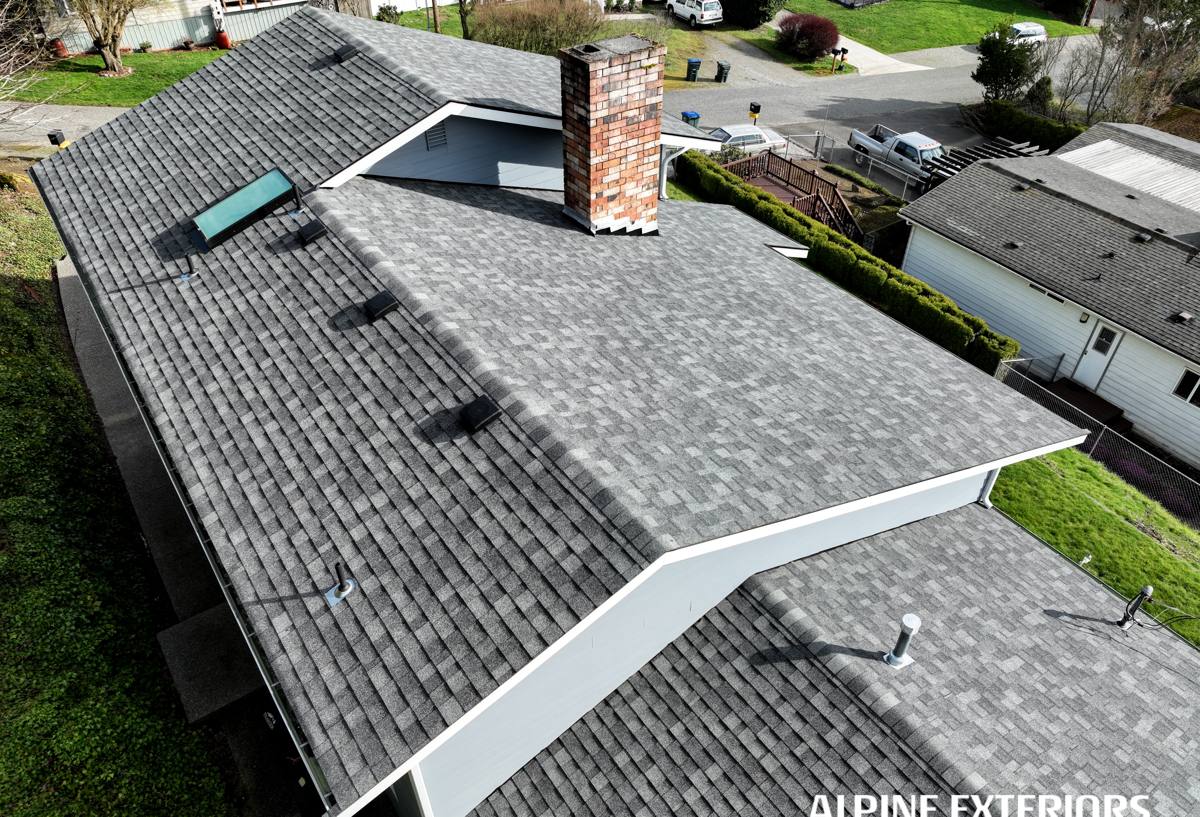
Most homeowners call us after a leak, but by the time water is visible inside the house, the roof has usually been failing for a while. A few warning signs point toward full replacement rather than another patch:
- Shingles that are cupping, curling, or losing granules in patches rather than just at the edges
- Moss or algae streaking that comes back within months of being cleaned off
- Soft or spongy spots when walking the roof, which usually means the decking underneath has taken on moisture
- Daylight visible through the attic roof boards, or damp insulation after a heavy rain
- A roof that's 18-20+ years old with asphalt shingles, or has multiple existing layers already
- Recurring ice-dam or water staining along the eaves each winter
Any one of these alone might still be repairable. Two or three together, especially on a roof that's already past the middle of its expected life, usually mean the cost of chasing repairs will outrun the cost of just doing the job right once.
What a Correct Installation Actually Involves
Tear-Off and Deck Inspection
We don't install new roofing over old shingles. A full tear-off is the only way to actually see the deck, and in this climate that inspection matters — chronic moisture exposure can rot sheathing in ways that aren't visible from the attic side. Any soft or delaminated decking gets replaced before anything new goes down. Skipping this step is one of the most common corners cut in cheap re-roofs, and it's the reason a roof can look fine for a year or two and then fail from the inside out.
Underlayment and Water Barrier
Given how much wind-driven rain Whatcom County sees, we don't treat underlayment as an afterthought. A synthetic underlayment rated for high wind and moisture resistance goes down across the whole deck, with self-adhered ice-and-water barrier at the eaves, valleys, and any roof-to-wall transitions — the spots where wind-driven rain actually gets pushed uphill under the shingle line rather than running off.
Ventilation
Balanced intake and exhaust ventilation keeps the attic from trapping moisture, which is what accelerates deck rot and encourages the kind of mildew and mold growth that's common in damp coastal climates. A roof can be installed perfectly and still fail early if the attic underneath it is sealed up wrong.
Flashing and Penetrations
Chimneys, vent pipes, skylights, and wall transitions are where the large majority of roof leaks actually start — not in the open field of shingles. We flash these with new metal or manufacturer-matched components rather than reusing old flashing or relying on roofing cement, which degrades faster than the shingles around it.
Choosing a Roofing Material for This Climate
There's no single "best" roofing material — the right choice depends on budget, how the home is shaded, and how much long-term maintenance a homeowner wants to take on. Here's how the common options stack up for a Ferndale property:
| Material | Moss/Algae Resistance | Typical Lifespan | Maintenance Level |
|---|---|---|---|
| Standard asphalt composition shingle | Moderate (better with algae-resistant granules) | 20-25 years | Periodic moss removal, especially on shaded slopes |
| Architectural/dimensional shingle | Good with algae-resistant granules | 25-30 years | Low to moderate |
| Standing seam metal | Very good — sheds moss growth medium | 40-50+ years | Low |
| Cedar shake | Poor without regular treatment | 20-30 years with upkeep | High — needs periodic cleaning and treatment |
For most Ferndale homes we recommend an architectural asphalt shingle with algae-resistant granules as the practical middle ground, and metal roofing for homeowners who want to minimize long-term maintenance and are planning to stay in the home long enough to see the higher upfront cost pay off. We're generally cautious about untreated cedar shake in this climate — it can look great, but it demands a maintenance schedule most homeowners don't keep up with, and neglected shake holds moisture against the deck in a way that shortens the life of everything underneath it.
How Our Process Works
- On-site inspection and estimate. We walk the roof and attic, note the condition of the decking and ventilation, and give you a written estimate — no pressure, no inflated "act now" pricing.
- Material selection. We go over the tradeoffs above in person, based on your budget and how long you plan to stay in the home.
- Permitting. Ferndale falls under Whatcom County's permitting requirements for roof replacement; we handle that paperwork so you don't have to track it down yourself.
- Tear-off and deck repair. Old roofing comes off in a single day on most homes, with any damaged decking replaced before we move forward.
- Installation. Underlayment, ice-and-water barrier, flashing, and the finish material go down in that order, with ventilation balanced as part of the install rather than treated separately.
- Site cleanup. We run a magnetic sweep for nails and haul away all tear-off debris — you shouldn't be finding roofing nails in your yard weeks later.
- Final walkthrough. We go over the finished roof with you and explain what the warranty covers before we consider the job done.
What Affects the Cost
Roof replacement pricing varies a lot based on the specifics of the house, but for context, a full tear-off and asphalt shingle replacement on an average single-family home in this region typically runs in the low-to-mid five figures, with metal roofing and larger or steeper homes running higher. Rather than quote a number that won't fit your house, here's what actually moves the price:
- Roof size and pitch — steeper roofs require more safety setup and labor time
- Number of existing layers — tear-off of multiple old layers costs more than a single layer
- Decking condition — rot found during tear-off means plywood or board replacement, which is priced separately since it isn't visible until we open the roof up
- Material choice — standard asphalt, architectural shingle, and metal are priced very differently per square
- Roof complexity — valleys, dormers, skylights, and multiple chimneys all add labor and flashing work
- Access — homes with difficult truck or dumpster access can add setup time
Living With Moss Long-Term
Even a well-installed roof in Whatcom County will see some moss and algae growth over time — the region's tree cover, shade, and near-constant fall-through-spring moisture make that unavoidable rather than a sign something was done wrong. What matters is keeping it from taking hold. Zinc or copper strips installed along the ridge during a new roof install release trace metals with rain runoff that discourage moss growth on the slopes below, and they're a low-cost addition worth including at install time rather than retrofitting later. Beyond that, keeping tree limbs trimmed back from the roofline, clearing gutters twice a year, and having moss physically removed (never pressure-washed, which strips granules) before it establishes a root mat will add real years to a roof's life.
Why Hire a Roofer That Already Works This Area
A lot of roofing crews will drive up from out of the area for a job, and the installation itself might be fine. What's harder to get from an out-of-town crew is the local judgment: knowing which slopes in a shaded Ferndale lot need extra moss protection, understanding how far wind-driven rain off the Sound actually travels up a valley or wall flashing, and being familiar with Whatcom County's permitting process so the job doesn't stall waiting on paperwork nobody's dealt with before. We work throughout Semiahmoo and the surrounding Whatcom County communities, and that means every roof we install has to hold up to the same salt air and rain patterns as the last one — it's not a one-off guess.
Get a Straight Answer on Your Roof
If your roof is showing its age or you just want a second opinion before committing to a repair, we'll come take a look and give you a straightforward, no-pressure estimate — no hard sell, just what we'd actually recommend for your home. Use the form below to schedule a free estimate.