 Semiahmoo
 Why Lynden Homes Need Siding That Can Take a Beating
Lynden sits inland from the coast, but it doesn't escape the weather patterns that define this corner of Whatcom County. Winters bring long stretches of driving rain pushed in off the Salish Sea, spring and fall add condensation and shade-driven moss growth, and the humidity rarely lets up long enough for wood-based products to fully dry out between soakings. Add in the salt-laden air that drifts inland from Semiahmoo Bay and Boundary Bay on a west wind, and you've got a climate that is quietly hard on exterior building materials — even when nothing looks wrong from the curb.
Homes in this area don't fail because of one big storm. They fail slowly, from siding that absorbs moisture it can't release fast enough, paint that traps water instead of shedding it, and moss and algae that hold dampness against the wall for months at a time. The right siding product, installed the right way, is the difference between a home that ages gracefully and one that needs paint, caulk, and board replacement every few years.
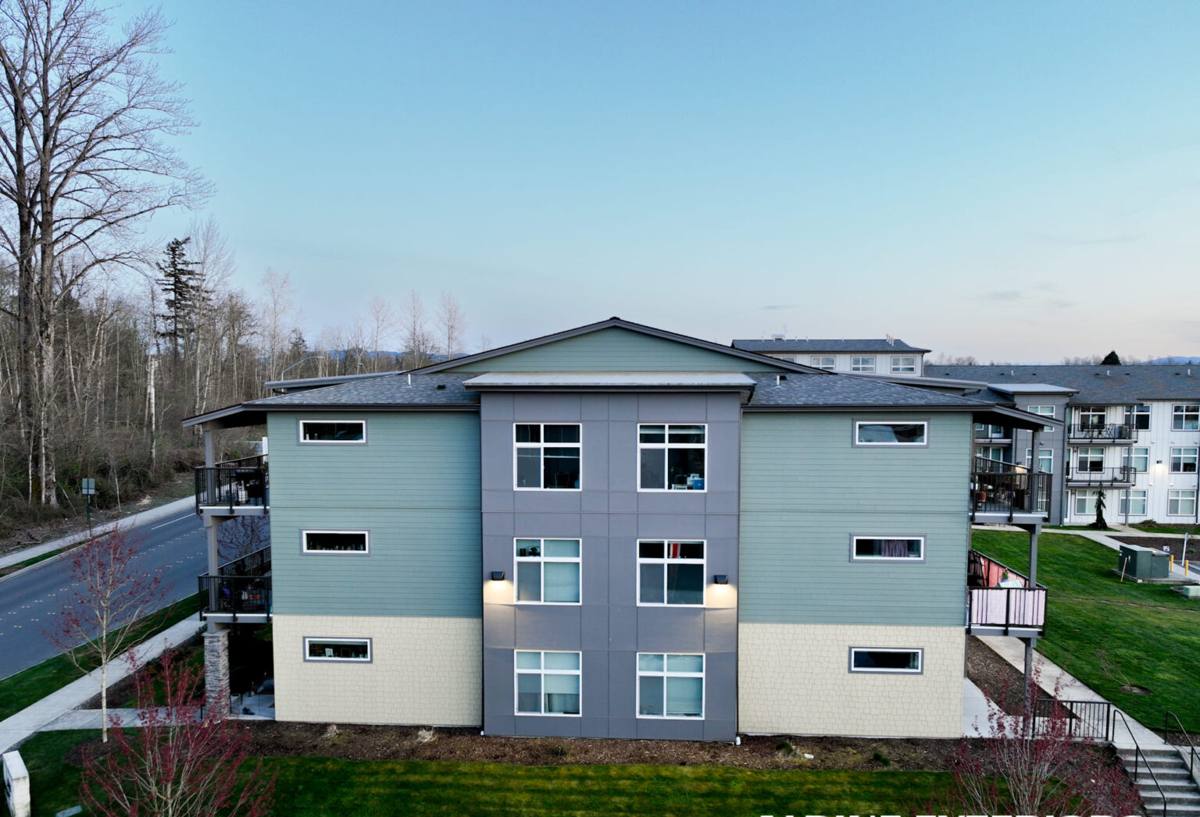
Why We Only Install James Hardie Fiber Cement
We made a decision early on to install one product system on Lynden homes: James Hardie fiber cement. Not because it's the cheapest option or the easiest to install — it's neither — but because it's the one product that consistently holds up to this specific climate without turning into a maintenance project for the homeowner.
Fiber cement is made from cement, sand, and cellulose fibers, which means it doesn't absorb and swell with moisture the way wood-based sidings do, and it doesn't rely on a factory or field-applied coating alone to keep water out — the material itself is dimensionally stable when it gets wet. That matters enormously in a place where siding can stay damp for days at a stretch during a fall rain system.
James Hardie also engineers its products by climate zone (their HZ5 line is built for regions like ours with freeze-thaw cycles and sustained moisture), and finishes them with a factory-applied ColorPlus finish that's baked on and warranted separately from the substrate. That's a meaningfully different proposition than a product that depends on careful field painting to perform over time.
What We Deliberately Don't Install
We get asked about LP SmartSide, vinyl, and primed cedar or spruce fairly often, so we're upfront about why we don't put them on Lynden homes:
- LP SmartSide is an engineered wood product with a resin-treated strand core. It performs well in many climates, but any wood-based product depends on caulking, flashing, and paint film staying intact to keep moisture out of the core — a bigger ask in a region with our rainfall totals and humidity.
- Vinyl siding is inexpensive and low-maintenance in a narrow sense, but it's a cladding, not a moisture-managed system in the way fiber cement is, it can warp or fade with sun and temperature swings, and it's not something we can offer a meaningful long-term warranty behind.
- Primed cedar or spruce looks great initially and has real character, but it's the highest-maintenance option of the three — it needs re-staining or re-painting on a tight cycle here, and any lapse in that maintenance shows up fast as checking, cupping, or rot.
Each of these products has a place. We just don't think that place is a Lynden roofline exposed to this weather pattern year after year, and we'd rather turn down work than install something we don't believe will hold up.
What a Correct Fiber Cement Job Actually Involves
The siding board itself is only part of the system. Most siding failures we get called out to inspect — regardless of brand — trace back to installation shortcuts, not the material. A correct James Hardie install in this climate includes:
Moisture Management Behind the Siding
- A weather-resistant barrier (housewrap or building paper) installed shingle-style so water is directed out and down, never trapped behind the cladding.
- Proper flashing at every window, door, and roof-to-wall intersection — the majority of hidden rot we find starts at a missed or poorly lapped flashing detail.
- Correct fastener placement and depth per James Hardie's published fastening schedule, since over-driven or under-driven nails compromise both the water seal and the board's wind resistance.
- Rain-screen or minimum clearance gaps at the foundation and roofline so the assembly can dry out between weather events instead of wicking moisture continuously.
Details That Matter Long-Term
- Factory-cut edges used wherever possible, with any field-cut edges sealed per manufacturer spec to protect the cut face.
- Caulking limited to where it belongs — a well-flashed assembly shouldn't depend on caulk as its primary defense against water.
- Trim and joint layout planned to shed water away from seams rather than concentrating it there.
Skipping any of these steps doesn't usually cause an immediate, visible problem. It shows up two, five, or ten years later as staining, soft trim, or paint failure — by which point the fix is far more invasive than it would have been at install.
Moss, Algae, and Salt Air: The Lynden-Specific Maintenance Picture
Even with the right product and a correct install, homeowners in this area should expect some ongoing upkeep — the climate simply asks for it. What we tell Lynden clients to plan for:
| Condition | What Causes It | What Helps |
|---|---|---|
| Moss/algae growth on shaded elevations | Long damp seasons, tree cover, north-facing walls that don't dry out | Soft-wash cleaning (no pressure washing directly into siding), keeping vegetation trimmed back from the wall |
| Chalking or dulling of finish over many years | UV exposure combined with damp cycles | ColorPlus finish resists this far longer than field-applied paint; repainting is possible if ever needed |
| Fastener or trim corrosion near the coast-facing side | Salt-laden air on west-facing exposures | Correct fastener material specified at install; periodic visual check of exposed trim fasteners |
| Water staining at butt joints or corners | Improper joint flashing or caulk-dependent seams | Caught by correct installation detail up front — not a maintenance item if done right |
None of this makes fiber cement high-maintenance in absolute terms — it's a fraction of what a wood-based product demands here — but it does mean an occasional gentle wash and a yearly walk-around are worth doing, the same way you'd check a roof.
Our Process for a Lynden Siding Project
- On-site assessment. We walk the whole exterior, check for existing moisture damage, note tricky details (window returns, roof transitions, dormers), and take real measurements — not a phone estimate.
- Product and color selection. We go through the James Hardie lines and ColorPlus palette options that suit the home's style and exposure, including which lines make sense on the sides that take the most weather.
- Written scope and quote. You get a clear breakdown of what's being removed, what's being repaired underneath (sheathing, flashing, trim) if needed, and what's being installed — no vague line items.
- Tear-off and inspection. Once old siding is off, we inspect the sheathing and framing for hidden moisture damage before anything new goes up. This is the point where problems that were invisible from outside get found and fixed.
- Weather barrier and flashing installation. This is the step that determines how the house performs for the next 30+ years, and we don't rush it.
- Siding installation to manufacturer spec. Fastening schedule, clearances, and joint layout all done to James Hardie's published requirements — not shortcuts that only show up as problems later.
- Final walkthrough. We go over the finished job with you in person before calling it done.
Why a Crew That Already Works Lynden Matters
Siding crews that split time across very different climates tend to install the same way everywhere. A crew that works Whatcom County regularly knows which elevations on a given lot take the worst of the weather, which older homes in the area are more likely to have hidden moisture damage behind their existing siding, and how to sequence a tear-off around our rain patterns so sheathing isn't left exposed longer than it should be. That local pattern recognition is hard to replicate from an out-of-area crew doing a one-off job.
It also matters for warranty follow-through. James Hardie's product warranty and our labor warranty are only worth what's behind them — a local company that's still in the area next year, and the year after, is the one that actually stands behind the install.
What to Ask Before Hiring Anyone for Fiber Cement Work
- Are you a certified or preferred installer for the product line, and can you show me examples of the fastening and flashing detail you use?
- What's your plan for the weather-resistant barrier and flashing at windows and rooflines — not just the siding itself?
- What happens if you find rot or moisture damage under the old siding once it's off?
- Is the manufacturer's product warranty registered in my name, and what does your separate labor warranty cover?
- Can I see your fastener schedule and clearance details in writing, not just verbally?
Any contractor who can't answer these clearly and specifically is worth a second look before you sign anything.
Ready to Talk About Your Home
If your Lynden home's siding is showing its age — paint that won't hold, boards that feel soft, moss that keeps coming back no matter how often it's cleaned — it's worth having a straight conversation about what's actually going on and what it would take to fix it right. We offer free, no-pressure estimates, and we'll tell you honestly what we see, whether that's a full re-side or something smaller. Use the form below to get started.