 Semiahmoo
 Why California Creek Is a Harder Climate on Siding Than It Looks
California Creek sits close enough to Semiahmoo Bay and Drayton Harbor that homes here deal with a combination most inland Whatcom County properties don't: salt-laden air, near-constant winter rain, and a moss and algae season that can stretch for most of the year. None of these on their own is unusual for western Washington. Together, over a decade or two, they're what separates siding that still looks good from siding that's failed early.
Salt air accelerates corrosion on fasteners, flashing, and any metal trim components. Driving rain — especially wind-driven rain off the water — finds gaps that would stay dry on a more sheltered inland lot. And the region's long stretch of cool, damp, low-sun months keeps exterior surfaces wet or humid long enough for moss, algae, and mildew to take hold on anything that can't shed water and dry out quickly. A siding product and installation method that works fine in a dry climate, or even in a milder coastal one, isn't automatically right for a lot near California Creek.
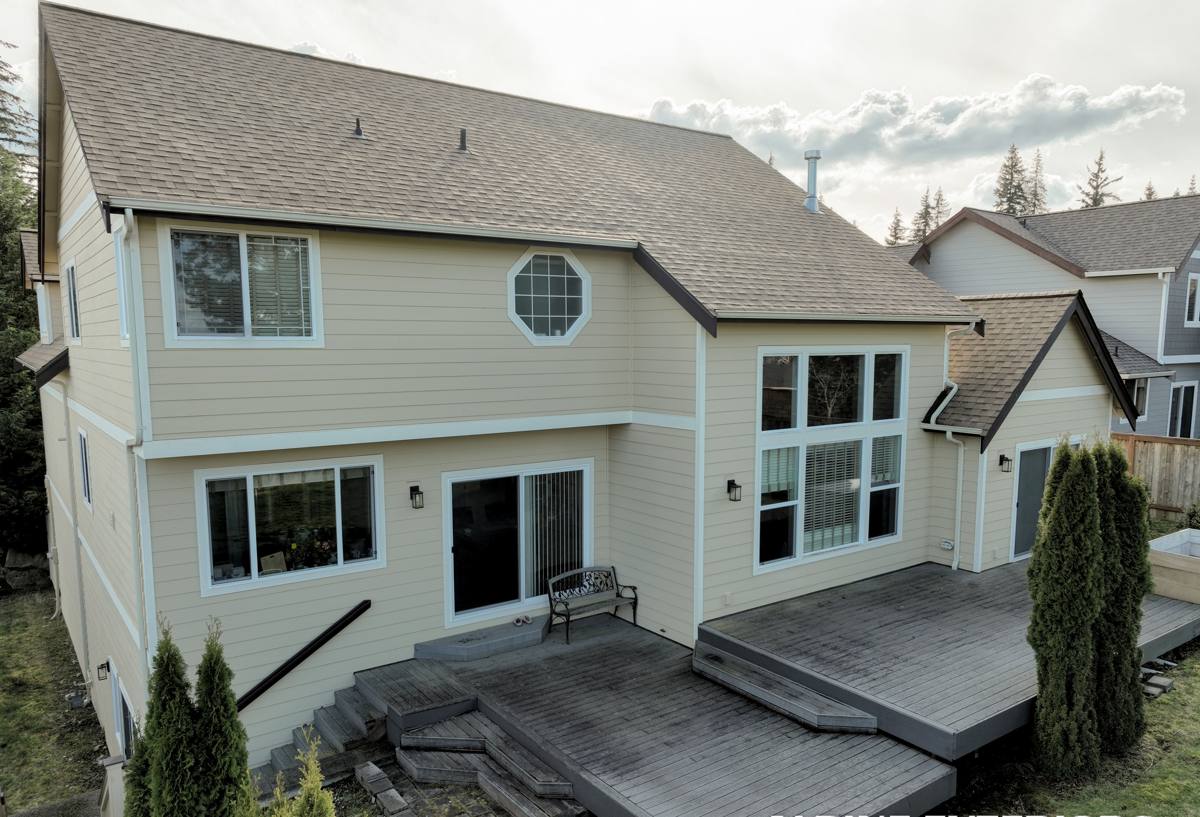
What This Climate Actually Demands From Siding
Moisture Management First
The single biggest factor in how long any siding lasts here isn't the material — it's whether water gets behind it and stays there. A correctly built wall assembly sheds bulk water at the surface, drains any water that does get behind the cladding, and lets the wall dry out between rain events. Skip any one of those and you're building in a slow, hidden problem regardless of what's on the outside.
Resistance to Moss, Algae, and Mildew Growth
Constant dampness plus shade from mature trees, which much of this area has, is exactly what moss and algae need to establish on a wall surface. Porous or absorbent siding materials hold moisture at the surface longer and give organic growth more to grab onto. A dense, factory-finished surface that doesn't absorb water the way raw wood or field-applied paint does simply gives moss less to work with.
Corrosion-Resistant Hardware
Salt air doesn't just affect the siding itself — it affects everything holding it on. Fasteners, flashing, and trim connectors near the water need to be rated for the exposure, not just whatever's standard inland. This is a detail that's invisible once the job is done, which is exactly why it's worth asking about before work starts.
Why We Install James Hardie for Homes Like This
We install James Hardie fiber cement exclusively, and a coastal, high-rainfall property like one near California Creek is a good example of why. Hardie's siding is manufactured from cement, sand, and cellulose fiber — it doesn't absorb and swell with moisture the way wood-based products can, and it's non-combustible. For this specific climate, two things matter most:
- HZ5 climate-engineered formulation — Hardie's HZ5 product line is engineered for regions with freeze-thaw cycles and high moisture exposure, which describes a coastal Whatcom County winter reasonably well.
- ColorPlus factory finish — a baked-on finish applied and cured under controlled conditions, rather than field-painted after installation. It resists fading and holds up to repeated wetting far better than a coat of paint applied on-site, and it gives moss and mildew a harder surface to colonize than a porous or absorbent material.
That's the honest case for the product: it's not that other materials can't be installed here, it's that we've standardized on the one we're confident holds up to this specific mix of salt, rain, and shade without needing early intervention.
Choosing the Right Hardie Line for This Lot
Not every California Creek property needs the same siding profile. Exposure, tree cover, and how close the home sits to open water or wind all factor in. Here's how the common options stack up for this climate:
| Hardie Product | Best Use Here | Coastal Suitability |
|---|---|---|
| HardiePlank Lap Siding (HZ5) | Most homes; standard full re-side | Strong — the default choice for salt-air, high-rain exposure |
| HardieShingle | Accent areas, gables, older-style homes | Good, but more seams mean more flashing detail to get right |
| HardiePanel | Modern facades, board-and-batten look | Good with proper vertical joint treatment |
| HardieTrim | Corners, window and door trim | Essential pairing — matches expansion behavior and finish life of the field siding |
For most homes near California Creek, HardiePlank in the HZ5 formulation with ColorPlus finish is the practical choice — it's the most tested combination for exactly this kind of exposure, and it keeps trim and field siding on the same warranty and finish system.
What Correct Installation Actually Involves
The Water-Resistive Barrier and Drainage Gap
Before any siding goes up, the wall needs a continuous water-resistive barrier, properly lapped and sealed at every penetration. In a driving-rain, high-humidity climate like this one, we also build in a drainage gap behind the siding so any moisture that does get past the cladding has somewhere to go and can dry out, instead of sitting against the sheathing.
Flashing at Every Transition
Windows, doors, roof-to-wall intersections, and deck ledgers are where water intrusion actually happens — not through the flat field of the siding. Every one of those transitions needs step flashing, head flashing, or kick-out flashing installed correctly, with the housewrap integrated so water is directed out and down, never trapped behind the assembly.
Fastening, Gapping, and Clearances
Hardie siding has specific fastening patterns, gap requirements between boards, and minimum clearances from grade, roofing, and decks. Those clearances exist specifically to keep the bottom edge of the siding from sitting in standing water or splashback — a common failure point on lots where drainage away from the foundation isn't ideal, which describes more than a few properties in low-lying, creek-adjacent parts of Whatcom County.
Caulking and Joint Treatment
Hardie's own guidance calls for specific joint treatment at butt joints and trim intersections. Over-caulking or under-caulking are both mistakes — done wrong, either traps moisture or leaves a path for it to get in. This is one of the most common places we see prior installations cut corners.
Our Process for a California Creek Job
The steps don't change site to site, but what we pay closest attention to does, based on the specific exposure and drainage of the lot.
- Site and exposure assessment — how much direct wind and salt exposure the home gets, tree cover and shade patterns, existing drainage away from the foundation, and condition of the current siding and sheathing underneath.
- Tear-off and sheathing inspection — old siding comes off and we check the sheathing underneath for rot or existing moisture damage before anything new goes on. This step matters more here than in drier climates, because hidden moisture problems are more common on coastal, shaded lots.
- Water-resistive barrier and flashing — barrier installed and lapped correctly, flashing detailed at every window, door, and roof transition, drainage gap built in.
- Hardie installation to spec — correct fastener type and spacing, proper gapping, correct clearances from grade and roofing, corrosion-resistant hardware throughout.
- Trim, caulking, and final inspection — joints treated per manufacturer guidance, trim installed, and a final walk-through before we call it done.
Why Local Installation Experience Matters Here
A siding crew that's worked other homes around Semiahmoo and California Creek already knows which lots tend to have drainage issues, where wind exposure is worse than it looks from the street, and which older homes in this area were built with sheathing or flashing details that need extra attention during tear-off. That's not something you get from a crew that mostly works drier, inland jobs and treats every coastal property the same as any other. It shows up in fewer surprises during the job and in an install that's actually built for the exposure the home has, not a generic one.
Living With Hardie Siding Through a Long Moss Season
Correctly installed Hardie with a ColorPlus finish is low-maintenance, but "low-maintenance" doesn't mean "no maintenance" in a climate like this one. A little seasonal attention keeps it looking the way it should for the long haul:
- Rinse the siding down once or twice a year, especially shaded north- and east-facing walls where moss and algae take hold first.
- Keep gutters clear so overflow isn't running down the wall face during heavy rain.
- Trim back vegetation and tree limbs that keep a wall section shaded and damp longer than the rest of the house.
- Check caulking at trim joints every year or two and have any cracked or missing sections redone before water gets behind it.
- Have a professional look at flashing details after any major windstorm, since that's when existing weak points tend to get found.
What a Project Like This Typically Costs
Every home is different, but these are the factors that actually move the price on a California Creek re-side:
| Factor | Why It Matters |
|---|---|
| Square footage and home shape | More wall area, corners, and cutouts mean more material and labor |
| Condition of existing sheathing | Rot or moisture damage found during tear-off adds repair work before new siding goes on |
| Siding profile mix | Lap siding alone costs less than lap paired with shingle accents or board-and-batten sections |
| Trim scope | Full trim replacement to match the new siding system costs more than reusing sound existing trim |
| Site access and exposure | Steep, wooded, or water-adjacent lots can add setup and staging time |
| Color and finish | Standard ColorPlus colors are typically more cost-effective than premium or custom-matched finishes |
We won't quote a number without seeing the home, but these are the variables worth understanding before you start comparing bids — a low bid that's missing flashing detail, drainage gap, or correct fastener spec isn't actually the same job as one that includes them.
Get a Straight Answer for Your Home
If you're planning a re-side near California Creek or anywhere else around Semiahmoo, we're happy to take a look at your home, walk you through what your specific exposure and drainage situation calls for, and give you a straightforward, no-pressure estimate. There's a form below to get started.